
Business & Finance
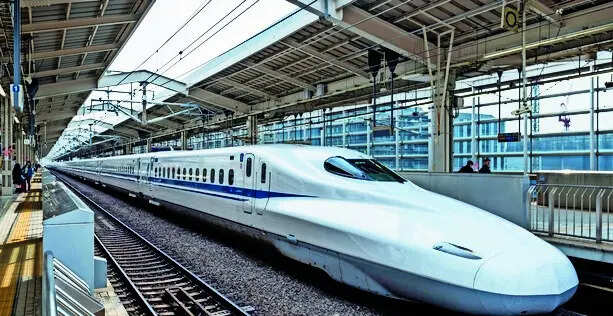
Indigenous bullet train B28 undergoes 'squeeze test'
Key Points
New Delhi: The country’s first indigenous high-speed train, B28, has undergone the vehicle body shell test, also known as the “squeeze test”, an important safety assessment to determine whether a train’s car body can withstand heavy external forces and pressure without excessive deformation or structural failure in case of a collision or crash. The test was conducted at BEML’s production facility in Bengaluru. The central PSU is manufacturing the first two of indigenous bullet trains, each...
NEW DELHI: New Delhi: The country’s first indigenous high-speed train, B28, has undergone the vehicle body shell test, also known as the “squeeze test”, an important safety assessment to determine whether a train’s car body can withstand heavy external forces and pressure without excessive deformation or structural failure in case of a collision or crash.
The test was conducted at BEML’s production facility in Bengaluru. The central PSU is manufacturing the first two of indigenous bullet trains, each comprising eight coaches. The trains have been designed for an operating speed of 249 kmph and a testing speed of 275 kmph, as per a BEML tender document.
People aware of the development said the squeeze test is crucial as the trains will operate at high speeds and their car bodies must be capable of withstanding heavy forces in the event of a collision or accident.
“After the successful completion of this test, the prototype should ideally be ready in less than six months. Since the B28 (Bharat 28) train is not being built on Japanese Shinkansen technology, the development process should not take much time. The squeeze test establishes whether the body retains its shape under pressure and whether the passenger compartment maintains its structural integrity,” an official said.
The railways plans to begin trial runs of B28 on the 100-km Surat-Vapi section of the Ahmedabad-Mumbai High Speed Rail corridor by May-June 2027. Commercial operations on this stretch are scheduled to begin in August 2027.
While seeking Cabinet approval for the escalated cost of the country’s first bullet train project, the railway ministry had stated that two prototype trains were expected to be ready for trial runs in the first quarter of 2027. It had also said that the entire Gujarat section of the corridor was expected to be completed by December 2027, while the full 508-km Mumbai-Ahmedabad High Speed Rail corridor is targeted for completion by December 2030.