
Science
Rare, roomy and pricey? Inside Singapore's niche jumbo HDB flat market
Key Points
Rare, roomy and pricey? Inside Singapore's niche jumbo HDB flat market With HDB reviewing the flat conversion scheme to create jumbo flats, CNA speaks with owners of such units about the attraction of extra space – and the extra cost. SINGAPORE: When Ms Aileen Tan’s father decided to downsize from his semi-detached house in 2018, he had one condition – his new home had to be spacious enough for his grandchildren to play when they visited, and large enough for the weekend parties he loved to...
Rare, roomy and pricey? Inside Singapore's niche jumbo HDB flat market
With HDB reviewing the flat conversion scheme to create jumbo flats, CNA speaks with owners of such units about the attraction of extra space – and the extra cost.
SINGAPORE: When Ms Aileen Tan’s father decided to downsize from his semi-detached house in 2018, he had one condition – his new home had to be spacious enough for his grandchildren to play when they visited, and large enough for the weekend parties he loved to host.
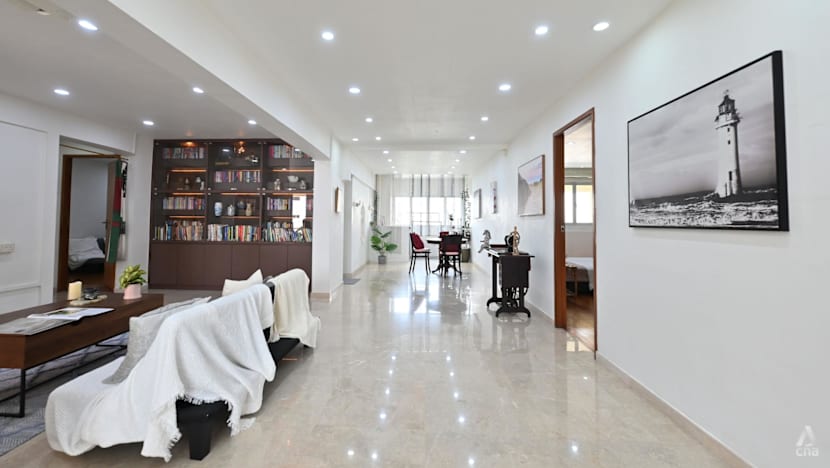
A jumbo flat in Clementi fit the bill - the 1,615 sq ft unit was created by combining a two-room and three-room flat, giving it four rooms and three bathrooms.
After her father died, Ms Tan inherited the flat. Today, the 61-year-old retiree lives in the jumbo flat and rents out two spare rooms for a combined S$3,300 (US$2,580) a month.
“There's plenty of storage and room for my books and a very large kitchen, so we sometimes can have parties and cookouts. I have a little spa room,” said Ms Tan.
“It's very, extremely comfortable. I cannot think of anything more that I would want from a home.”
Her jumbo flat is rare. It is one of an estimated 2,900 such flats created by merging two complete units into one – that is about 0.25 per cent of the over 1.1 million flats in Singapore.
Their generous living space and rarity have at times translated to eye-watering asking prices. In September, a 1,465 sq ft jumbo flat in Telok Blangah was listed for S$2.18 million on PropertyGuru, prompting the Housing and Development Board (HDB) to announce it would review the flat conversion scheme, which allows eligible owners to combine adjoining HDB units.
The asking price has since been lowered to S$1,999,999.
At the same time, shorter leases, financing and a limited pool of potential buyers can add to the challenges of selling such homes.
“This jumbo flat market is niche and could be illiquid, meaning subsequent resales could be harder,” said Professor Sing Tien Foo, Provost's Chair Professor of the Department of Real Estate at the National University of Singapore (NUS).
While jumbo flats in good locations can “command substantial premiums”, less well-located and older units could be more difficult to sell, he added.
MORE SPACE AND FLEXIBILITY
HDB first began combining adjoining flats in the late 1980s due to an oversupply of unsold flats in several new towns then, such as Woodlands, Yishun and Bedok, said Prof Sing.
In 1993, the flat conversion scheme was introduced to let households needing more living space combine their flats.
“The scheme gave flexibility to families whose housing needs had expanded but who wanted to stay in their existing neighbourhood and social networks,” he said.
Today, supply is limited as HDB no longer offers jumbo flats, and new flats would only be available if flat owners find adjoining units suitable for merging when conditions are met.
Property agent Thomas Tong, who listed the Telok Blangah jumbo flat, said going through the flat conversion scheme requires a lot of “timing and luck”.
For one, home owners can only buy their neighbour’s unit after fulfilling their minimum occupation period (MOP), then meet the new MOP before they can sell their jumbo flat.
“A combination of all these things makes jumbo (flats) rare, hard to find, and they don't come by easily,” he said.
Mr Tong said he has received a “ridiculous” number of enquiries on the Telok Blangah listing as its long remaining lease of 91 years sets it apart from other jumbo flats, which tend to be older. In Singapore, public housing units have a 99-year lease before they are returned to the government.
Buyers value jumbo flats because of the space they offer, he said.
“(It) means I have a bigger space. If I don't need the space, I can rent it out. If I need the space, I can use it as a store. If my kids decide to come and want to stay with me, I can have it all,” he said.
It was this flexibility that interior designer Vivian Wang had in mind when searching for her first flat this year. The 30-year-old permanent resident, who currently lives with her husband and his parents in a rented flat in Bishan, specifically sought out a jumbo flat.
As her parents-in-law are foreigners and cannot buy their own, the family has to live in one house.
But they have different lifestyles – Ms Wang and her husband enjoy eating out and late nights while his parents prefer to cook and stay in.
“It is a lifestyle that is very different. So I want to find a jumbo flat so we can live separately, become like two units, but we still can share the common area,” she said.
It was a challenge to find a jumbo flat that had an ideal layout and was in a location they preferred.
Most of the jumbo flats she came across were in estates such as Woodlands and Bedok, Ms Wang said.
The couple eventually bought a 1,600 sq ft jumbo flat in Bendemeer for S$940,000 earlier this year.
It has about 46 years left on the lease, meaning the property’s value could fall as the lease term shortens. But that is not a drawback for Ms Wang, who said they have no intention of selling the flat.
REALITIES OF SELLING
For jumbo flat home owners, selling can come with its own set of challenges.
Despite Ms Tan’s affection for her jumbo flat, she hopes to sell the place, which has about 56 years left on the lease.
“Initially, I didn't intend to sell the place. It has memories of my dad here. It's providing very good income with the tenants, and it's very spacious, lots of room, so my children can come back and visit,” she said.
But circumstances have changed, she said. Both her children are based overseas, and Ms Tan sees herself travelling to meet them more often for long periods of time.
Her house is listed for about S$1.1 million, and has been on the market for over a year.
In the first five months, there were only two enquiries and two viewings. The lifting of the 15-month wait-out period in July has helped, she said, with the house now receiving multiple viewings a week.
With the removal of the wait-out period, private property owners can buy any size non-subsidised HDB resale flat immediately without waiting, as long as they do not take an HDB loan.
Prof Sing said demand for jumbo flats has become more selective, appealing to those with large families and who need more space.
Additionally, many jumbo flats created in the late 1980s and 1990s are in less central locations and face significant lease decay, which may soften demand, he added.
Willing buyers may also not translate to a successful sale; property agent Mr Tong said the challenge often comes in financing such a property, which is often older and comes with a higher price tag.
The older a property is, the shorter its remaining lease. This may affect a buyer’s ability to finance the purchase, as a shorter remaining lease can limit the amount that they can borrow from the bank or the Central Provident Fund (CPF) savings they can use.
“So, regardless of whether or not it's valuable, the value might not match the price that people can afford. So a buyer might want to buy a jumbo … they are willing to pay, but they cannot take a loan,” he said.
For jumbo flat owners Rafael Shah and Ann Baki, the challenge was about finding the right buyer and aligning timelines.
The couple first bought their jumbo flat for S$650,000 in 2012 after getting married. They were drawn to the huge space it offered, which was ideal for hosting family and friends.
After having children, Mr Shah and Ms Baki spent about S$100,000 to renovate and partition the approximately 1,900 sq ft home to create separate living areas for themselves and Mr Shah's mother, allowing them to live together while maintaining privacy.
The couple listed their flat in 2018, hoping to move closer to the central area, but eventually decided against selling it as they could not find a suitable replacement home. They put it on the market again this year in hopes of moving closer to their daughter’s primary school in the east.
But they found that their dual-key arrangement – with two kitchens, two living areas and separate entrances connected by a shared corridor – did not appeal to everyone.
“Means to say they don't want the dual-key stuff, so they wanted the space. And out of 10, maybe one of the buyers actually (said), ‘oh, okay, this might work for me’,” said Mr Shah, who works in the hospitality industry.
“So the pool of buyers for us, we’re looking very specific. We wanted those people who either want a passive income or families that want to live together but separately,” the 47-year-old added.
Although they received a “healthy number” of enquiries and eventually found a buyer willing to offer close to their expected price of S$1.2 million, the sale did not proceed.
The buyer could only move in a year later, which meant the family would have to endure long daily commutes when their daughter entered primary school in January.
Mr Shah and Ms Baki have since decided to hold off the sale and rent out part of their flat for about S$3,500 a month, while renting a private property in the east. His mother will continue to stay in the flat.
The couple said they are not concerned about selling the house in the future.
“I believe there's always a buyer in any home … but it is whether you can reach the (price) expectation or not,” Ms Baki, 39, said.
Prof Sing said that asking prices do not indicate market value.
“The S$2 million record could only become reality if a willing buyer completes a transaction at or near that price. Otherwise, the listing reflects the seller's optimism and niche demand, not a fundamental repricing of the jumbo flat market,” he said.
In a parliamentary reply in October, the Ministry of National Development said there were a total of 408 resale transactions of converted flats between 2016 and 2025. In 2025, the median resale price was S$910,000.
THE FUTURE OF JUMBO FLATS
HDB has not disclosed details about its review, including what it entails and when it will be completed.
Prof Sing said the scheme could be tightened to prevent conversions from causing significant price inflation in resale markets, which could have unintended spillover effects on surrounding flats.
“The conversion scheme and jumbo flats were introduced during the oversupply period, and the scheme needs to be reviewed; it may no longer be relevant in today's market, when resale flat prices have increased significantly,” he added.
While the future of the conversion scheme remains uncertain, existing jumbo flat owners said the appeal of these homes goes beyond their potential resale value.
For Ms Tan, her jumbo flat would be the “perfect forever home” – if not for her frequent travels.
“But since I'm not here most of the time, it makes sense to leave this home to other families who need it, who need the space, and would appreciate it more,” she said.
Singapore (LOCATION)
Rare (ORG)
HDB (ORG)
CNA (LOCATION)
Ms Aileen Tan’s (PERSON)
Clementi (ORG)
Ms Tan (PERSON)
Telok Blangah (PERSON)
S$2.18 (ORG)
the Housing and Development Board (ORG)
Sing Tien Foo (PERSON)
the Department of Real Estate (ORG)
the National University of Singapore (ORG)
Woodlands (LOCATION)
Yishun (PERSON)