
Health
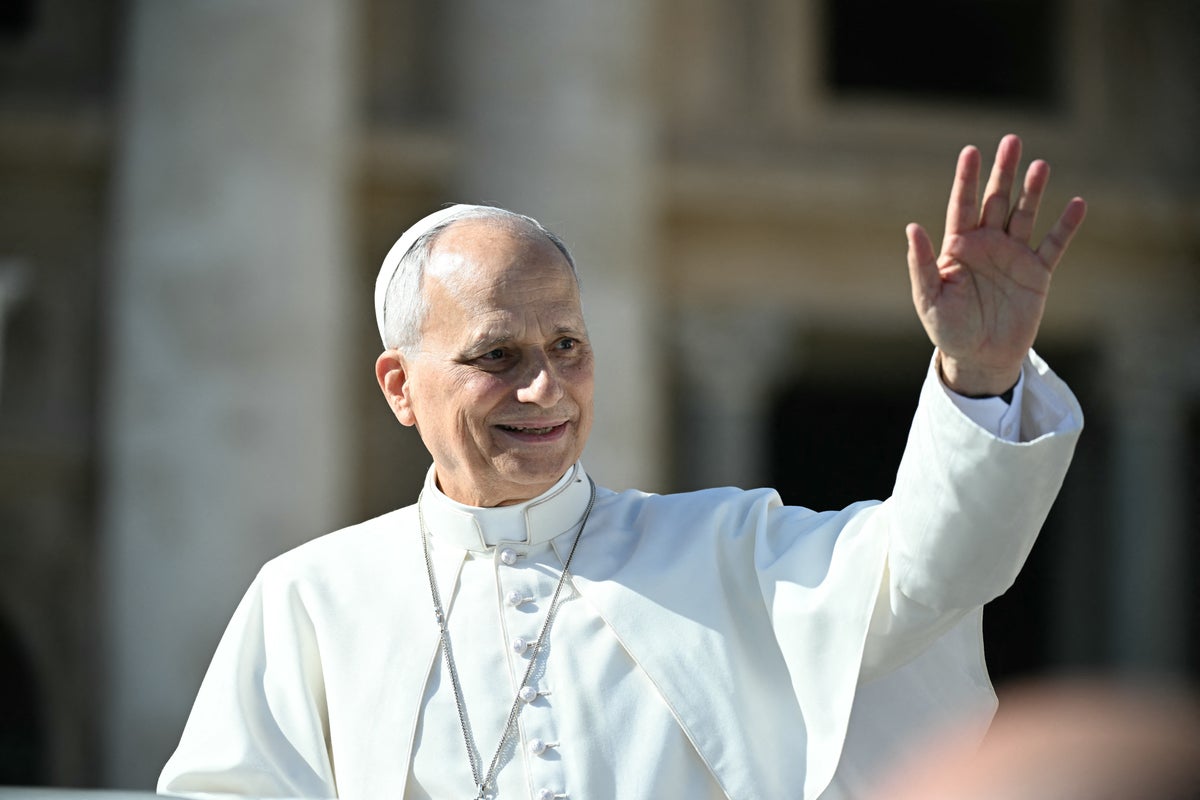
How Pope Leo is preparing for high altitude South America trip just weeks after lung cancer operation
Key Points
How Pope Leo is preparing for high altitude South America trip just weeks after lung cancer operation Pope Leo is due to embark on one of the most intense papal tours in decades, just weeks after surgery. Experts say the Vatican is sending a message: ‘this health crisis is over’. Alex Croft reports - Bookmark - CommentsGo to comments Become an Independent member to bookmark this article Already a member?
How Pope Leo is preparing for high altitude South America trip just weeks after lung cancer operation
Pope Leo is due to embark on one of the most intense papal tours in decades, just weeks after surgery. Experts say the Vatican is sending a message: ‘this health crisis is over’. Alex Croft reports
- Bookmark
- CommentsGo to comments
Become an Independent member to bookmark this article
Already a member? Log in
After Pope Leo underwent treatment for lung cancer, the Vatican’s foreign minister said it was a potential “gamechanger” for his papacy.
Archbishop Paul Richard Gallagher said there had been a temptation for some Catholics to think Leo was a “Superman, a Superpope” after he was elected in 2025 and “hit the ground running” following the drawn-out illness and death of Pope Francis. Instead, his all-too common health battle demonstrates that Leo “is a poor mortal like the rest of us”.
But just weeks after having a part of his lung removed in an operation on 13 October, Leo appears keen to prove he is the energetic pontiff the world has grown used to in the past 18 months.
Fulfilling his duty towards 1.4 billion Catholics worldwide, the 71-year-old will embark on an intense tour of South America, visiting Uruguay, Argentina and Peru. The latter a country he has deep ties to, having served as bishop of Chiclayo and later being appointed president of the Pontifical Commission for Latin America.
“Cancelling [the trip] would have meant… sending a certain message that this [surgery] has been a real rupture in this pontificate,” Massimo Faggioli, a papal historian at Villanova University, said.
“The message is now, 'No, that health crisis is over. And I can do it,’” he told Reuters.
The pontiff’s doctors have said the cancer was localised and has not spread, and the pope will not require further treatment. Medics have removed the lower lobe of his right lung as part of his treatment for the most common form of lung cancer, lung adenocarcinoma.
However, the trip is nonetheless a demanding one and comes with its own challenges, especially given the Pope’s current condition.
The 6 November to 17 November tour will be one of the busiest decades, with Leo set to travel 19,300 miles (31,000 kilometres ) across 10 cities, giving 36 speeches. It will involve 12 flights, two helicopter trips and a stop at the high-altitude city of Cusco in Peru, some 11,000ft above sea level.
Despite this, no changes have been made to the Pope’s schedule.
Peruvian priest Guillermo Inca Pereda, who is co-ordinating this part of the trip, told TV Peru: “Nothing has been ruled out. Everything remains exactly as the Holy Father envisioned it.
“He has always wanted to visit Cusco, as it offers a significant moment: an encounter with the region’s popular faith and religious traditions. He wants to be there. That is why I believe Cusco will certainly remain on the itinerary.”
Steps are being taken though, to ensure the Pope’s support team are ready to deal with any emergency.
“He will have a specialized ambulance—as is appropriate for a head of state—accompanying the delegation at all times,” Pereda said.
“For the visit to Santa Cruz, the use of an air ambulance is being considered in case of any emergency. In addition to his personal physician, a Peruvian doctor will also be on hand to address any situation that may arise.”
Rome correspondent for news site Crux Elise Ann Allen said oxygen tanks, extra medical staff, ambulances and equipment would likely be stationed along the Pope’s route, The Times reported.
“They’re going to be ready for every eventuality,” she said. “They have some flexibility to change things on the fly if needed.”
When speaking to reporters earlier this week, Archbishop Gallagher said that the cancer treatment will no doubt have an impact.
“I think that is going to change how we see him and possibly how he sees himself as well,” he explained, before adding that Pope Leo wants to press on with the duties of the papacy,
“All of the medical advice is very positive ... so he feels he can go. I think he's going on this trip very simply because he wants to go on [the trip]... It was obviously quite advanced in the planning.”
Dr. Stephen Liu told Reuters patients in this situation should “not push themselves too far and listen to their body when it asks for rest”.
The pontiff’s team – which includes Leo’s personal physician Dr Luigi Carbone – will “primarily be watching for any signs of exhaustion”, Dr Liu added.
Argentinian officials have estimated as many as seven million people could attend Leo’s events during his three days in the country – proof of the impact of a papal tour.
“[It has] become the real test of the papacy, if you can do exhausting trips or not,” says Faggioli. “The papacy is… a global job and you have to be there in person.”
Join our commenting forum
Join thought-provoking conversations, follow other Independent readers and see their replies
Comments
Leo (PERSON)
South America (LOCATION)
Vatican (LOCATION)
Alex Croft (PERSON)
Independent (ORG)
Paul Richard Gallagher (PERSON)
Catholics (ORG)
Francis (PERSON)
Uruguay (LOCATION)
Argentina (LOCATION)
Peru (LOCATION)
Chiclayo (LOCATION)
the Pontifical Commission (ORG)
Latin America (LOCATION)
Massimo Faggioli (PERSON)