
Science
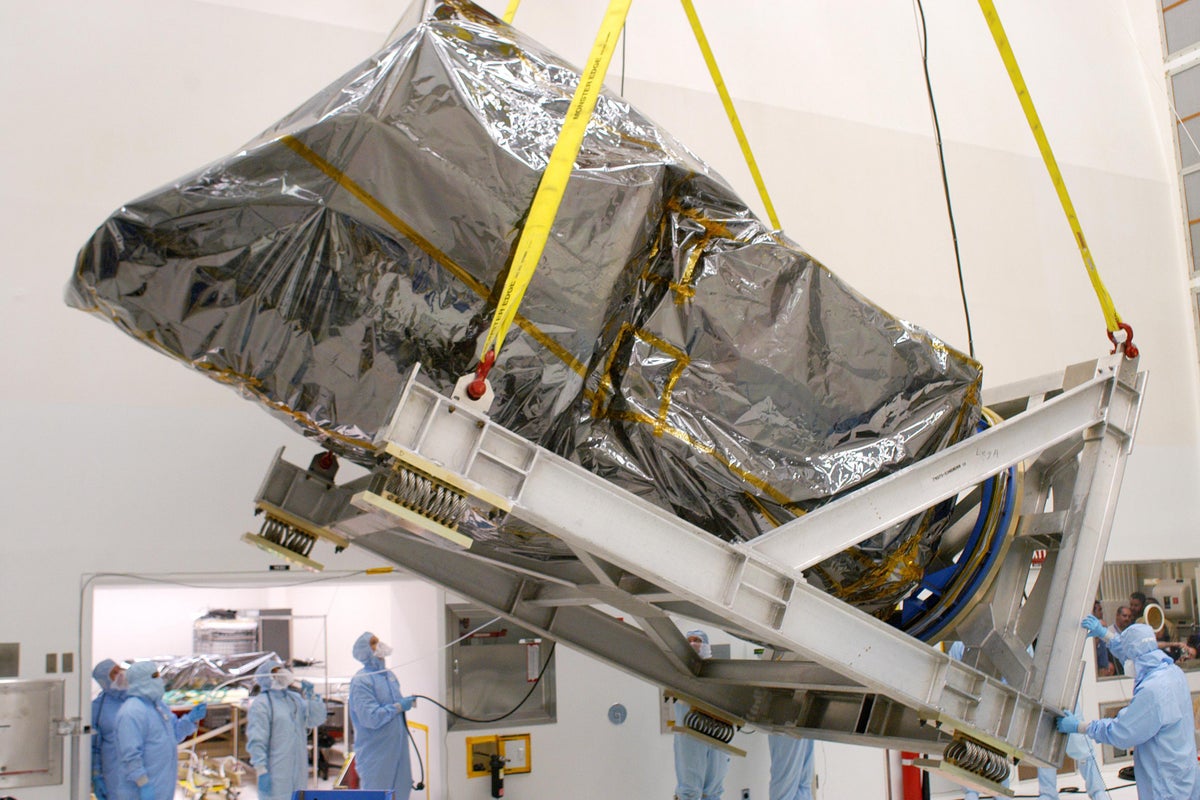
Decades-old NASA telescope heading back to Earth — to crash
Key Points
Decades-old NASA telescope heading back to Earth — to crash The Neil Gehrels Swift Observatory, which launched in 2004, is expected to come crashing down to Earth soon - Bookmark - CommentsGo to comments Become an Independent member to bookmark this article Already a member? Log in An aging NASA telescope is expected to crash back down to Earth this week. The U.S. Space Force predicts the Neil Gehrels Swift Observatory will crash down soon — likely on or around Friday — following a failed...
Decades-old NASA telescope heading back to Earth — to crash
The Neil Gehrels Swift Observatory, which launched in 2004, is expected to come crashing down to Earth soon
- Bookmark
- CommentsGo to comments
Become an Independent member to bookmark this article
Already a member? Log in
An aging NASA telescope is expected to crash back down to Earth this week.
The U.S. Space Force predicts the Neil Gehrels Swift Observatory will crash down soon — likely on or around Friday — following a failed rescue effort of the 1.5-ton telescope.
Most of the telescope will burn up in the atmosphere, but pieces of some of its denser parts, as well as some mirrored portions, may survive re-entry, according to NASA’s Brad Cenko, the mission’s chief scientist.
Parts of Africa, Australia, India, Southeast Asia and Central and South America are within the telescope’s reentry zone. However, any pieces that survive the fall will most likely end up in the ocean, Cenko told the Associated Press.
The Swift telescope spent 22 years in orbit, blasting off on November 20, 2004.
While in orbit, the telescope would search for gamma-ray bursts — the most powerful explosions in the universe — and supernovas.
“We’ve known this day would come since before Swift was launched. At least in low-Earth orbit, what goes up must come down. And that end is catastrophic,” Pennsylvania State University’s John Nousek, an astronomer involved in the mission, told AP.
The Space Force is tracking the telescope’s path as it falls back to Earth.
According to the report, the Swift was brought down faster than anticipated due to intense solar activity in recent years. While NASA tried to do a rescue of the telescope last year, it was unsuccessful.
While the telescope continued observations of gamma-ray bursts after the failed rescue mission, its orbit had decayed to 171 miles above Earth, making the observatory unable to operate any longer, Space.com reported.
In the over 20 years it was in orbit, Swift discovered more than 2,000 gamma-ray bursts and 1,400 exploding stars.
It’s not immediately clear when or where Swift will plunge back to Earth, but experts expect it to occur on or around Friday.
Join our commenting forum
Join thought-provoking conversations, follow other Independent readers and see their replies
Comments
NASA (ORG)
Earth (LOCATION)
Independent (ORG)
The U.S. Space Force (ORG)
Brad Cenko (PERSON)
Africa (LOCATION)
Australia (LOCATION)
India (LOCATION)
Southeast Asia (LOCATION)
Central and South America (LOCATION)
Cenko (PERSON)
the Associated Press (ORG)
Swift (PERSON)
Pennsylvania State University’s (ORG)
John Nousek (PERSON)