
Politics
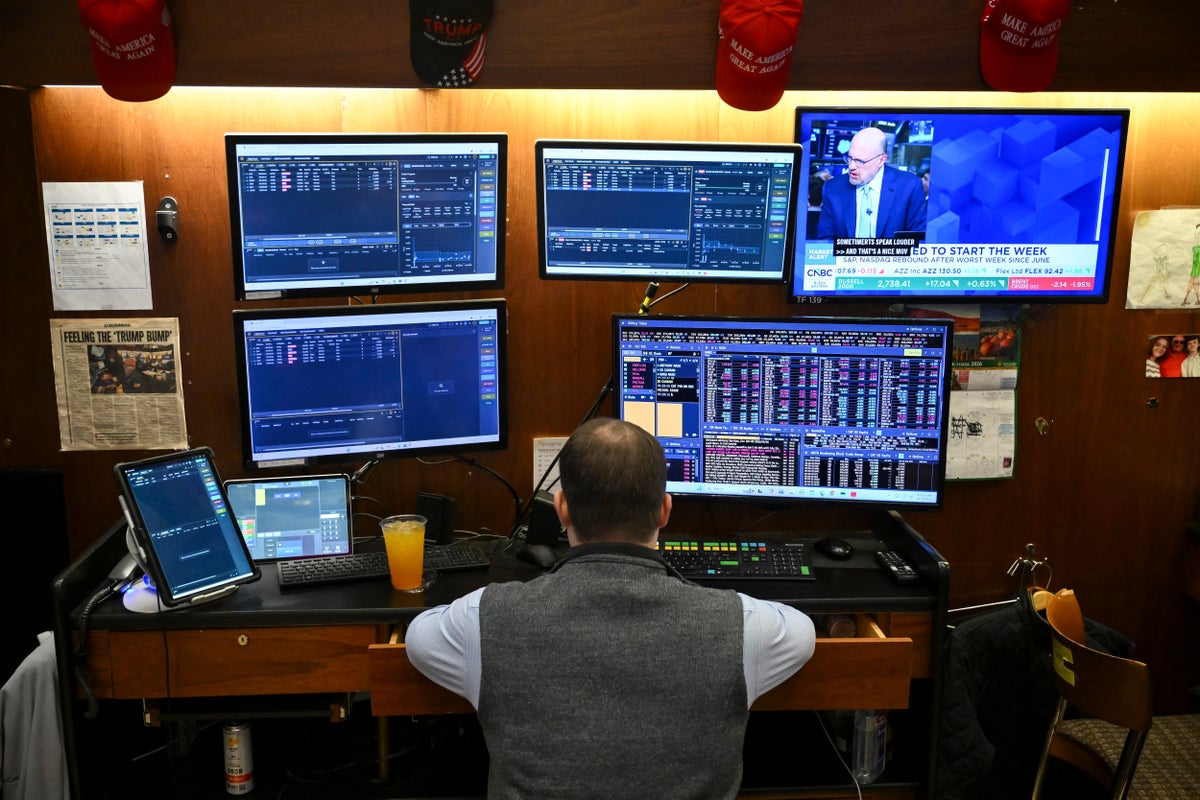
US midterm elections: The sectors bracing for potential shift in balance of power in Washington
Key Points
US midterm elections: The sectors bracing for potential shift in balance of power in Washington Several sectors could face greater scrutiny from lawmakers in the case of a strong Democratic showing - Bookmark - CommentsGo to comments Become an Independent member to bookmark this article Already a member? Log in Corporate America has been preparing for a potential shift in Washington's balance of power as US midterm election results loom. If Democrats show strongly, analysts and strategists...
US midterm elections: The sectors bracing for potential shift in balance of power in Washington
Several sectors could face greater scrutiny from lawmakers in the case of a strong Democratic showing
- Bookmark
- CommentsGo to comments
Become an Independent member to bookmark this article
Already a member? Log in
Corporate America has been preparing for a potential shift in Washington's balance of power as US midterm election results loom.
If Democrats show strongly, analysts and strategists say clean energy, housing, and healthcare stocks could gain, while artificial intelligence, data center, and defense firms may face greater legislative scrutiny.
Polymarket, the world's largest prediction market, puts the odds of a Democratic sweep at 72%, while Republicans keeping the Senate alongside a Democratic House win stands at 23%.
The chances of Republicans holding both chambers are a slim 6%, as a Reuters/Ipsos poll shows President Donald Trump's approval ratings at a career low over living costs and the war with Iran.
A divided Congress would still grant Democrats enhanced power over funding and investigations, though overcoming any presidential veto from Trump would remain necessary.
Investors are closely watching these sectors:
Potential beneficiaries of a blue wave
CLEAN ENERGY
A strong Democratic showing could reinforce expectations that federal support for clean-energy development will remain in place, analysts said, benefiting companies such as solar maker First Solar FSLR.O, residential solar installer Sunrun RUN.O, inverter maker Enphase Energy ENPH.O and clean-power developer NextEra Energy NEE.N.
The Democratic-controlled Congress passed the Inflation Reduction Act in 2022, devoting hundreds of billions to climate and energy-security measures, including expanded tax credits for renewable energy, nuclear power and EVs.
In case of a divided government, brokerage UBS sees room for bipartisan legislation to speed up energy and infrastructure approvals and expects nuclear power to get backing from both sides.
Democrats plan to scrutinize the Trump administration's efforts to roll back emissions rules and could use the Congressional Review Act to overturn regulations that make it easier to sell gas-powered trucks and SUVs.
Automakers Ford F.N, General Motors GM.N and Stellantis STLAM.MI, which have scaled back EV plans and lobbied for looser rules, could face pressure.
HOMEBUILDERS
UBS said the Trump administration would continue to implement the 21st Century ROAD to Housing Act, which Congress passed in late June, to increase the availability of affordable single-family homes.
If Democrats take both chambers, they could add affordability measures, including restrictions on large institutional landlords, though those would still face Trump's veto, UBS said.
The PHLX Housing Index .HGX has slipped close to 5% so far this year as the prospect of higher interest and mortgage rates weighs on the sector.
Sectors at risk from a blue wave
AI AND DATA CENTERS
Analysts expect a Democratic majority to bring greater scrutiny of AI, potentially pressuring data-storage and memory names such as Micron Technology MU.O, Sandisk SNDK.O and Seagate STX.O, which have rallied this year.
A slowdown in AI and data-center spending could also weigh on semiconductor-equipment makers AMAT.O, LRCX.O, KLAC.O, power providers CEG.O, VST.N and data-center builders PWR.N, VRT.N.
A Democratic majority would be more likely to use subpoena powers to compel tech executives to testify under oath or hand over records related to harmful AI-agent behavior.
Also, voters in at least 10 states could consider ballot measures that could impose new restrictions, permitting requirements or pauses on data-center development.
Still, Societe Generale said the AI trade is likely to remain intact as Democrats are unlikely to secure a majority large enough to override a Trump veto and key federal agencies remain under Republican control.
HEALTHCARE
Healthcare faces a mixed outlook under a Democratic sweep, with greater scrutiny of Medicaid and Medicare Advantage plans potentially weighing on insurers, though TD Cowen sees limited risk of major industry changes and broad structural reform.
The S&P 500 healthcare sector .SPXHC has jumped more than 19% this year to record highs, trailing only energy stocks, as investors rotated into defensive sectors amid market volatility.
A Democratic-controlled House would heighten the possibility of raising taxes to fund a fiscal program that includes more health spending.
"A Democratic sweep could create greater momentum behind measures targeting healthcare costs, consumer fees, prescription drug pricing and areas perceived to contribute to affordability concerns," said Magdalena Ocampo, market strategist at Principal Asset Management.
DEFENSE
Defense stocks rallied in January after Trump called for a $1.5 trillion military budget, above the approved $901 billion, but they have since surrendered most of those gains.
A budget vote is unlikely before 2027. Democratic control of the House could bring military spending back under scruntiny, with analysts noting Congress has yet to appropriate funds for the multibillion-dollar contracts that big defense contractors signed to replenish stockpiles.
However, with the Iran conflict showing no sign of ending, companies such as RTX RTX.N and Northrop Grumman NOC.N continue to see robust demand for arms, pushing their backlogs to record levels.
FINANCIALS
Morgan Stanley analysts said additional oversight under a Democratic outcome could slow the pace of regulatory easing, but was unlikely to derail it.
A Democratic Congress last overhauled bank regulations with the 2010 Dodd-Frank law, which tightened capital rules, created a consumer watchdog and imposed new trading restrictions.
A stronger GOP hand would support regulatory clarity and policy continuity. Keeping conditions favorable for mergers and acquisitions and sustaining capital markets activity are a big earnings driver for large banks, Barclays analysts said.
Quarterly results from JPMorgan JPM.N, Citigroup C.N, Goldman Sachs GS.N and Wells Fargo WFC.N earlier this month suggested that a dealmaking and trading boom that powered record first-half earnings may be slowing.
CRYPTOCURRENCIES
Analysts say the election is unlikely to have a significant impact on cryptocurrency prices but will likely influence how quickly crypto legislation moves through Congress.
The Senate failed in September to advance the Clarity Act amid Democratic opposition, and analysts say a Democratic-controlled Senate would make it harder for the crypto bill to be revived next year.
Reuters has reported that Democrats in Congress are preparing investigations into crypto companies tied to Trump and his family, arguing the dealings present potential conflicts of interest.
That could generate adverse headlines and legal risks for some publicly listed firms in the crypto and blockchain industries, attorneys told Reuters.
Join our commenting forum
Join thought-provoking conversations, follow other Independent readers and see their replies
Comments
[Image text:] MAKE
GREAT AGU
ANS
CNB
FLEX92.42