
Science
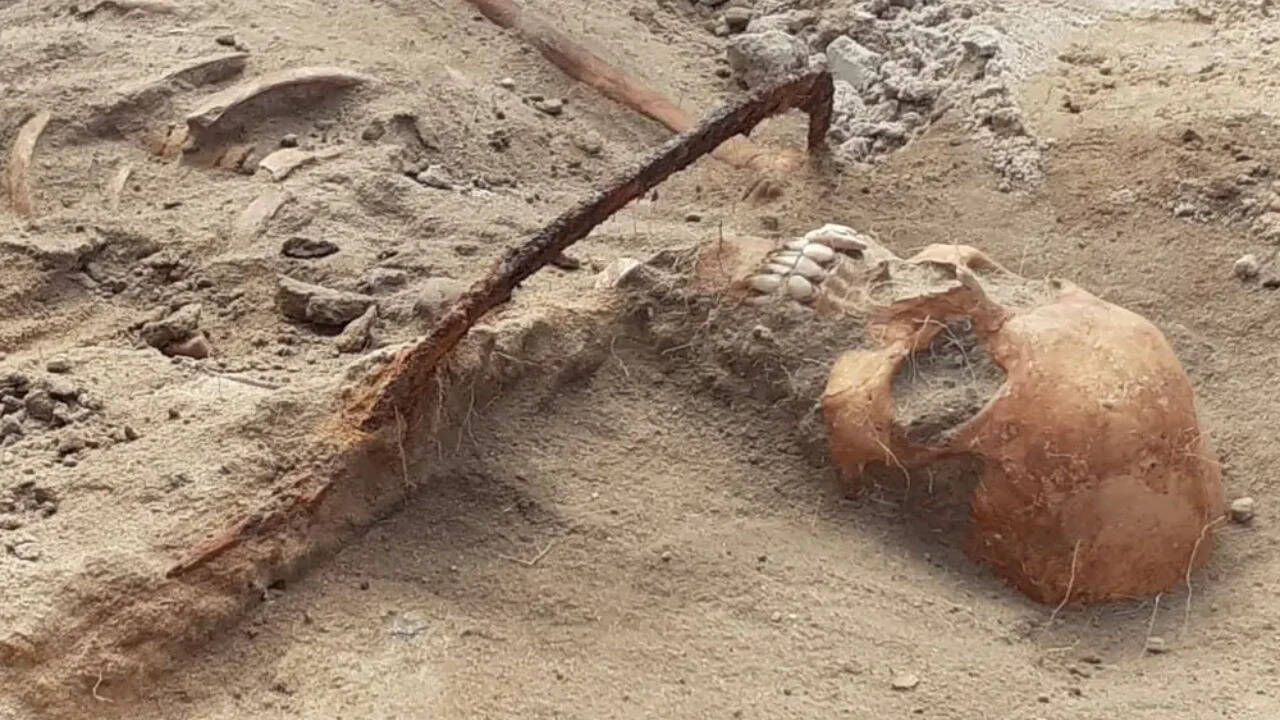
17th-century Polish 'vampire' grave found with sickle and padlock
Key Points
Vampires are one of the most famous mythological creatures in history. These blood-sucking creatures roam the night searching for people to feed upon. Perhaps it is the fascinating legends surrounding these creatures: their sharp fangs, their association with the night, their ability to morph into a bat, or their aversion to garlic (imagine how sad?).
Vampires are one of the most famous mythological creatures in history. These blood-sucking creatures roam the night searching for people to feed upon.
Perhaps it is the fascinating legends surrounding these creatures: their sharp fangs, their association with the night, their ability to morph into a bat, or their aversion to garlic (imagine how sad?). Or perhaps it is the actual idea of being a vampire, meaning immortality, that makes them such a fan(g)-favourite.
Maybe this fascination and fear led to the unusual burial of a 17th-century Polish woman, found with a padlock on her toe and an iron sickle across her neck. Whether she was a vampire or not, someone went to great lengths to ensure she remained dead.
A grave that was anything but ordinary
Image Courtesy: D. Poliński et al., Journal of Archaeological Science: Reports, 2026
In 2022, archaeologists digging through a cemetery in the Polish village of Pień made a rather unsettling discovery.
US Midterm Election Results 2026
Grave 75 held the remains of a young woman, buried with an iron sickle across her neck, the blade facing her, and a triangular padlock attached to her big toe.
The burial dates back to the mid-17th century, and the objects were anything but normal grave offerings. They were put there to keep the dead from coming back into the world of the living. The woman was later named Zosia by archaeologists, in an attempt to restore some of the identity and dignity she had been denied in death.
For years, archaeologists led by Dariusz Poliński of Nicolaus Copernicus University studied her remains and the strange objects found with her. The findings, published in 2026 in the Journal of Archaeological Science: Reports, suggest the local people may have seen Zosia as a threat, associating her with misfortunes such as disease and famine.
Interestingly, the burial appeared to have happened in two stages. The padlock was likely attached to her toe during the initial burial. At some point, the grave was reopened, the soil disturbed and the body repositioned before the sickle was placed across her neck. The blade was positioned so that any attempt to rise would potentially result in the woman decapitating herself.
What made Zosia so frightening?
To understand why someone would go to such lengths to restrain a dead woman, researchers had to look beyond the grave and into the beliefs of 17th-century Poland.
At the time of her burial, i.e. 17th century, vampires were not quite the elegant, blood-sucking aristocrats we recognise from modern films. They were considered demonic beings, somewhere between ghosts, witches and the undead. People believed that certain individuals could return after death and bring disease, destruction and misfortune to their communities.
One Polish folk belief held that a person could possess two souls. While one remained in the body, the other could wander around causing trouble. A padlock was believed to keep the good soul trapped inside the body and prevent the supposedly evil one from escaping.
The fear was not restricted to people who had behaved badly during their lives. Outsiders, religious heretics, orphans and people who died under unusual or tragic circumstances were particularly vulnerable to suspicion. Those who drowned, died by suicide or passed away during childbirth could also be considered potential threats after death.
Zosia, however, may have stood out for reasons beyond the circumstances of her death.
Examinations of her skeleton revealed that she was approximately 18 years old. She also had a condition known as Kimmerle anomaly, a bony formation on one of her cervical vertebrae. The condition can be associated with headaches, neck pain and fainting spells. Researchers believe these symptoms may have made her appear unusual to people who did not understand her condition.
Her bones also showed Harris lines, markers of interruptions in childhood bone growth. They may have been caused by periods of malnutrition, illness or physical stress. More tests revealed a strange growth on her breast bone, possibly a benign tumour or some other abnormality. It could have been a visible lump or a red mark on her chest, depending on its external appearance.
A wealthy woman in an unwelcoming graveyard
There is another interesting detail about Zosia's burial. Despite the rather brutal treatment of her remains, evidence suggests that she may have belonged to a wealthy family.
Archaeologists discovered delicate silk fibres around her skull, which textile specialists later examined under an electron microscope. The fibres were woven with silver and gold threads, possibly forming an ornamental band on an expensive head-cap.
Such cloth was a luxury in 17th century Poland and would have been unavailable to common villagers. The quality of the material suggests that Zosia might have been a member of the upper classes, even perhaps a noblewoman.
Her expensive clothing raises another question: why was someone who may have enjoyed considerable wealth buried in such an unusual cemetery?
Researchers believe the Pień burial ground may have been unconsecrated land, located away from a church or chapel. It appears to have been used for people who were poor, disgraced or otherwise excluded from conventional burial grounds.
Zosia may have belonged to the last category.
There is also a possibility that she was not originally from the village. Chemical analysis of her teeth, particularly the strontium isotopes preserved in their enamel, suggested that she could have grown up in several regions across Europe, including southern Sweden or the Upper Rhine region of Germany.
Sweden and Poland were involved in military conflict during the 17th century. If Zosia was Swedish, she may have been regarded with considerable hostility by the local population. Her wealth, foreign origins and physical differences could have made her an easy target.
An entire cemetery of vampires?
As unsettling as Zosia's grave was, it was hardly the only unusual burial discovered in Pień.
Archaeologists examined around 100 graves at the cemetery, with more than a dozen displaying what they describe as extraordinary burial practices. These included skeletons weighed down with rocks, a child buried face down with a padlock beneath its foot, and even an infant buried with a lock.
A disturbing discovery was a child aged 5-7 with most of the upper body missing. Another burial contained a man and a child in a crucifix position near his feet.
The results indicate that the fear of the undead was not aimed at Zosia alone. Even children, who could hardly have posed a threat to anyone during their short lives, were subjected to similar precautions. Such practices were part of a wider wave of vampire hysteria across Eastern and Central Europe.
Bringing Zosia back to life
Image Courtesy: Oscar Nilsson/Projekt Pień
Perhaps the most remarkable part of Zosia's story is that, 350 years after her burial, researchers have managed to give the young woman a face again.
Forensic sculptor Oscar Nilsson, who has worked on facial reconstructions for decades, used measurements of her skull, skeletal structure, age and estimated body composition to recreate her appearance. After approximately 150 hours of work, he produced a lifelike reconstruction showing a young woman with blue eyes, light brown hair and a broad nose.
The people who buried Zosia did everything they could to prevent her from returning to life. Centuries later, archaeologists and scientists have spent years doing almost the exact opposite.
Her story remains incomplete. Researchers still do not know exactly how she died, where she spent her childhood or what happened during her final days. But her burial offers a glimpse into a society where fear could turn a person's differences into something monstrous.
After all, vampires may be creatures of folklore, but the fear that creates them is very real. And sometimes, the scariest thing about a vampire story is not the person buried in the grave, but the people who put them there.