
Science
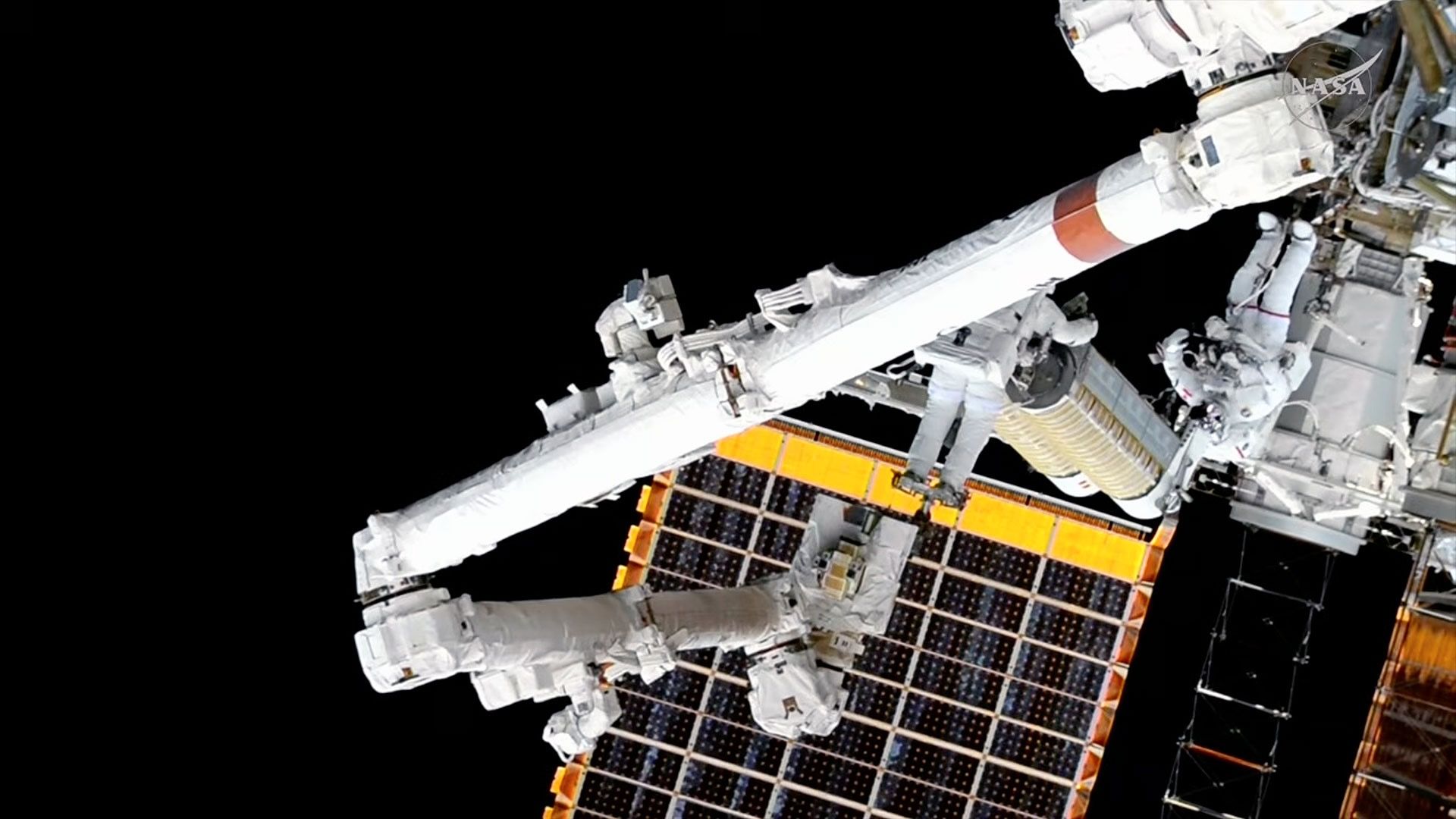
'We got it done!' Spacewalking astronauts finish installing next-gen ISS solar arrays
Key Points
Spacewalking astronauts finish installing next-gen ISS solar arrays The first iROSA arrays were deployed in 2021. Just as NASA is preparing to demonstrate "Max Power" on the ground, two astronauts on a spacewalk have provided the International Space Station (ISS) with the same. Expedition 75 flight engineers Anil Menon of NASA and Joshua Kutryk of the Canadian Space Agency installed and deployed the eighth and final ISS Roll-Out Solar Array (iROSA) on Thursday (Nov. 5), augmenting the space...
'We got it done!' Spacewalking astronauts finish installing next-gen ISS solar arrays
The first iROSA arrays were deployed in 2021.
Just as NASA is preparing to demonstrate "Max Power" on the ground, two astronauts on a spacewalk have provided the International Space Station (ISS) with the same.
Expedition 75 flight engineers Anil Menon of NASA and Joshua Kutryk of the Canadian Space Agency installed and deployed the eighth and final ISS Roll-Out Solar Array (iROSA) on Thursday (Nov. 5), augmenting the space station's legacy solar array wings to produce as much as 30% more electricity.
"We got it done!" said Menon at the end of the 6-hour-and-59-minute spacewalk. The EVA (extravehicular activity) began at 8:36 a.m. EST and ended at 3:35 p.m. EST (1336 to 2035 GMT).
Repeating many of the same tasks as they did on an Oct. 29 spacewalk that added the penultimate iROSA, Menon and Kutryk worked this time on the starboard side of the station's backbone truss on the 3B power channel. The two retrieved the 750-pound (340 kilograms) iROSA assembly from a temporary stowage platform, carried it to the worksite by way of the Canadarm2 robotic arm and mounted it to its previously assembled bracket kit.
Menon then attached the cables to tie the iROSA into the station's systems but ran into a problem.
"We are seeing half of the expected shunt current that we want," radioed Nichole Stilwell, a NASA astronaut serving as the spacewalk officer in Mission Control. "In this current config, we are not necessarily going to deploy."
To address the issue, the connectors needed to be inspected. Out of safety concerns — given that the arrays generate electricity whenever lit by the sun — the astronauts needed to wait for the space station to enter the shadow of Earth to see what could be done. In the interim, they spent the time cleaning up their worksite and returning the Canadarm2 to its park site as they would have done after the deployment.
Fortunately, they were able to clear the issue.
"We are seeing good shunt currents on the ground, so we are go for deploy," said Stilwell.
After releasing two bolts, Kutryk and Menon watched as the array started to unfurl to its full 63-foot (19 meters) length. No motor was needed; the iROSA, as designed, used only the potential energy stored by its rolled-up carbon composite booms to extend itself. The entire process took about 10 minutes.
"Today marks the completion of not just one solar array but, over 15 years after its development, eight arrays," said Menon at the close of the spacewalk. "These solar arrays are incredible. Half the size of the old ones and bringing 40% more power."
Each of the eight iROSAs and their mounting assemblies were delivered to the space station by SpaceX Dragon cargo spacecraft. Beginning in June 2021, four teams of two astronauts did as was done on Thursday to deploy each array. In addition to Kutryk and Menon's work on the 2A and 3B power channels, the spacewalkers included Shane Kimbrough of NASA and Thomas Pesquet of the European Space Agency for the 2B and 4B channels; Josh Cassada and Frank Rubio, both with NASA, on 3A and 4A in December 2022; and NASA's Steve Bowen and Woody Hoburg on 1A and 1B in June 2023.
The need for the iROSA augmentations was discovered by flight controllers when the space station's eight original arrays began to show degraded power output as they exceeded their 15-year design life. The iROSAs provide the additional electricity needed to support ISS operations through its retirement and controlled deorbit, which are currently scheduled to occur in late 2030.
"Congratulations to you all on your stellar work to finish the last of the roll-out solar arrays and the upgrades to the ISS power system that will take it to the end of its journey," said Stilwell, addressing Menon and Kutryk. "It is fitting that we just surpassed 26 years of constant human presence on the International Space Station, and you all showed us what the best of humanity looks like executing one of the most difficult and dangerous [things] humans do and making it look easy. Congratulations!"
Menon has now logged 33 hours and 30 minutes on four spacewalks, while Kutryk has tailed 14 hours and 10 minutes on two EVAs. Thursday's spacewalk was the 101st U.S. EVA at the International Space Station without a space shuttle being present and the 286th overall in support of ISS assembly, maintenance and upgrades. It was the ninth spacewalk of 2026 and the sixth conducted by the station's 75th resident crew.
Robert Pearlman is a space historian, journalist and the founder and editor of collectSPACE.com, a daily news publication and community devoted to space history with a particular focus on how and where space exploration intersects with pop culture. Pearlman is also a contributing writer for Space.com and co-author of "Space Stations: The Art, Science, and Reality of Working in Space” published by Smithsonian Books in 2018.
In 2009, he was inducted into the U.S. Space Camp Hall of Fame in Huntsville, Alabama. In 2021, he was honored by the American Astronautical Society with the Ordway Award for Sustained Excellence in Spaceflight History. In 2023, the National Space Club Florida Committee recognized Pearlman with the Kolcum News and Communications Award for excellence in telling the space story along the Space Coast and throughout the world.
You must confirm your public display name before commenting
Please logout and then login again, you will then be prompted to enter your display name.
NASA (ORG)
the International Space Station (ORG)
Anil Menon (PERSON)
Joshua Kutryk (PERSON)
the Canadian Space Agency (ORG)
ISS Roll-Out Solar Array (ORG)
Menon (PERSON)
Kutryk (PERSON)
Nichole Stilwell (PERSON)
Mission Control (ORG)
Earth (LOCATION)
Stilwell (PERSON)
SpaceX Dragon (ORG)
Shane Kimbrough (PERSON)