
Britain's ambitions for AI, advanced chips, and clean energy rest on mineral supply chains dominated by China, and MPs say they cannot establish whether ministers have a credible plan to reduce that dependence.
The House of Commons Business, Innovation, Science and Trade Committee has set ministers ten tests for securing critical minerals. Its verdict is hardly glowing – it cannot be confident the government passes any of them.
The tests cover whether ministers know which industries and technologies need protecting, what minerals they require, where supplies could be disrupted, and how domestic production, overseas partnerships, skills, and financing will close the gaps.
In a report published today, the committee warns that diversifying supplies will take ten to 15 years, and will require sustained investment and cooperation with allies. Completely cutting China out is neither realistic nor desirable, it says. Leaving Beijing with so much leverage is another matter.
Critical minerals underpin everything from batteries and semiconductors to datacenters and military equipment. The designation reflects their economic or security importance and vulnerability to supply disruption, rather than membership of an especially exclusive geological club.
The UK – like pretty much all major industrialized economies including the US, the EU, Japan, and India – is almost entirely dependent on imports of these materials and mineral products. But digging up more ore outside China would solve only part of the problem. The bigger bottleneck is processing.
Citing International Energy Agency figures, the committee says China is the leading refiner for 19 of 20 strategic minerals, with an average market share of 70 percent. A different flag over the mine does not necessarily mean a different route through the refinery.
The exposure extends beyond chips and batteries. As The Register reported in August, erbium is used to amplify signals in fiber-optic links, while yttrium goes into components including ceramic capacitors. IEEE Spectrum warned that China effectively monopolized the processing of both into the industrially usable materials manufacturers need.
That concentration has already caused disruption. China's rare earth export controls in April 2025, introduced following US tariffs, rippled through manufacturing supply chains and forced temporary automotive plant closures. British manufacturers can suffer even when Britain isn't the intended target.
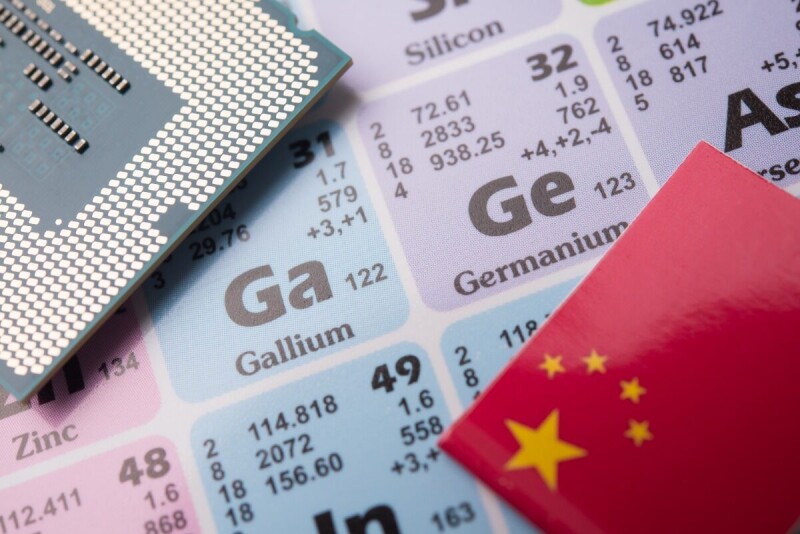
The committee also highlights gallium and germanium, used in advanced semiconductors for radar, communications, and electronic warfare. China accounts for 95 percent and 93 percent of their global production respectively, according to the report [PDF].
Beijing flexing its leverage over chip materials is not new. China announced export licensing requirements for gallium and germanium in July 2023 amid tightening Western restrictions on semiconductor technology.
Yet MPs say the government has not clearly identified which domestic industrial and technological capabilities it wants to protect, making it difficult to determine which supply chains deserve priority.
Nor do import statistics reveal the whole exposure. Minerals can arrive inside batteries, magnets, and other manufactured components, disappearing from view as individual materials. Businesses themselves may not know precisely what lies several layers down their supply chains.
The committee wants confidential mapping and stress-testing with firms in critical sectors, followed by joint purchasing arrangements with allies to give new mining and refining projects dependable customers.
Committee chair Liam Byrne said: "Critical minerals are the alpha of the new economy. We cannot re-arm Britain, build AI or deliver net zero unless we secure the minerals these technologies depend on.
"Yet sixteen years after China first weaponised its chokehold over rare earths, Britain remains dangerously exposed. We don't know enough about what minerals we need or where to find them. Our energy costs make processing uneconomic, we're exporting valuable metal waste, and our public finance institutions are shackled by outdated rules."
More than a shopping list
The committee's five-part prescription is to identify the capabilities Britain must protect, map their mineral needs, expand domestic mining, processing, and recycling, pool purchasing power with allies, and establish a dedicated financing facility.
The proposed facility would bring together public funding bodies to back projects through grants, equity, loans, guarantees, and long-term purchase agreements.
"We're never going to eliminate Chinese minerals from our supply chains. But it's foolish to leave Britain exposed to economic coercion when we could be building alternative supplies," Byrne said.
"That's why we need a new Critical Minerals Finance Facility with the financial firepower to invest in new mines, processing plants and recycling, working with our allies to share the costs."
The report argues that existing institutions leave gaps, particularly for early-stage projects. It recommends expanding UK Export Finance's remit and allowing British International Investment to take equity stakes in overseas mineral projects.
Long-term purchasing commitments and price guarantees could help keep strategically important projects commercially viable despite volatile mineral prices.
There is also material closer to home. The report says 80 percent of UK metal products classified as waste are exported. MPs want better sorting and separation infrastructure, alongside more detailed trade data to establish exactly what valuable scrap is leaving the country.
For domestic projects, they recommend designated critical mineral clusters with permitting deadlines, help navigating approvals, energy support, and priority grid access.
Stockpiles could provide a short-term buffer too. The committee calls for an initial reserve covering approximately 60 days of minerals needed for defense capabilities, while stressing that warehouses are no substitute for diversified supply.
None of this offers a quick escape from dependence on China. The committee's argument is that Britain needs to decide what it must protect, work out what those industries actually consume, and help finance alternatives before the next disruption.
"De-risking even a prudent proportion of our supplies will take over a decade. Britain cannot afford to drift," Byrne said. "We must act now before dangerous dependencies become strategic liabilities." ®