
Science
Anker Soundcore Space 2 Pro review: Big bang for less bucks
Key Points
Anker Soundcore Space 2 Pro review: Big bang for less bucks The company’s latest headphones rival Apple, Bose and Sony at a much lower price. We may receive a commission on purchases made from links. If you don't like the idea of paying $350 to $500 for a set of flagship headphones, Anker's Soundcore line offers a lot of performance at much lower prices.
Anker Soundcore Space 2 Pro review: Big bang for less bucks
The company’s latest headphones rival Apple, Bose and Sony at a much lower price.
We may receive a commission on purchases made from links.
If you don't like the idea of paying $350 to $500 for a set of flagship headphones, Anker's Soundcore line offers a lot of performance at much lower prices. Over the years, the company has refined its formula by balancing sound and features in various packages so as to compete with the likes of Apple, Bose, Sony and Sennheiser. With the Space 2 Pro, Anker put its new Thus audio chip in headphones for the first time, making lofty claims about the upgraded voice clarity as a result. At $200, these aren't just an affordable alternative to the big names in headphones, they're a worthy contender in their own right.
What's good about the Space 2 Pro?
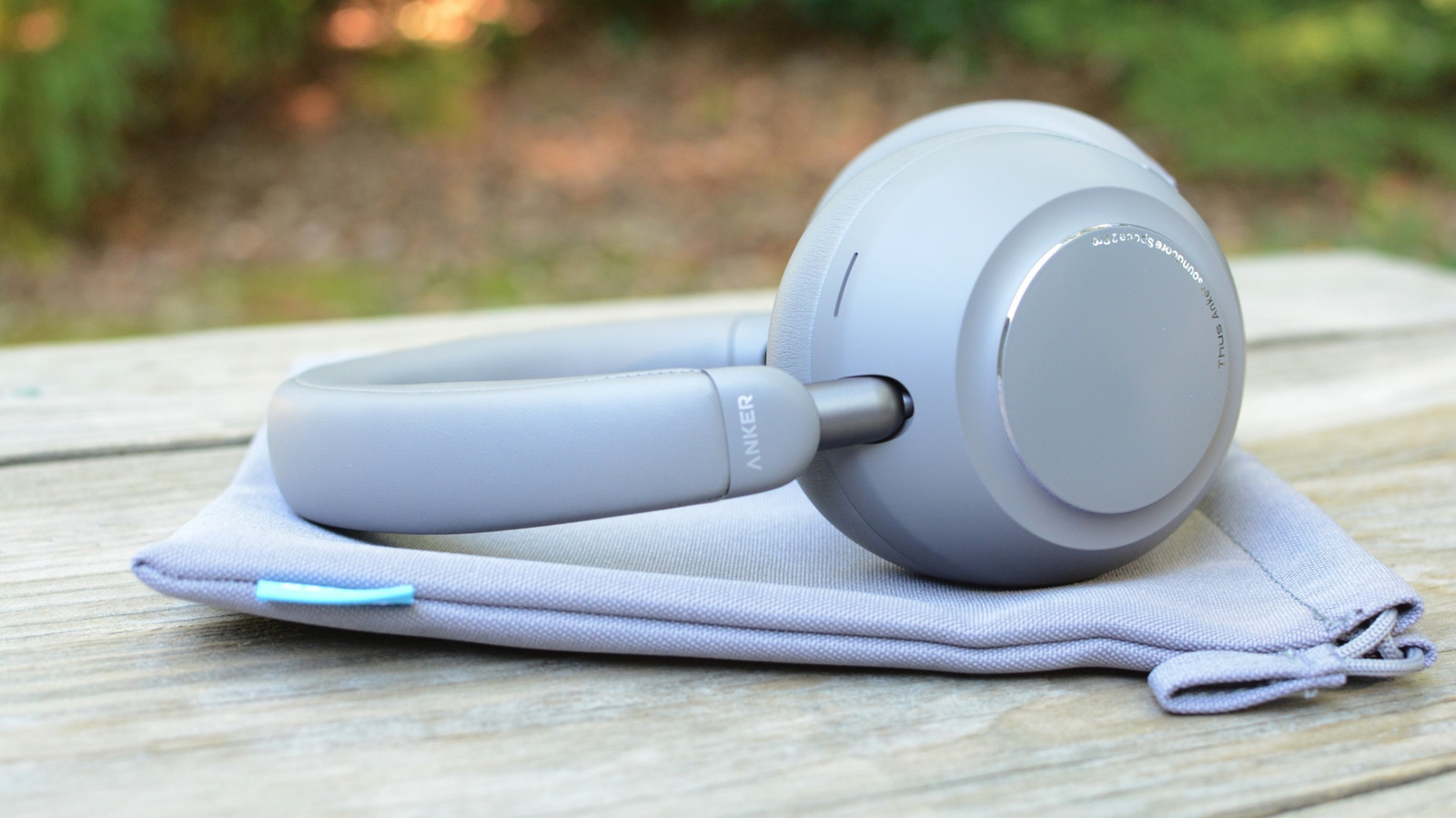
The first thing that stood out to me about the Space 2 Pro is the design. These do not look like they cost $200, especially not the grey version that I tested. Anker refined the look of the Space line here for a premium aesthetic and a build that's lightweight, but not overly plastic. The sliders for fit adjustments are metal and both the headband and ear pads are wrapped in soft leather. There are also subtle metallic accents to complete the premium design, like the circles on the outside of the ear cups and subtly placed product name.
Even though the Space 2 Pro is the flagship Soundcore headphones, the price tag pits them up against decidedly midrange competition. Design-wise, the Space 2 Pro is vastly superior in that category, and that advantage continues into audio performance. These headphones have more bass and overall clarity than you'll typically find in the $200 range. The 35mm drivers are made with two different materials in order to maximize both high-end clarity and deep bass.
When I listened to Mastodon's Marrow Deep, Brann Dailor's drums boom throughout and Troy Sanders' bass provides the backbone for the guitar riffs. Thanks to Anker's "crystalline highs" here, guitars and synths cut through the mix clearly, so you never miss a note of Bill Kelliher's handiwork. The overall clarity and detail on the Space 2 Pro is really on display with more acoustic-driven genres, like Zach Bryan's Young Manhood and Other Donatable Organs. The piano, acoustic guitar and string section seem to float behind the interwoven vocals of Bryan and Lana Del Rey on "Lies," for example.
Anker is very proud that the Space 2 Pro currently holds the Guiness World Record for the "clearest over-ear headphones for calls." I was immediately skeptical that this would hold any weight in real-world use, but boy was I wrong.
Plenty of headphones manage to nullify background noise, but they do so at great expense to voice clarity. But thanks to that Thus chip and a six-microphone array, the Space 2 Pro offers extremely clear voice performance while effectively blocking background noise. Not only do they combat would-be distractions exceptionally well, they do so without making you sound even the slightest bit robotic. I thought I sounded pretty close to how I did in a quiet room when the processing kicked in, maybe only the slightest bit muffled, but never like a digitized version of myself.
The company promises battery life of up to 30 hours when you have active noise cancellation (ANC) on, or up to 60 hours with it off. During my testing, which I conducted almost entirely with noise cancellation enabled, I got 31 hours before the Space 2 Pro shut off. I did take a call or two a day where I needed to switch to transparency mode so I didn't feel the need to shout to hear myself speaking, but I'd say 95 percent of the time, I was using ANC.
What's not so great about the Space 2 Pro?
The most disappointing aspect of the Space 2 Pro to me are a number of subpar audio features. The Thus chip powers what Anker calls Hear ID 5.0, a feature that uses a hearing test to customize the sound of the headphones to your preferences. I didn't think the resulting tailored audio profile offered any meaningful improvement over the stock tuning, neither did spatial audio settings or the collection of curated presets. I tested all of them, of course, but every time I used one, I found myself longing for the out-of-the-box sound after just a few minutes of use.
Anker boasts Adaptive ANC 3.0 on the Space 2 Pro, a noise-canceling setup that relies on the Thus chip and eight microphones to combat background noise. The company specifically lists "blocking office chatter and keyboard clicks for instant silence" among the headphones' strengths. While I do think the Space 2 Pro does an above average job of lowering the volume on human voices, and it definitely blocks keyboard clicks, its general noise canceling abilities are just okay. The headphones struggled with constant noise sources, like white noise machines and particularly raucous fans.
On Anker's flagship earbuds, the Liberty 5 Pro Max, the company built an AI note taking assistant into the charging case (which has a touchscreen). Even though the Space 2 Pro doesn't have a case, it does have plenty of microphones, and "AI Note-Taker" is currently listed as "TBD" on the spec sheet. If that feature does eventually arrive, there are two potential issues with it.
First, it will be a lot more awkward to wear over-ear headphones in a meeting than it would be to slide a small earbuds case to the middle of the table. Second, if you plan to regularly use Anker's transcription service and cloud storage, you'll have to pay for a subscription. You only get two hours of transcriptions and 10,000 minutes of audio storage monthly for free, and only for two years. Plans are then either $8.33 or $20 per month (billed annually) depending on your needs. Since it's unclear if this feature will ever arrive, its absence doesn't impact my overall assessment.
Wrap-up
It's easy to dismiss Soundcore as merely a budget brand, but that would be a mistake. With products like the Space 2 Pro, Anker proves it can hang with the best, offering comparable performance for significantly less money. In fact, I'd argue if voice clarity is your primary factor in choosing a new set of headphones, this model should be your first choice. For many, though, that's further down the list of priorities.
While there are caveats when it comes to ANC performance, audio features and a (potentially) unnecessary note taker, the Space 2 Pro has a lot of premium traits. The overall sound quality is good, the design is refined, the fit is comfortable and battery life claims hold true. At a time when the best overall headphones you can buy are $460 at full price, Anker's ability to produce a $200 alternative that won't disappoint you is no small feat.