
Environment
Australia releases six rare snakes into wild after world-first breeding effort
Key Points
Endangered broad-headed snake conservation has reached a world first, with captive-bred juveniles released into the wild in Australia. The reptile, native only to sandstone escarpments around the Sydney Basin, faces serious decline, yet a breeding programme in New South Wales that began with just 17 wild-sourced adults has now returned six young snakes to their natural rocky habitat. The release involved the University of Technology Sydney and Traditional Landowners of the Shoalhaven, and it...
Endangered broad-headed snake conservation has reached a world first, with captive-bred juveniles released into the wild in Australia. The reptile, native only to sandstone escarpments around the Sydney Basin, faces serious decline, yet a breeding programme in New South Wales that began with just 17 wild-sourced adults has now returned six young snakes to their natural rocky habitat. The release involved the University of Technology Sydney and Traditional Landowners of the Shoalhaven, and it follows two years of world-first milestones. The outcome gives conservationists a working model for protecting one of the country’s rarest reptiles while shelter sites keep disappearing.
Inside the specialist terrariums where the world’s first captive birth of the species took place
According to Aussie Ark’s announcement of the release, the conservation organisation secured the founding adults in October 2024 to create the world’s first wild-sourced breeding and rewilding programme for the species. The insurance population later grew to 20 snakes, all housed in specialised terrariums at Conservation Ark in Somersby, New South Wales.
Early in 2026, the programme recorded the world’s first captive birth of the species. Only weeks later, remote-sensor cameras captured a live birth, something never witnessed or documented before. By the time of the May 2026 announcement, eight juveniles had been bred. Two stayed in the insurance population because of their important genetics, and the other six went into the wild.
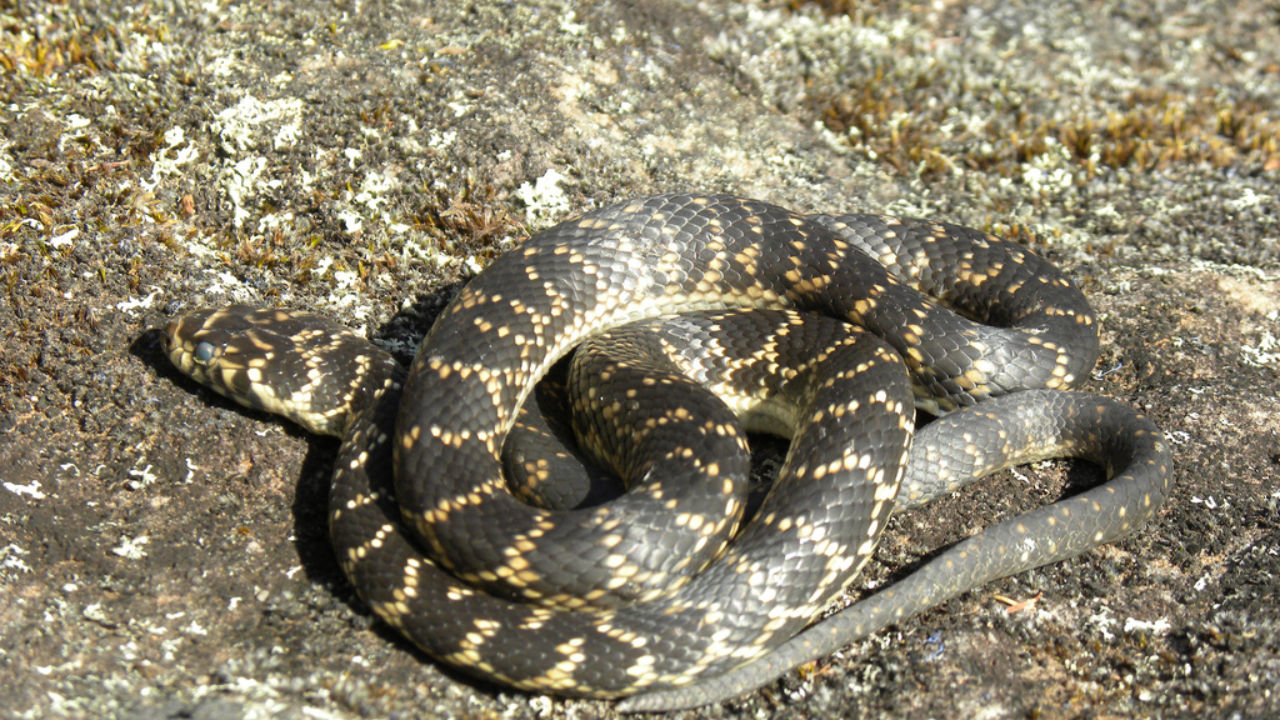
Image: Wikipedia
Why artificial rocks matter for a nocturnal snake that has lost so many natural hiding places
The broad-headed snake shelters under rocks by day and hunts at night. Habitat destruction, illegal rock removal and fragmentation have stripped away the shelter sites it depends on. Professor Jonathan Webb, who has studied the species for more than three decades, said habitat loss remains the greatest threat to its survival.
Webb explained that the rocks let the snakes regulate their body temperature and hide, and that they also attract prey. Much of that habitat has been cleared over the decades for landscaping and building. He described the pilot programme using artificial rocks as vital to the snakes’ survival. All six juveniles were released beneath specially designed artificial rocks. Each snake carries a unique marking on its head, so the team can identify every released animal and monitor it over the long term.
Indigenous rangers are being trained and supported to monitor and protect the species on Country
The programme also trains and supports Indigenous rangers, so that monitoring and protection continue on Country long after the first release. Ranger Ashley Thomas said the work is more than a job: “I love it, it’s not a job for me, it’s a passion of mine.” He described the effort as everyone coming together to do what is best for Country.
Traditional Owner Frank Connolly Junior said the broad-headed snake is important to his culture. He added that the programme lets young people learn about it, so the knowledge passes to the next generation.
Release day cheers and a holistic conservation model for threatened species across Australia
Project lead Dylan Wallis and Chief Conservation Officer Hayley Shute released one of the juveniles together, and cheers erupted from the crowd as the snake vanished into its new home. “It was thrilling to watch the snakes zip off into the wild,” Shute said.
Aussie Ark Managing Director Tim Faulkner called the moment proud and emotional for everyone involved, saying the team had spent many years navigating red tape to reach it. He described the result as a unique, holistic programme that serves as a model for threatened species conservation across Australia.
Major partners Australian Power Equipment and the Sunshine Foundation supported the work. The species is also recognised as a priority threatened species under New South Wales and Commonwealth conservation programmes and legislation.
Australia (LOCATION)
the Sydney Basin (LOCATION)
New South Wales (LOCATION)
the University of Technology Sydney (ORG)
Shoalhaven (ORG)
Aussie Ark’s (ORG)
Conservation Ark (LOCATION)
Somersby (LOCATION)
Jonathan Webb (PERSON)
Webb (PERSON)
Ranger Ashley Thomas (PERSON)
Country (ORG)
Frank Connolly Junior (PERSON)