
Science
Why early humans avoided Arabian desert interiors despite ancient lakes
Key Points
Simple fifth-grade science would have us believe that we need just three things to survive: air, water and food. So, when scientists discovered evidence of freshwater lakes across the interiors of the Arabian Peninsula, they expected to find traces of large prehistoric human settlements. Surprisingly, most archaeological evidence of human occupation was found around the desert's outskirts, rather than its water-rich interior.
Simple fifth-grade science would have us believe that we need just three things to survive: air, water and food. So, when scientists discovered evidence of freshwater lakes across the interiors of the Arabian Peninsula, they expected to find traces of large prehistoric human settlements. Surprisingly, most archaeological evidence of human occupation was found around the desert's outskirts, rather than its water-rich interior. What was keeping humans away?
A
new study published in Nature on 28 October 2026 offers an interesting explanation. Researchers suggest that early humans did not simply settle wherever they found freshwater. They also needed access to particular types of stone to make tools, which were essential to their everyday survival.
What was Green Arabia?
You would be surprised to know that the dry, arid sea of sand that the Arabian Peninsula is today was, at multiple points throughout history, considerably greener. This is what scientists refer to as ‘Green Arabia’.
Over the past eight million years, large parts of the peninsula have experienced repeated periods of wetter weather, supporting lakes, rivers, grasslands and vegetation. However, Green Arabia was not one continuous period of greenness.
These humid phases were separated by dry intervals, and the entire peninsula was not necessarily green at the same time.
Scientists have established this through several forms of geological evidence. Ancient lake deposits, or palaeolakes, contain layers of sediments, minerals, shells and other biological remains that indicate the presence of freshwater. Fossils of animals such as hippopotamuses and crocodiles, which depend on aquatic environments, also suggest that parts of Arabia once supported very different ecosystems. Researchers have even studied mineral formations called speleothems, which develop when mineral-rich water drips through limestone caves, leaving behind layers of calcium carbonate.
However, despite the presence of ancient lakes in the interior, known evidence of prehistoric human occupation was concentrated around the edges of the Arabian desert. If freshwater was available, why were humans not settling further inside?
The missing ingredient: stone
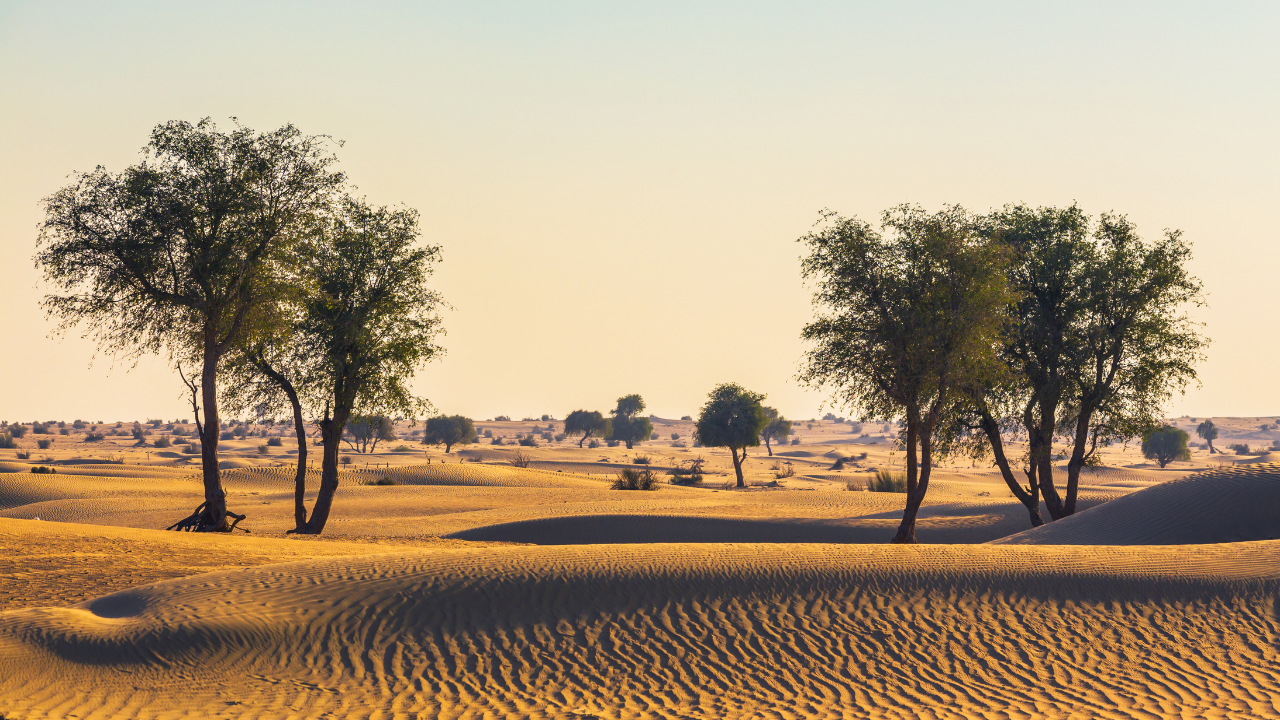
To investigate this, an international team of researchers conducted a large archaeological and geological survey across the Rub' al Khali, also known as the Empty Quarter. It is the world's largest continuous sand sea, stretching across parts of Saudi Arabia, Oman, the UAE and Yemen.
Between 15 November and 20 December 2023, the team travelled approximately 1,500 kilometres across the desert over 35 days. They examined 125 locations, looking for evidence of ancient lakes, freshwater, stone suitable for making prehistoric tools and fragments of materials that could indicate human activity.
At 55 of the 125 locations, they discovered evidence of ancient lakes. These included freshwater mollusc shells, ostrich eggshell fragments and sediment deposits left behind by ancient water bodies.
However, there was something missing. Despite finding evidence of freshwater, researchers found no stone tools, no traces of human toolmaking and no suitable stone that early humans could have used to manufacture tools along the surveyed interior route.
This is because early humans depended heavily on stone tools for everyday survival. They used them to cut meat, process plants, scrape animal hides and prepare other materials. But not every rock is suitable for making a tool. They needed what archaeologists call knappable stone, a material that could be chipped and shaped into sharp edges without breaking unpredictably.
The researchers found that the central Arabian basin largely lacked these suitable rocks. More than 95% of the ground surface was visible during their survey, making it reasonably possible to spot archaeological remains if they were present.
Water and stone: A combination for survival
The researchers did not stop at their desert expedition. They also created geographical models to understand how the availability of water and stone influenced prehistoric human settlements across the Arabian Peninsula.
They compared 363 known prehistoric archaeological sites with the availability of freshwater and suitable stone. Their findings revealed that approximately 57% of the peninsula's water-accessible terrain sits on geological formations that lack suitable stone for making tools.
Thus, having freshwater did not necessarily make a location suitable for sustained human settlement.
When researchers included the availability of stone in their models, their predictions of where early humans actually settled became more accurate. Humans were more likely to establish themselves in places where both essential resources existed together.
The researchers describe this landscape as a lithic archipelago. Think of an archipelago as a collection of islands. Here, the islands were pockets of land where freshwater and suitable rocks were both available. These could support human populations, while the vast stretches between them were considerably less suitable.
What does this change about human migration?
Until now, researchers studying prehistoric human migration have largely relied on climate records, rainfall patterns and evidence of ancient lakes to predict where humans could have lived. This study suggests that geology deserves just as much attention.
It also raises an interesting possibility: the absence of archaeological evidence in certain regions does not necessarily mean humans never explored them. They may have encountered landscapes that had water but lacked the materials they needed to maintain their everyday tools.
Of course, the researchers have not proved that nobody ever entered the interior of the Rub' al Khali. Their survey found no archaeologically visible evidence of occupation along the investigated route, and their findings suggest that sustained settlements were more likely where water and suitable stone occurred together.
Human migration is influenced by more than favourable weather and the availability of food and water. Sometimes, the difference between a place humans could visit and a place they could actually settle in came down to the rocks beneath their feet.