
Environment
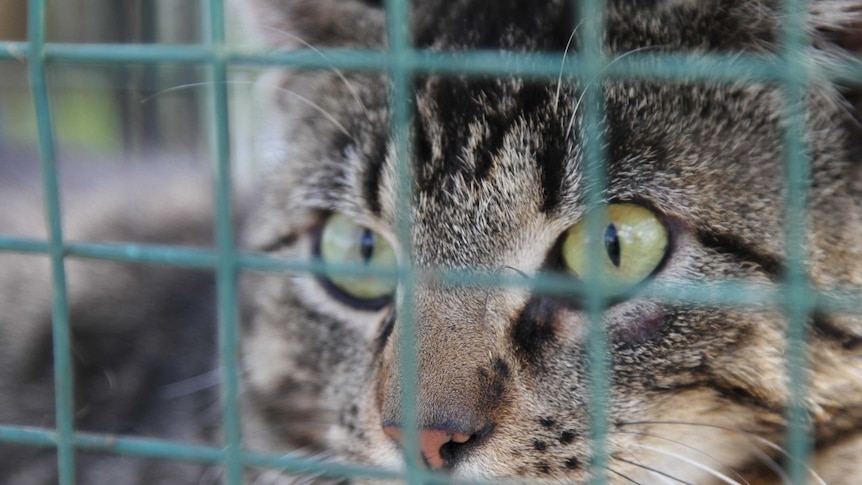
Roaming cats 'split' town as concerns grow for native wildlife
Key Points
Tasmanian wildlife park owner sounds alarm as 'devastating' feral, roaming cats threaten native species In short: There are growing concerns about the impact of feral and roaming cats on Tasmanian native wildlife. A feeding station was found inside a native garden, while work is underway to remove 90 cats from one property. The state government is preparing to release its new cat management plan, with more than 500 submissions received from the public.
Tasmanian wildlife park owner sounds alarm as 'devastating' feral, roaming cats threaten native species
In short:
There are growing concerns about the impact of feral and roaming cats on Tasmanian native wildlife.
A feeding station was found inside a native garden, while work is underway to remove 90 cats from one property.
What's next?
The state government is preparing to release its new cat management plan, with more than 500 submissions received from the public.
Androo Kelly has spent most of his life building a haven for Tasmania's renowned native wildlife.
Potoroos, bettongs, quolls and bandicoots inhabit Trowunna Wildlife Sanctuary, a 30-hectare property near Mole Creek in the state's north.
But some of the native species Mr Kelly has helped thrive are now being increasingly threatened by what he says are record numbers of feral and roaming cats.
He estimated 35 feral cats had been trapped and humanely euthanised at Trowunna alone over the past 20 months.
"The cat issue is devastating," he said.
"We're seeing less of these [native] animals, and in fact the eastern quoll population has completely disappeared."
'Outrage' at cat feeding station
On a quiet Friday afternoon in the nearby town of Mole Creek, the ABC sees a black and white cat crossing the main drag.
Local resident and director of the Pulawini Aboriginal Corporation, Darlene Mansell, is growing increasingly worried about the "vulnerable" wildlife within the nearby Mole Creek Karst National Park.
Ms Mansell said she was "outraged" when a cat feeding station was discovered earlier this year inside a native garden, opposite the Mole Creek grocery store.
She said it took too long for authorities to act — a claim rejected by the Meander Valley Council.
"The timeframe from notification to removal of the infrastructure referred to as a cat feeding station included the time required for Biosecurity Tasmania to investigate the matter," a council spokesperson said.
"Once they had confirmed they would not be responsible for removing the infrastructure, Meander Valley Council acted promptly to undertake its removal."
The council did confirm it had received a report of one local resident keeping 14 pet cats.
"We referred the issue to Biosecurity Tasmania who are the lead agency for these issues," a spokesperson said.
A Department of Natural Resources and Environment (NRE) Tasmania spokesperson told the ABC it investigated the report and "appropriate compliance action has since been undertaken".
Ms Mansell said the incident highlighted a "split" in the community between "bleeding heart" cat owners and those, like her, who were determined to protect the native wildlife.
"I think it's all going to come to a head," she said.
"We have to come together as a community, and they have to realise the damage that roaming cats can have."
'Struggle to manage'
Those working on the frontline of cat welfare in Tasmania say the proliferation of feral and roaming cats is not an isolated issue.
Just Cats Tasmania director Rachel Beech said the organisation routinely had between 300 and 400 cats in its care.
"There is not a day that goes by where we are not taking in cats of some description," she said.
"With no operating costs being funded, we struggle to manage the day-to-day running of the shelter."
She said the organisation recently began the process of removing 90 cats from one property in the state's north-west.
Northern Tasmanian veterinarian and farmer Helen Baillie said her livestock had been impacted by toxoplasmosis — an infection caused by a parasite found in cats.
"For our farm business, toxoplasmosis causes abortion in our ewe lambs," Ms Baillie said.
"That can be really quite devastating."
A 2014 CSIRO study found Tasmania had one of the highest recorded rates of cat-carried toxoplasmosis infection in the world, with about 85 per cent of stray and feral cats carrying the parasite.
Ms Baillie said roaming cats could "become feral cats pretty quickly".
"Cats can be really lovely pets, but they are inherently hunters," Ms Baillie said.
Cat containment debate
The Tasmanian government is currently renewing its first "comprehensive" cat management plan, which has been in place since 2017.
A number of individuals and organisations, including the Australian Land Conservation Alliance, are calling for stronger measures "to keep pet cats contained".
"Roaming pet cats kill hundreds of native animals per year, and about 78 per cent of roaming cats hunt wildlife," ALCA wrote in its submission.
"This occurs during both day and night, meaning partial measures like curfews do not fully address the problem."
The current Tasmanian legislation does not include any containment requirements for cat owners.
However, the Cat Management Act allows for local governments to enact by-laws to mandate cat containment, with Kingborough Council requiring pet cats on Bruny Island to be confined to a property at all times.
NRE told the ABC the state's next cat management plan — expected to be released in the new year — would "build on the significant progress made since 2017".
More than 500 submissions were received from the public, with "broad support" for measures to promote responsible cat ownership.
"Cat containment was widely supported as an important way to protect wildlife, reduce nuisance behaviour and improve cat welfare," said Minister for Primary Industries Gavin Pearce.
"Importantly, the community also emphasised that any new measures should be practical, affordable and supported by education and effective compliance and enforcement."
However, domestic cat containment and curfew laws have divided opinion across the country.
A New South Wales government report released last year found there was "insufficient evidence" to support the effectiveness of mandatory cat containment.
The RSPCA also said mandatory containment would lead to more cat abandonment and "disproportionately impact people from lower socio-economic backgrounds and renters".
Mr Kelly is firmly in favour of stricter cat containment laws.
He believes too many domestic cat owners are "ignorant" to the environmental risks of allowing their pets to roam freely.
"Cats should not have the right to roam wherever they like,"he said.
Tasmanian (ORG)
Androo Kelly (PERSON)
Tasmania (LOCATION)
Trowunna Wildlife Sanctuary (LOCATION)
Mole Creek (LOCATION)
Kelly (PERSON)
ABC (ORG)
the Pulawini Aboriginal Corporation (ORG)
Darlene Mansell (PERSON)
Mole Creek Karst National Park (LOCATION)
Ms Mansell (PERSON)
the Meander Valley Council (ORG)
Biosecurity Tasmania (ORG)
Meander Valley Council (ORG)
A Department of Natural Resources and Environment (ORG)