
Politics
Gas prices fall below $4 per gallon for the first time since July
Key Points
The average nationwide price for regular gasoline on Tuesday fell below $4 per gallon for the first time since July 20, according to data from AAA. The drop comes as oil prices have plunged, with President Donald Trump repeatedly playing down the prospect of a renewed war with Iran, and pushing for progress between Russia and Ukraine in new trilateral talks. Still, gas prices remain elevated by more than 30% since the war with Iran started on February 28, and around 40% since the beginning...
The average nationwide price for regular gasoline on Tuesday fell below $4 per gallon for the first time since July 20, according to data from AAA.
The drop comes as oil prices have plunged, with President Donald Trump repeatedly playing down the prospect of a renewed war with Iran, and pushing for progress between Russia and Ukraine in new trilateral talks.
Still, gas prices remain elevated by more than 30% since the war with Iran started on February 28, and around 40% since the beginning of the year.
The drop in pump prices came after oil futures plunged 13% last week. For the global crude oil benchmark Brent, it was its biggest one-week percentage drop since April 2020, when the Covid pandemic began shutting down the global economy and demand for oil rapidly declined. Oil prices slid by another 5% on Monday, to their lowest point since August 31. And on Tuesday they briefly fell below $90 a barrel.
The slide in oil prices started after Trump told NBC News last week that he did not plan to attack Iran. The fall continued after Democratic candidates put up commanding vote totals in Tuesday’s midterm elections, which some called a “blue tsunami.”
Markets quickly began betting that Democratic control of the House and Senate would put a cap on some of Trump’s most economically-disruptive policies, such as the Iran war.
“Given the Democrats’ control of Congress, there will likely be more scrutiny over the war, while funding it could become more difficult,” said ING commodities strategists in a note. “The outcome of the elections means there could be more pushback from the Republican Party, too.”
“The reason we lost is the war,” Vice President JD Vance wrote in a post on social media in the wake of the results on Wednesday morning. Vance added that “any honest conversation about where we go from here must start there.”
For traders, Vance’s acknowledgment of the unpopularity of the war bolstered the case for lower oil prices. But on Friday, Trump was briefed on a narrow window for a potential new military campaign against Iran, sources told NBC News. No decision has been taken, the officials also said.
Trump on Monday again reinforced that he was leaning against a major escalation. “Iran militarily is effectively over,” the president told reporters at the White House. “We’re just keeping it the status quo.” He said there was there was “positive momentum” in talks and that he saw a “good chance” that the war “could get ended.”
He added that “The military action doesn’t seem to be a very necessary thing, but we’re locked and loaded, ready to go for any reason that changes.”
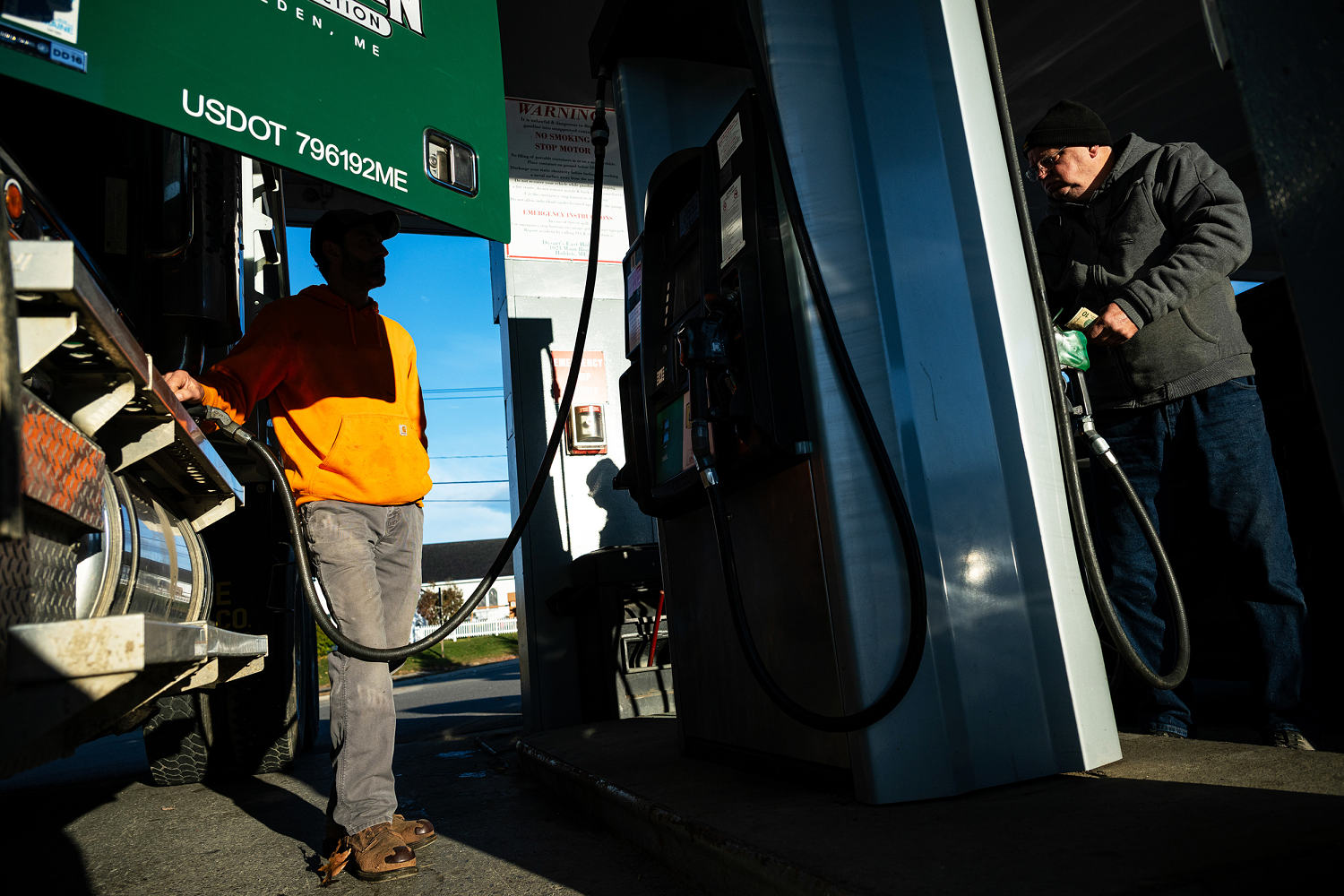
As a result of the newly-set market expectations and the decline in oil prices, consumer relief at the pump was swift, with more likely in coming days. The nationwide average regular gas price, which was $4.14 on election day, has already fallen to $3.97.
Diesel prices have also fallen sharply in recent days, from $6.28 per gallon on election day, to $6.15, which could take even more pressure off consumers at the grocery store or during their holiday shopping trips.
The rise in diesel prices, economists say, can quickly spill over into inflation on grocery and department store shelves, given that the fuel is critical for transporting goods around the country and world on trains, ships and trucks.
The rise in diesel has been far more than the rise in gas prices, with the commercial fuel still elevated by more than 70% since the start of the year, due to not only the Iran war but also continued attacks on energy infrastructure in the Ukraine-Russia war.
Ukrainian President Volodymyr Zelenskyy has promised to continue striking Russian energy assets, in retaliation for attacks on Ukraine. Russia has historically been one of the largest diesel exporters to the rest of the world.
The U.S. is hosting talks between Russia and Ukraine n Abu Dhabi on Tuesday, the first trilateral negotiations since February.
But analysts warn that oil markets still face several significant risks, which could limit further downside, or spark another price surge.
“How all this plays out is still highly uncertain,” said ING’s team, adding that in their assessment “the degree and speed to which the oil market has sold off seems to be overdone.”
Oil markets will also need to support the refilling of hundreds of millions of barrels of reserves that have been emptied this year in an attempt to keep a lid on prices. The U.S. strategic petroleum reserve currently contains the smallest amount of crude oil since 1982.
Citigroup commodities analysts noted that “the period between now and January 3rd, when the new Democratic Congress is seated, is a ‘lame duck’ window during which the White House could seek to advance foreign policy objectives as well as personnel changes with fewer political constraints.”
“This period could see either accelerated dealmaking or renewed escalation, meaning markets could remain choppy even if the longer-term direction points to eventual diplomatic resolution,” Citi’s analysts wrote.
Already, Trump has announced some changes. On Friday, Susie Wiles left the White House as Trump’s chief of staff, replaced by Stephen Miller, the architect of the administration’s hard-line immigration crackdown.
Citi’s team also said that the recent Israeli elections could have implications for oil prices. “The recent inconclusive Israeli elections mean that Prime Minister Netanyahu could continue to pressure the US to be more hawkish on Iran for the moment.”
On Saturday, Netanyahu’s long tenure came a step closer to ending. Israeli president Isaac Herzog handed Netanyahu’s rival Gadi Eisenkot the chance to form the country’s next government. But, for at least the next six weeks, Netanyahu remains in place.
[Image text:] 0016
USDOT796192ME
VARNIN