
Technology
Indian Army’s four-legged robots give a new edge to border surveillance in J&K
Key Points
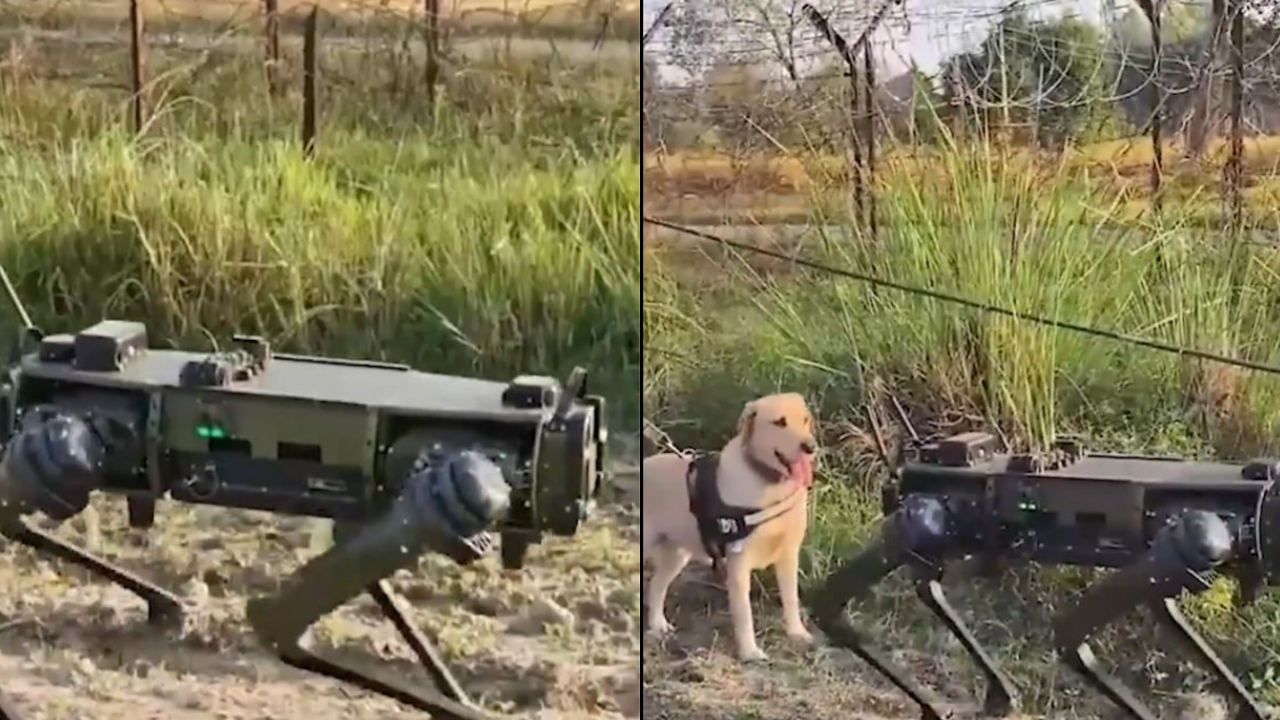
NEW DELHI: Indian Army has started a new chapter of border surveillance in Jammu & Kashmir where four-legged robots, along with their human colleagues and military dogs, are keeping a tight vigil in difficult terrains in forward areas. Besides introducing robots, Indian Army has modernised its border surveillance through artificial intelligence, high-tech sensors, smart-fencing and satellite integration and multi-agency intelligence coordination along the Line of Control (LoC). It has also...
NEW DELHI:
Indian Army has started a new chapter of border surveillance in Jammu & Kashmir where four-legged robots, along with their human colleagues and military dogs, are keeping a tight vigil in difficult terrains in forward areas.Besides introducing robots, Indian
Army has modernised its border surveillance through artificial intelligence, high-tech sensors, smart-fencing and satellite integration and multi-agency intelligence coordination along the
Line of Control (LoC).
It has also integrated laser-based counter-drone systems and laser-intrusion detection components along parts of the border in J&K.But the centre of attraction are the four-legged robotic units that have been patrolling the difficult terrains of the over 740-km-long LoC. Army received the first batch of 100 four-legged robotic units, known as MULE (multi-utility legged equipment) in June 2024 and has since extended their active deployment to sensitive border areas such as Akhnoor and Rajouri in J&K. Videos of these robotic mules patrolling in Akhnoor sector went viral recently.
“Hundreds of such robotic mules have already been deployed along the LoC and border in Jammu to strengthen surveillance systems. These machines have not only provided a new edge to border security with advanced technology and real-time intelligence in high-security sectors but also helped in providing logistics in rugged and difficult terrains in forward areas,” defence sources told TOI.
They also support ambush operations (during encounters with infiltrators or terrorists) and help track enemy movements.
The advantage of having such four-legged robotic chassis is that they can easily navigate rugged landscapes where traditional wheeled or tracked vehicles cannot reach; they can climb mountain slopes and walk easily on 45-degree inclines, snow-clad areas, in deserts and river crossings.
They have also been engineered to function reliably in harsh weather extremes, with operational temperatures typically ranging from -40°C to +55°C.The robotic units are also capable of carrying tactical payloads—of 12 kg to 15 kg -- such as ammunition, rations and fuel to reduce the physical burden on soldiers. They have been equipped with 360-degree cameras, electro-optics, thermal/infrared technology and radar systems for real-time threat detection and object recognition.