
Business & Finance
PUB trials remote-controlled pump vehicle, road sensors to tackle flooding
Key Points
PUB trials remote-controlled pump vehicle, road sensors to tackle flooding The pump vehicle can be remotely manoeuvred into flooded areas, navigating uneven terrain and staircases. SINGAPORE: A remote-controlled vehicle that can pump out floodwater and road sensors that monitor road surface water levels in real time are among the new tools being trialled by national water agency PUB to strengthen its flood response capabilities. The agency announced the initiatives on Thursday (Nov 12) ahead...
PUB trials remote-controlled pump vehicle, road sensors to tackle flooding
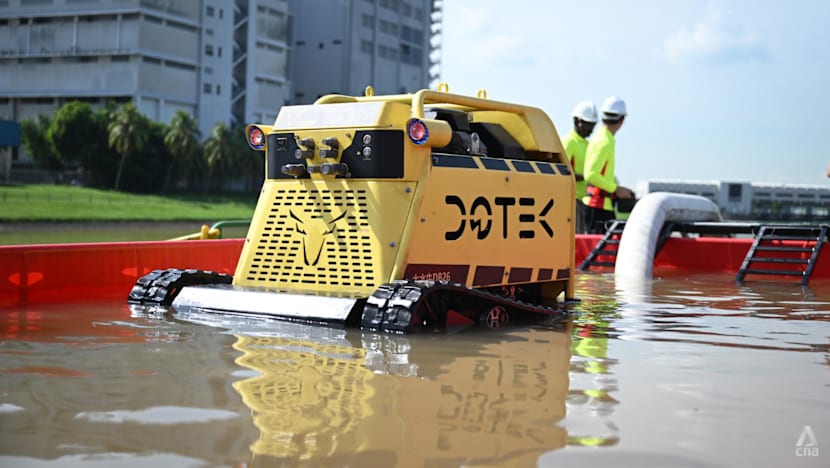
The pump vehicle can be remotely manoeuvred into flooded areas, navigating uneven terrain and staircases.
SINGAPORE: A remote-controlled vehicle that can pump out floodwater and road sensors that monitor road surface water levels in real time are among the new tools being trialled by national water agency PUB to strengthen its flood response capabilities.
The agency announced the initiatives on Thursday (Nov 12) ahead of the northeast monsoon season - typically between December and March - as it launched its third flood resilience campaign to encourage the public to be better prepared for floods.
While Singapore experienced frequent and severe flooding between the 1950s and 1980s, investments in drainage infrastructure over the years have reduced the flood-prone area from about 3,200ha in the 1970s to less than 25ha today.
However, flash floods still occur, particularly in low-lying areas.
COMPACT VEHICLE
PUB has started a one-year pilot of its remote-controlled pump vehicle to support flood response operations.
Unlike conventional pumping arrangements that require large vehicles, bulky generators and substantial manpower, the new vehicle is a compact, tracked mobile pumping platform that is designed for rapid deployment with minimal setup.
It can be remotely manoeuvred into flooded areas, navigating uneven terrain and staircases to pump out floodwater into nearby drainage systems.
Operators can control the vehicle from up to 100m away, minimising the need for workers to enter floods where there may be potential hazards, such as electrical installations in basements.
Besides basements, it can also help with flooded car parks and tunnels.
Conventional pumping methods can take up to a few hours to set up, depending on site conditions, and require at least three to four people on site.
In comparison, the remote-controlled vehicle requires one person to operate it, set up the hoses and ensure the area is clear.
During a media demonstration, a technician used a remote control to guide the vehicle up a ramp and into a pool containing about 15 cubic metres of water, simulating a flooded area.
Another technician attached the hoses to the vehicle before it entered the water. Once the vehicle was positioned in the pool, it began pumping water into the nearby canal.
The pool was drained within minutes.
The vehicle has a minimum pumping capacity of 500 cubic metres per hour – equivalent to draining an Olympic-sized swimming pool in five hours – and can operate continuously for at least seven hours without requiring a fuel top-up.
Its pumping capacity is twice that of current conventional portable pumps deployed by PUB-appointed contractors.
The vehicle can also be deployed at private premises, although property owners remain responsible for managing flooding on their premises.
It can also be used to accelerate the removal of floodwater in coastal areas during high tide coinciding with rainfall, when coastal tide gates are closed and stormwater cannot be discharged directly to the sea.
Asked if it will consider acquiring more pump vehicles, PUB said this would depend on the results of the pilot, including the speed of the vehicle’s deployment and pumping efficacy.
The agency said the pump vehicle is unlikely to replace conventional pumping equipment entirely, as there are multiple factors, including cost, to consider.
ROAD FLOOD SENSORS
PUB’s new road flood sensors provide automated, real-time monitoring of road surface water levels.
The devices are installed within the drop inlet chambers along road kerbs and are able to detect water as soon as it starts accumulating on the road surface.
PUB carried out a six-month trial from the end of 2025, covering the last monsoon season.
During the trial, 30 such sensors were installed in flood-prone locations and hotspots, such as King’s Road, Craig Road and Balmoral Road.
Following the encouraging results, PUB plans to extend the trial with 15 more sensors deployed at roadsides in locations prone to flooding.
The agency is also exploring deploying the sensors outside residential properties to provide earlier alerts for residents to protect their properties and vehicles.
The extended trial will also examine how road flood sensors can be integrated with existing monitoring measures – water level sensors and closed-circuit television (CCTV) video analytics – into a single, automated flood monitoring and alerting system.
"The integrated approach aims to improve the accuracy and timeliness of flood detection," PUB said in a press release.
"This would provide better situational awareness for flood response operations, and facilitate earlier flood alerts to the public.
“The system would also reduce manpower-intensive manual CCTV monitoring, enabling more scalable and cost-effective monitoring across PUB’s extensive monitoring network.”
More than 1,200 water level sensors have been deployed to monitor water levels in drains and canals islandwide. Together with over 700 closed-circuit television cameras, they provide round-the-clock remote monitoring of real-time ground conditions.
By the end of 2028, PUB aims to install about 500 additional water level sensors and 200 more CCTV cameras to expand monitoring coverage.
PUBLIC URGED TO BE READY
PUB’s third flood resilience campaign centres on two key messages: flash floods can happen anytime, anywhere and to anyone; and that everyone needs to be ready for floods.
The agency launched the Flood-Resilient Developments Guidebook in June, providing practical guidance, examples and case studies of developments that have successfully integrated flood-resilient designs and operational strategies.
It cited the Singapore Institute of Technology's Punggol campus and Funan mall as examples of developments that have incorporated features that alleviate or prevent floods.
PUB's Deputy Chief Executive of Flood Resilience Angela Koh said: “Flood resilience is not about being lucky and hoping for the best – it is about being prepared for the unexpected.
"PUB will continue to strengthen our flood monitoring, infrastructure and response capabilities, but building a flood-resilient Singapore takes all of us. By staying informed, acting early and taking steps to protect ourselves and our properties, we can reduce flood risks and strengthen Singapore’s resilience together.”