
Weather
What El Nino will mean for UK in 2027 as experts warn of 500,000 deaths
Key Points
What El Nino will mean for UK in 2027 as experts warn of 500,000 deaths El Nino has already surpassed the expected rise of +3C - Bookmark - CommentsGo to comments Become an Independent member to bookmark this article Already a member? Log in El Niño will cause “pandemic-scale mortality” across the world, epidemiologists have claimed, as the weather phenomenon has hit record-breaking levels. The World Meteorological Agency said El Nino will strengthen further and persist until at least 2027.
What El Nino will mean for UK in 2027 as experts warn of 500,000 deaths
El Nino has already surpassed the expected rise of +3C
- Bookmark
- CommentsGo to comments
Become an Independent member to bookmark this article
Already a member? Log in
El Niño will cause “pandemic-scale mortality” across the world, epidemiologists have claimed, as the weather phenomenon has hit record-breaking levels.
The World Meteorological Agency said El Nino will strengthen further and persist until at least 2027.
“The 2026-27 El Niño is going to cause pandemic-scale mortality,” Dr Colin Carlson, an assistant professor of epidemiology at Yale University, said, in an article in Think Global Health with Prof Christopher Callahan, a climate scientist at Indiana University.
In a sinister prediction, he warned that half a million people would die from extreme heat alone, while epidemics of dengue fever, cholera, and other infectious diseases could also occur at the same time.
El Niño could cause as many as 451,000 excess deaths between June 2026 and February 2027, according to research by the University of Chicago’s Climate Impact Lab, The Telegraph reported.
The weather phenomenon is having a significant impact across the globe causing reduced monsoon rain in India, a quiet hurricane season in the Atlantic while the east Pacific sees an active one, there are strong typhoons in East China and Japan and droughts in Indonesia.
What does this mean for the UK?
Next year is forecast to be the hottest on record in the UK due to an “unprecedented” El Niño event, the Met Office has warned.
The summer of 2026 was declared to be the UK’s hottest since records began, but the El Niño is forecast to continue raise sea temperatures, with the Met Office warning it would make the weather event “the largest since the 19th century”.
El Niño is a phenomenon linked to climate change that is declared when sea temperatures in the eastern Pacific rise 0.5C above the long-term average. The weather pattern usually takes place every two to seven years and lasts several months and impacts rainfall and average temperatures across the globe.
This year’s El Niño is “very strong” and is strengthening, with live monitors revealing the sea temperature has risen by 0.5C in the past four weeks alone to +3.3C — an increase from +2.8C on September 9.
Temperatures have now sat at +3.3C since October 7 and as of October 18, the El Niño has caused sea temperatures to sit above 0.5C for 27 weeks.
For context, data from the National Oceanic and Atmospheric Administration (NOAA) reveals that in September this year temperatures were recorded at +3.39C, while in 2015 they were +1.80C and in 1997 they were +2.38C.
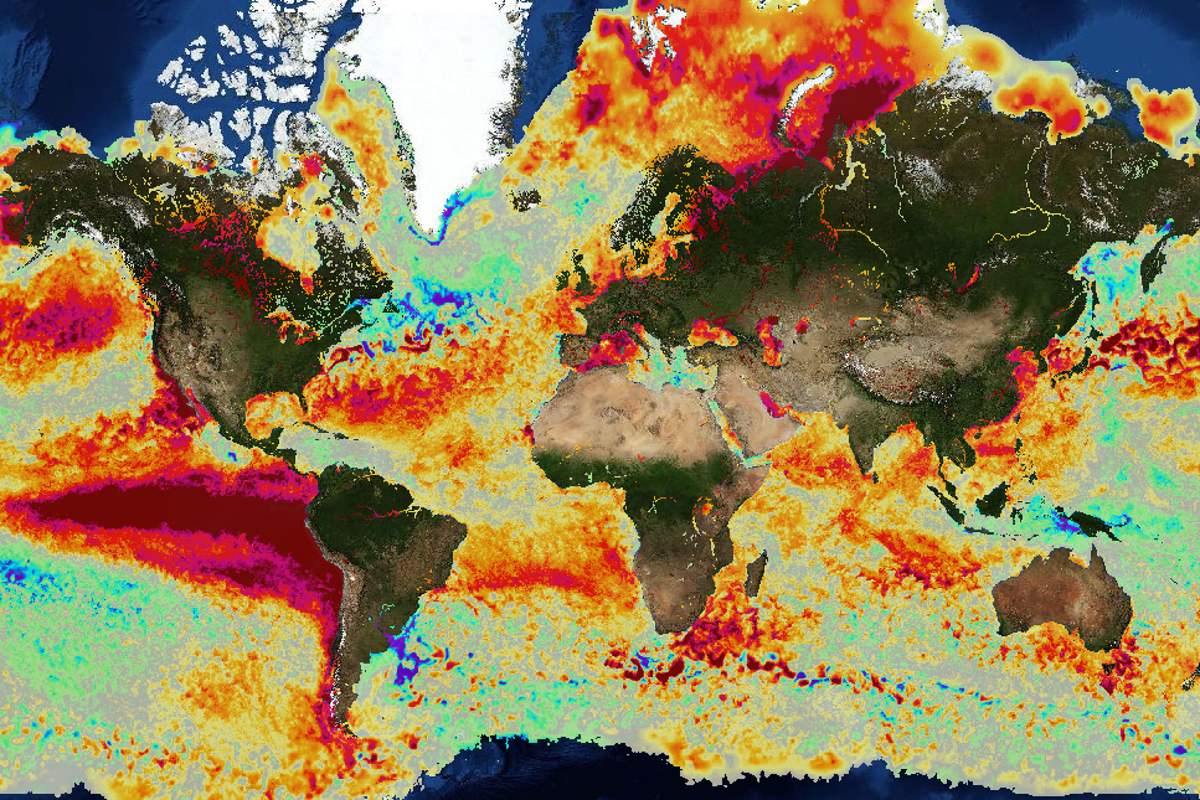
Global heat maps show extreme heat forming in the Pacific Ocean off the coast of South America.
But there are also pockets of warmer sea temperatures surrounding the south of the UK and parts of the North Sea.
Experts have suggested the weather in the UK will not change drastically, but “the price of coffee and chocolate, the cost of reinsurance, the timing of Asian shipping, and the odds that 2027 sets a global temperature record” will all impact the UK and Europe, according to NOAA.
“We should be clear that this is an unprecedented event,” Professor Adam Scaife, head of long-range forecasting at the Met Office, said.
A typical El Niño leads to a sea temperature rise of between 1-2C, with 2C being a “really big event”, Mr Scaife said, noting that it had already surpassed the expected rise of +3C.
Speaking to BBC Radio 4’s Today programme, Mr Scaife added: “I have not seen an event like this developing in our forecasts before. And assuming the forecasts are correct – and many other centres are giving the same signals – then we’re expecting the biggest El Niño for over a century, peaking at something over 3C.
“That is unheard of in modern climate records.”
The UK is also forecast to experience more storms and rain over the coming autumn and winter due to the El Niño weather pattern.
Mr Scaife explained that the impacts of the weather phenomenon are strongest in the tropics, in regions like South America and the West Pacific.
“And then there are wave-like disturbances that come out from the tropics and affect places like the UK,” he said.
“So we already see signals for increased rainfall and storminess in the autumn here in the UK around November time.”
Water supplies have been significantly impacted by record breaking temperatures this summer leaving reservoirs depleted.
Water companies have now been told to conduct daily monitoring of reservoir and river levels and the Environment Agency will increase checks on businesses that withdraw water from natural sources to ensure they are only taking permitted quantities of water.
The announcement was made by the Environment Agency following a meeting of the National Drought Group and declared parts of Cornwall, Devon, Dorset, Somerset, East Sussex and West Sussex are in severe drought.
Rainfall was 80 per cent lower than average in September in some areas raising the threat of dwindling water supplies.
In August, 71.3 per cent of England was in drought, while the North East and Yorkshire was under a “prolonged dry weather” status.
In October, Yorkshire joined ten other regions in England in drought, leaving just the Northeast, Cumbria and Lancashire and Greater Manchester, Merseyside and Cheshire with prolonged dry weather status.
Research by the Environment Agency shows England needs 20 per cent more rainfall than average until the end of April for all of the areas to emerge from drought status.
Join our commenting forum
Join thought-provoking conversations, follow other Independent readers and see their replies
Comments
El Nino (LOCATION)
UK (LOCATION)
Independent (ORG)
El Niño (LOCATION)
The World Meteorological Agency (ORG)
Colin Carlson (PERSON)
Yale University (ORG)
Think Global Health (ORG)
Christopher Callahan (PERSON)
Indiana University (ORG)
the University of Chicago’s Climate Impact Lab (ORG)
Telegraph (LOCATION)
India (LOCATION)
Atlantic (LOCATION)
the east Pacific (LOCATION)