
Science
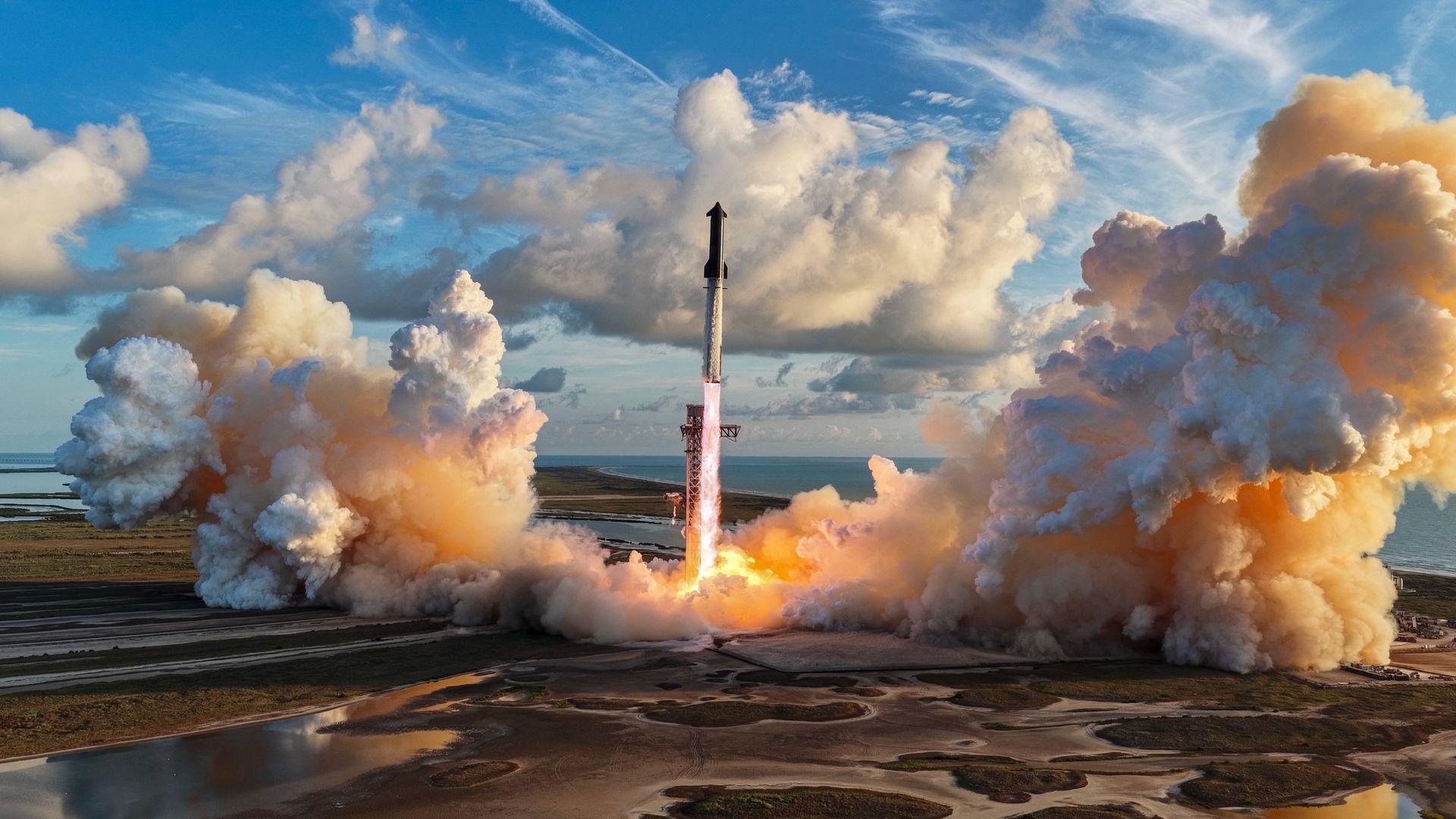
Double-catch drama: Why Starship's Flight 15 is so important to SpaceX
Key Points
Double-catch drama: Why Starship's Flight 15 is so important to SpaceX "This is the critical breakthrough needed to make life multiplanetary." Having reached orbit for the first time with Starship last time out, SpaceX is looking to take a huge stride toward full reusability with Flight 15 — the first attempt to catch the megarocket's Ship upper stage, as the company eyes hourly launches by 2030. SpaceX is targeting today (Nov. 13) for Starship's 15th flight, which will lift off from the...
Double-catch drama: Why Starship's Flight 15 is so important to SpaceX
"This is the critical breakthrough needed to make life multiplanetary."
Having reached orbit for the first time with Starship last time out, SpaceX is looking to take a huge stride toward full reusability with Flight 15 — the first attempt to catch the megarocket's Ship upper stage, as the company eyes hourly launches by 2030.
SpaceX is targeting today (Nov. 13) for Starship's 15th flight, which will lift off from the company's Starbas site in South Texas. If all goes well, the mission — which you can watch here at Space.com — will end on Saturday (Nov. 14) with the first attempt at what SpaceX itself calls the "Holy Grail of rocketry": Catching both Starship's Super Heavy booster and Ship upper stage chopstick-style back at the launch pad.
"If successful, this will mark the first full recovery of an orbital launch system and a breakthrough moment in making Starship a reliable, rapidly reusable rocket," SpaceX wrote in its Flight 15 mission description.
The 75-minute Flight 15 launch window opens today at 5:45 p.m. EST (2245 GMT), and a number of Starship firsts are planned for early in the flight. For example, while SpaceX has caught three Super Heavy boosters and reused two of them to date, the first attempt to catch a next-gen Super Heavy "V3" vehicle will come today, around 6.5 minutes after liftoff.
If the Ship upper stage gets the go-ahead for orbital insertion, it will deploy 26 Starlink V3 satellites — designed especially for use on Starship — into low Earth orbit (LEO), starting about 35 minutes after launch. Then, 21 hours later, if "internally developed, and FAA-approved, conditions" for a return to Starbase and catch are met — including on-orbit assessment of Ship's heat shield by three of the V3 satellites — SpaceX will attempt to recover the orbital upper stage.
This landmark try will follow the first-ever Ship reentry over inhabited areas, as the vehicle will maneuver its way over sparsely populated regions of northern Mexico and southern Texas. (On previous missions, Ship has splashed down in the open ocean.) It will head back to Starbase and make a bellyflop maneuver as it descends to the site's Pad 2 before flipping itself vertical, ready for embrace of the launch tower's waiting mechanical arms.
"SpaceX will attempt to catch both the Super Heavy booster and Starship on the upcoming flight. If both are successful, it will mark the first time that all parts of an orbital rocket return to Earth intact," Elon Musk said via X, the social media platform he owns, on Nov. 6. "This is the critical breakthrough needed to make life multiplanetary."
The catch
Half of the system is already proven. With catching and reflying boosters largely established, the next and unprecedented step is catching Ship. This is no easy task. The vehicle, returning from orbital speeds, must survive the heat of reentry, make its way precisely back to the pad put itself in position to be caught by the tower's "chopstick" arms. The full recovery of an orbital launch system would, in the words of SpaceX, be a "breakthrough moment in making Starship a reliable, rapidly reusable rocket" and would open the "door to airplane-like cadence."
A successful catch would allow SpaceX to then work on refurbishing Ship for reflight, the next challenge of full reusability. Musk said in August in a SpaceX earnings call that the company will aim to refly the Super Heavy and Ship early next year.
SpaceX has a lot of experience with rocket reuse, as its workhorse Falcon 9 rocket pioneered the practice. But the company is eyeing another level of reflight with Starship: It's targeting roughly 10,000 launches of the megarocket per year by 2030, which works out to more than one launch per hour.
"We're aiming to reach 30+ Starship launches/day in 2030, which is ~10k annualized," Musk posted on X in August.
Why so many launches?
The company has repeated that figure to regulators. In comments filed with the U.S. Federal Aviation Administration in late October, it said that "SpaceX anticipates conducting 10,000 launches per year itself." Meanwhile, the recently signed National Space Transportation Policy aims to boost the U.S.'s capabilities to support more than 1,000 rocket launches per year by 2030.
Musk added that SpaceX's planned Starbase Louisiana site alone could support that many Starship launches. For context: SpaceX launched 165 Falcon 9 missions in 2025, and that was about half of the global total for orbital flights.
Why is SpaceX targeting this incredible increase in launch cadence? It wants to build satellite megaconstellations that dwarf anything the world has ever seen.
The company's V3 Starlink satellites are too large to fly efficiently on the Falcon 9. Each one of the next-gen spacecraft adds 1 terabit of capacity to SpaceX's broadband network, and the 26 flying on Flight 15 are equivalent to around 10 Falcon 9 launches packed with Starlink V2 Mini satellites, according to SpaceX. And the company wants to put a staggering 100,000 V3 Starlink satellites into orbit. (There are currently about 11,000 current-gen Starlink satellites in orbit, and that's by far the largest satellite network assembled to date.)
SpaceX's Starmind project blows even this figure out of the water. SpaceX wants to launch up to 1 million satellites to serve as orbital AI data centers, and it appears to be making the moves terrestrially regarding the hardware. On Nov. 10, German firm Singulus Technologies announced a contract worth more than 60 million euros for a solar cell production line for Starmind satellites, which SpaceX builds in Bastrop, Texas. Musk said the order covers equipment for 100 gigawatts of solar cells per year. In terms of orbital hardware, the project is only feasible if SpaceX can reach its targeted "airplane-like cadence."
The gap
The gap between SpaceX's vision and the situation today is vast. Starship flew four times in 2024 and five times in 2025, and Flight 15 would be its fourth launch of 2026. Musk said on the earnings call that he expects Starship to fly weekly at some point in the first half of 2027, and twice weekly or more by the end of that year. Starbase in Texas is currently authorized for 25 launches per year, and the Louisiana site is not expected to host a launch before 2029.
Even a perfect outing for Flight 15 and two clean catches will leave lots of work to do. SpaceX will then need to demonstrate reflight with Ship, after assessing the impact on its heat shield system. Then comes orbital refueling, which is a necessary step for any Starship trip beyond LEO and a requirement for SpaceX's commitment to NASA's Artemis program of moon exploration. It's unclear how many tanker flights and refuelings will be needed to make a lunar mission possible, but, whatever the number, Starship will probably need to be rapidly reusable. Another step is carrying people. SpaceX has tested life support hardware on the ground in a crew cabin for the moon lander version of Starship that it is building for NASA, but no Starship has flown with such a system.
There are no guarantees for Flight 15. Ship will only be cleared for a return to Starbase and a catch attempt if it meets safety checks after reaching orbit, which itself is an achievement not to be taken for granted. Flight controllers may end up needing to bring Ship down in the Pacific Ocean or divert its reentry into the Gulf late into flight.
Musk told investors last month that success on this flight is "more likely than not." Whatever happens today and on Saturday, the measure of Starship's progress will soon shift from whether SpaceX can catch a Ship to how quickly it can launch one again.
Andrew is a freelance space journalist with a focus on reporting on China's rapidly growing space sector. He began writing for Space.com in 2019 and writes for SpaceNews, IEEE Spectrum, National Geographic, Sky & Telescope, New Scientist and others. Andrew first caught the space bug when, as a youngster, he saw Voyager images of other worlds in our solar system for the first time. Away from space, Andrew enjoys trail running in the forests of Finland. You can follow him on Twitter @AJ_FI.
You must confirm your public display name before commenting
Please logout and then login again, you will then be prompted to enter your display name.