
Sport
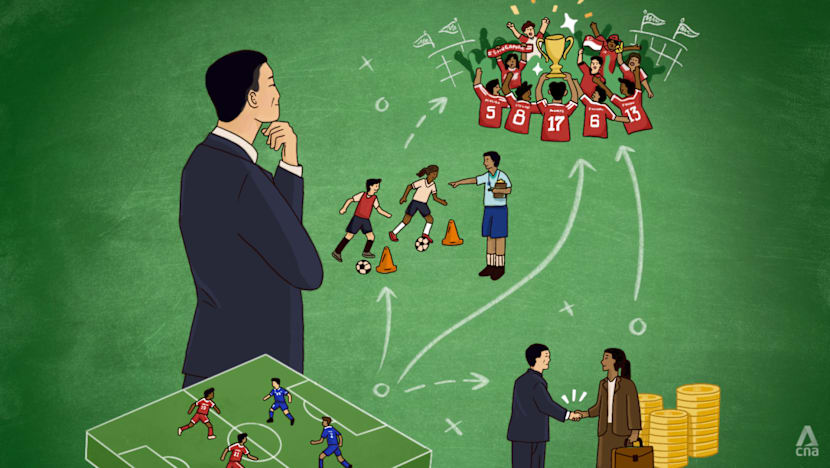
Forrest Li has given Singapore football a lift, but can he build a legacy that lasts?
Key Points
Forrest Li has given Singapore football a lift, but can he build a legacy that lasts? With the Asian Cup pushed back to December 2027, Singapore faces fresh questions over its ageing senior players and whether younger talent can step up. When Mr Forrest Li first assumed the reins as president of the Football Association of Singapore (FAS) in April 2025, he was taking on what many thought was an impossible mission: the revitalisation of Singapore football.
Forrest Li has given Singapore football a lift, but can he build a legacy that lasts?
With the Asian Cup pushed back to December 2027, Singapore faces fresh questions over its ageing senior players and whether younger talent can step up.
When Mr Forrest Li first assumed the reins as president of the Football Association of Singapore (FAS) in April 2025, he was taking on what many thought was an impossible mission: the revitalisation of Singapore football.
The billionaire pledged to raise the standard of football and bring "positive energy" back to the sport.
The naturalised Singapore citizen in his late 40s was born in China and is best known as the founder of Sea Group, the technology giant behind e-commerce platform Shopee and gaming platform Garena. Media company Forbes estimated Mr Li's wealth at about S$6.3billion (US$4.9 billion).
His foray into a sport held back by public apathy and poor national team performances was seen as an injection of much-needed star power and ambition.
He had his work cut out for him. Although the association's most visible successes and shortcomings are reflected in the men's national team, FAS also oversees domestic leagues, youth development, women's football and commercial development, among other things.
He quickly rolled up his sleeves. In August 2025, Mr Li said that the national team's immediate goal was to qualify for the Asian Cup. He committed to a financial incentive structure under which players' win bonuses were tripled and local training allowances almost doubled.
The team achieved that goal in November last year, when Singapore beat Hong Kong 2-1 away from home to qualify for the Asian Cup for the first time on merit under then-interim coach Gavin Lee.
To mark the achievement, Mr Li announced a S$2 million reward for the team.
Shortly after the historic match, Mr Li appointed Mr Lee as permanent national coach. Results have generally been positive since then.
The win rate of the Singapore men's national team rose from 25 per cent in 2024 to 40 per cent in 2025, when Mr Li became FAS president, and to 50 per cent as of Nov 12, 2026.
But there have been setbacks, too. Still fresh in the minds of many supporters is the 6-0 mauling by arch-rivals Malaysia in October.
The humbling FIFA ASEAN Cup defeat may have been a sobering reality check, but it is hard to deny the Lions' progress under Mr Lee.
After all, Singapore has produced encouraging performances this year, including draws with regional powerhouses Vietnam and Indonesia and their first away win over Thailand in 14 years.
Mr Li has also backed his commitment to Singapore football with substantial funding. Earlier this year, his company Sea pledged S$50 million, with an initial S$10 million already donated to FAS.
The money will support the long-term development of football in Singapore, the association said in March.
Beyond the national team, Mr Li has also pledged to build a stronger football ecosystem, with improved youth development and a more competitive domestic league.
But how much progress has been made on these fronts in his first 18 months as FAS president?
Analysts who spoke to CNA described Mr Li's passion project as a work in progress.
CNA sought an interview with Mr Li, but he declined the request. FAS instead responded through its general secretary, Mr Badri Ghent, who said the association's goal was to "bring the pride and joy back to Singapore football".
"We are working to build more competitive teams, raise standards and professionalism across the sport, and make the game more inclusive," he said.
"This means strengthening support for our players and clubs, while developing clearer pathways for the next generation to fulfil their potential."
Former football commentator Edwin Yeo said the "most visible" change under Mr Li's FAS presidency was the national team's improvement following increased funding.
"A football association isn't just about the men's national team. It's about the administration of the sport of football across all ecosystems," he said.
These responsibilities include youth development and the management of the Singapore Premier League (SPL).
"If you look at everything else, in the most neutral way, we can say that the jury is still out," Mr Yeo added.
NATIONAL TEAM'S PERFORMANCE
Despite recent mixed results, pundits and fans agreed that Mr Li had done a satisfactory job overseeing the national team.
His decision to appoint Mr Lee as permanent head coach has so far proved to be the right one, they said.
Mr Yeo said Mr Lee's appointment could initially have seemed "hasty", given the young coach's relative inexperience in international football.
But the 36-year-old has since proved his detractors wrong.
Mr Lee was coaching Tampines Rovers FC when then-national head coach Tsutomu Ogura recruited him to join the Lions' coaching team in 2024.
He later became an assistant coach and took over as interim head coach following Mr Ogura's departure in 2025, before securing the permanent role.
Mr Yeo, a former FAS communications consultant, said that he had seen firsthand how Mr Lee developed under Mr Ogura's guidance.
After taking charge, Mr Lee built on Mr Ogura's philosophy, emphasising tactical discipline and organisation. Players were expected to maintain positional awareness both on and off the ball, Mr Yeo noted.
But Mr Lee also introduced his own style of play.
"Gavin had a more patient approach, which was to draw (opposing) attackers in, then play out from the back and attack from there," Mr Yeo said.
The defensive statistics suggest that these tactics have paid off.
In 2026, the Lions conceded an average of 1.4 goals per game, despite the 6-0 loss to Malaysia. That was close to the 1.2 goals per game recorded in 2025, and well below the 2.6 in 2024.
Football presenter and former professional footballer Rhysh Roshan Rai said that beyond tactics, Mr Lee instilled a "never give up" mentality in the team.
"He knows what he wants from his side, and we tend to see some of that on the pitch," Mr Rai added.
"He's able to extract a lot from some players who I feel, when it comes to the context of international football in the region, are technically not as good as some of our neighbours. But they are hardworking, they run a lot and they are certainly fighters for the team."
Mr Dil Amarasekara, a member of the Lions supporters' group SingaBrigade, agreed, pointing to Singapore's 1-3 loss to Thailand at the ASEAN Championship in August as an example of the team's fighting spirit.
The 36-year-old managing director of a laboratory equipment company said: "Thailand is probably the strongest team in our region, and our boys were not giving up, they were really fighting, and we could see it as well.
"Despite missing a penalty that could have made (the final score) 2-3, they just kept going, and the fans were responding to that."
Responding to CNA's queries, Mr Lee said that his goal had always been to "have a national team that Singaporeans can identify with – a team that never gives up despite the challenge in front of them, a team that always gives 100 per cent".
"In our football, we want people to see players willing to receive the ball under pressure, support one another and react together when we lose it," Mr Lee said.
He added that the team would "remain humble and hungry as we continue to try to earn the trust and belief of the people, and to give them more memorable nights like the one in Hong Kong".
Choosing a Singaporean coach to lead the national team was also a public relations masterstroke on Mr Li's part, Mr Yeo said.
"There was a huge public relations uptick with having a young local coach who just proved himself ... because one of the things that the football association has to do is get more fans to come and support the sport."
Former FAS general secretary Yazeen Buhari, who stepped down from the role in 2024, said he was encouraged by the national team's direction, particularly its ability to rally fan support.
"Whether at the stadium, in our homes, in the social media space or at public viewing venues, there is a renewed sense of excitement and belief surrounding our national team."
Mr Yazeen added that he had been involved in football for "long enough to appreciate that the good times will not always last, and that there will inevitably be bumps along the way".
"But speaking now as a fan, I think we can all recognise the shift in mindset among the Lions," he said.
"There is a growing sense of self-belief, a willingness to compete and importantly, a mentality of not fearing whoever stands in front of us."
Beyond appointing Mr Lee as head coach, Mr Li has also poured substantial resources into the national team's development.
FAS' annual reports showed that spending on the national team rose from S$2.63 million in the financial year 2024/2025 to S$4.65 million in 2025/2026 – a 77 per cent jump.
Asked about the increase in national team spending, FAS said that the Lions' backroom team has grown "several fold".
The expanded team includes more specialist coaches providing individualised training, dedicated performance analysts studying players and opponents, and a larger medical team supporting player care, injury prevention and recovery.
FAS also said that many staff members previously worked on old, slow laptops, while "only a handful even had an additional monitor".
"Most people would assume these basics were in place. They were not," the association said.
The old equipment has since been replaced with newer devices that "most offices take for granted", FAS said.
Mr Lee acknowledged that the team was now fortunate to have greater resources.
"But the question is, what do you do with the resources, right? Just because you got more resources doesn't mean you're going to become a better organisation," he said.
The national coach credited Mr Li with bringing in the right people to lead FAS.
For instance, Mr Li appointed Mr Ghent, the former sporting director of top SPL club Lion City Sailors, as FAS general secretary.
"With (Mr Li) leading the charge, I think he has brought in new changes, new people, new faces, to try to drive the whole organisation into a new direction," Mr Lee said. "The national team is just a consequence of that."
National team captain Hariss Harun agreed, saying that since Mr Li became FAS president, particularly following Singapore's qualification for the Asian Cup, the team had developed a greater sense of purpose.
"Previously maybe when you came to the national team, you felt a little bit more relaxed… we don't take things for granted, but things were done on a relaxed note," he said.
"Whereas now, I think there's a lot of purpose… Gavin has aligned the team in terms of how we want to play, how we carry ourselves off the pitch as well, and I think to a certain extent, the public can see that as well."
He added that with more resources flowing into the game, the situation was now "vastly different" from a couple of years ago in Singapore football.
"We're moving forward, but we have a lot, a lot of things to do. If you look at the top teams in Asia, that's where we aspire to be."
ASIAN CUP DELAY BRINGS MORE TIME, BUT NEW CHALLENGES
While the national team's performance has improved, questions remain over whether the Lions can mount a strong Asian Cup campaign and move Singapore closer to Mr Hariss' dream of becoming a regional football powerhouse.
The recent 6-0 pummelling by Malaysia has dampened an otherwise positive year for the Lions, pundits noted.
Mr Jose Raymond, founder of The Monitor Singapore, an independent football news and commentary site, cautioned against overplaying the significance of Singapore's Asian Cup qualification almost a year ago.
"The thing which we have going for us was the qualification to the Asian Cup, but if you keep referring just to that one point over and over again, it's what I call a confirmation bias," he said.
As of November, Singapore is the lowest-ranked team to have qualified for the Asian Cup and will face Tajikistan, Iraq and Australia in the group stages.
The Asian Cup, originally scheduled to be held in Saudi Arabia early next year, has been pushed back to December 2027 following recent attacks on the country.
Mr Raymond questioned whether Mr Lee had enough international experience to guide Singapore against stronger opponents at the Asian Cup, given the team's struggles against regional rivals.
"Indonesia, Malaysia, these teams are really performing at a different level, and we saw where we stood," he said.
"There's a combination of things which we have to do, whether it's foreign talent or whether it's having a coach who knows how to navigate past a team which is very physically strong and fast like Malaysia or who's got physical presence like Indonesia," Mr Raymond added.
Mr Lee said that Singapore's performance against Malaysia was "not good enough" and took responsibility for the defeat as head coach.
However, he stressed the need for a fair assessment of the team, "without letting either a good result or a poor one decide everything we think about the team".
The postponement gives Singapore more time to prepare for the Asian Cup, but Mr Lee warned that arranging friendlies against stronger opponents could become more difficult.
He said that the 2027 international football calendar could be crowded with competitive matches, including World Cup qualifiers, Asian Cup qualifiers and ASEAN competitions, leaving fewer opportunities for such friendlies.
This could complicate the Lions' preparations.
Mr Lee had said last year that the Lions must play stronger teams ahead of the Asian Cup, even at the risk of defeat, to test themselves against tougher opposition.
"The question for us is, can we find other solutions to help make sure our players arrive in the best possible way? It is still a work in progress because the news (of the postponement) broke not too long ago," he said.
However, Mr James Walton, Asia-Pacific sports business group leader at professional services firm Deloitte, cautioned against exposing players to too many potentially demoralising defeats.
He said it was important to "get the balance right, as there's no point getting players demoralised either".
The postponement also means that the Asian Cup will now take place after Mr Lee's 18-month contract as national head coach expires in May 2027.
Mr Walton said that the coach should be given more time, arguing that the delay should not affect the faith placed in him.
"To me, we trusted Gavin enough to go into this tournament as a young, promising coach, still learning his way in international football," Mr Walton added.
"I don't think anything should change in terms of the trust placed onto Gavin, just because the tournament was delayed."
Mr Lee said that he had discussed his contract with the FAS executive committee and that an announcement would be made "in due time".
Another challenge posed by the Asian Cup's postponement is the ageing national squad, Mr Rai said.
He noted that captain Hariss Harun and goalkeeper Izwan Mahbud will both be 37, while defender Safuwan Baharudin will be 36, when the tournament kicks off at the end of 2027.
"How much longer can they hang on, because they are still crucial players?" Mr Rai asked. "What is the situation going to be when the tournament kicks off at the end of next year, what sort of condition are they going to be in?"
ActiveSG Football Academy lead coach Rafi Ali said younger players should use the additional time to prove themselves and stake a claim for a place in the national team.
"More young players should come knocking on the door, and give Gavin a good headache for selection," the former national player added.
"We need to have another Hariss Harun, we need to have another Safuwan, we need to have another Izwan, because they are senior players and their age is catching up."
Mr Lee said he welcomed younger players stepping up.
"Our premise has also always been: if you're good enough, you're old enough. If you're good enough, you're young enough. So, age is really irrelevant," he said.
"As long as you can deliver the goods, we will consider you to be part of that team."
Captain Hariss said he was "more than happy" to see young players come forward and stake a claim for a place in the team.
"I'm more than happy to play my role as well, wherever that may be, because obviously these younger players are the future, they're going to lead the team in the next five, 10, 15 years," he added.
WHERE WILL THE NEXT GENERATION COME FROM?
With key players moving beyond their prime, developing a stronger pipeline of young talent will be crucial to sustaining the national team's momentum, analysts said.
Some, however, felt youth development had taken a back seat to strengthening the senior men's team.
Mr Raymond pointed to a 35 per cent drop in spending on youth and football development, from S$4.58 million in 2024/2025 to S$2.96 million in 2025/2026.
He described the youth football development plan as "messy".
"You've got Singapore Sports School, you've got National Development Centre, and then you've got Unleash the Roar! (UTR!), and then you've got the clubs doing their own thing… who's in charge, and what exactly is the grand plan here?" Mr Raymond said.
Announced in 2021, UTR! aims to raise standards in local football and develop a stronger pipeline of Singaporean players. The project includes talent identification, overseas scholarships for promising players and specialised elite football training.
Mr Yeo pointed to the results of Singapore's youth teams. The under-23 squad suffered a string of defeats in last year's U-23 Asian Cup qualifiers and SEA Games, and won just one of three matches this year.
The under-17 squad fared little better, winning just two of its nine matches.
He added that few players emerging from youth development pathways had shown the potential to break into the national team.
"In the one-and-a-half years (of Mr Li's tenure as FAS president), they are not exactly seeing the youngsters rising to a level where you think, oh, this is a potential superstar in the future.
"But I don't want to prejudge it, because I think one-and-a-half years in terms of football is not really that long," Mr Yeo said.
In his message in the FAS' latest annual report, published in September, Mr Li said that the association had worked with UTR! and Sport Singapore to establish the Singapore Premier Youth League (SPYL) in August 2026.
He described the SPYL as a "key platform to bring our youth development to the next level, by providing our most promising players with consistent, meaningful, challenging competition".
Mr Li added that the clearer pathway from youth to senior football would help strengthen Singapore's pipeline of professional players.
Mr Rafi, who coaches young players at the ActiveSG Football Academy, said that the SPYL provided an important platform for them to play competitive matches every week.
Before the league was established, competitive opportunities for young players were largely limited to school leagues and the National Development Centre, an elite youth football pathway.
"We need to continue this league and get many more kids, they need these games to increase the level of competition, so the standard of football can be increased," he added.
In addition to the SPYL, FAS said that it would provide more funding for the Young Lions, a developmental team created by the association to groom under-23 national team prospects, to improve daily training and competition standards.
National age-group teams would also receive stronger coaching and technical support, backed by expanded staffing and improved medical care, FAS added.
SingaBrigade member Dil said that nurturing young talent and strengthening the senior men's team must go hand in hand.
"It' not an either/or situation – a stronger national team inspires the next generation, and a stronger next gen inspires the national team," he said.
CAN THE REST OF THE SINGAPORE PREMIER LEAGUE CATCH UP?
The SPL's competitiveness has also come under scrutiny with concerns that Lion City Sailors' financial strength and concentration of top domestic talent could leave rival clubs struggling to keep pace.
In 2020, Mr Li's company Sea acquired Home United, one of Singapore's most successful football clubs, and rebranded it as Lion City Sailors.
With Mr Li as chairman and Sea's financial backing, the Sailors have enjoyed considerable success, securing back-to-back domestic league and cup doubles in the 2024-2025 and 2025-2026 seasons.
Of the 24 players named on Nov 4 for international friendlies against Paraguay and Brazil, 10 came from Lion City Sailors.
Another four came from Tampines Rovers, while each of the remaining six SPL clubs contributed no more than two players. No players from Tanjong Pagar United were called up.
Pundits warned that the perceived concentration of domestic talent at a single SPL club could limit opportunities for young players and hinder their development across the league.
Mr Raymond said that the other seven clubs would need to "go and hunt for more money to develop themselves" to compete with Lion City Sailors, which enjoys Mr Li's strong backing.
Without similar investment, other clubs could struggle to compete, leaving young players with fewer pathways to develop their talent, he cautioned.
Mr Raymond therefore stressed the importance of making the SPL more competitive.
"A strong Singaporean league will mean that our local players will be able to get opportunities to develop, and they will also be able to be in a much better position when they play at the national level," he said.
He added that higher-quality matches could also attract more fans, which would "help with the economics of running a club".
Mr Li said in his president's message that FAS was working to make the SPL "more exciting and competitive".
The prize pool more than doubled from S$290,000 to S$600,000 for the 2025-2026 season, before rising to a record S$1 million for the 2026-2027 season.
Mr Li also outlined plans for training programmes to improve refereeing standards.
National head coach Gavin Lee said that he and his team left no stone unturned in scouting footballing talent.
His coaching staff members watched every SPL match live, with "a lot of eyeballs on all the local players that are playing in the league".
Overseas-based players are also monitored through video footage, Mr Lee added.
BUILDING A GAME THAT CAN STAND ON ITS OWN
While Mr Li's first 18 months at the helm of FAS have brought fresh investment and renewed optimism, observers said the next phase would be crucial in determining whether these gains can be sustained.
Mr Yeo, the former FAS communications consultant, said that success should be measured not just by results on the pitch, but also by whether Singapore football can attract more fans and sponsors.
He pointed to sponsorship revenue and attendance at SPL matches as tangible indicators of progress, stressing that FAS must look beyond Lion City Sailors.
"Your job at FAS isn't just about Lion City Sailors, right? It's also about the other clubs. So are you able to get people more interested in the league? I think that that aspect of it is very important for FAS to consider," Mr Yeo added.
Mr Raymond said the Asian Cup's postponement could provide an opportunity to rally public support and attract a new generation of fans.
"The FAS has an opportunity right now to bring a country behind it as it goes towards the Asian Cup," he said.
To achieve this, FAS would need to improve standards in both the SPL and the national team to generate greater interest in local football.
But improving standards alone would not be enough, Mr Raymond said. Players also needed to engage more with fans through activities such as meet-and-greets.
"For every match the Lions play in, you want to have a strong base of fans who want to spend on Singapore football, because with that you will be able to reach out and get more sponsors, more money, and build the economy around football," he said.
Analysts also called for a clearer youth development plan.
Mr Yeo suggested better coordination among youth development pathways involving FAS, UTR! and individual clubs.
Such a plan should give aspiring footballers and their parents confidence that pursuing a professional career in the sport is a viable option, whether in Singapore or overseas, Mr Yeo said.
"(The blueprint) will never be 100 per cent correct, but at least there's a long-term vision."
Mr Raymond also questioned whether FAS had established a clear national football agenda, including preparations for the 2029 SEA Games on home ground.
Singapore national football head coach Gavin Lee says the Lions must test themselves against formidable opponents like Brazil and Paraguay to improve ahead of the 2027 Asian Cup. Ranked 149th in the world, Singapore will face both South American sides in the Mizuho Blue Challenge, which also features Japan. The Lions are also looking to bounce back from a humiliating 6-0 defeat by Malaysia at last month’s FIFA ASEAN Cup. Alif Amsyar reports.
Ultimately, Mr Yeo hopes that Singapore football could thrive without relying on Mr Li's personal involvement or financial backing.
"To have an ecosystem that hinges on one man contributing significantly is in some ways a very weak ecosystem," he said.
"If they use this opportunity of (Mr Li) pumping in money to build a very robust ecosystem that can survive him getting out of football, then I think that would be something good."
Mr Yeo suggested that FAS consider whether maintaining a professional domestic league would be financially viable in the long term, or whether Singapore should instead focus on developing players for professional careers in stronger overseas leagues.
He said either approach would require a clear, long-term blueprint to ensure the sustainability of Singapore football.
Mr Li said in his president's message that rebuilding Singapore football would require a collective effort involving clubs, partners, government agencies, schools, volunteers, parents and supporters.
He noted that sports brand Adidas and insurance provider MSIG had stepped forward as partners, and expressed hope that more would follow.
SingaBrigade member Dil also welcomed growing corporate interest in Singapore football.
"In the longer term, what I would like is to see if systems are set in place so that the entire ecosystem goes away from depending on one billionaire," he said.