
Politics
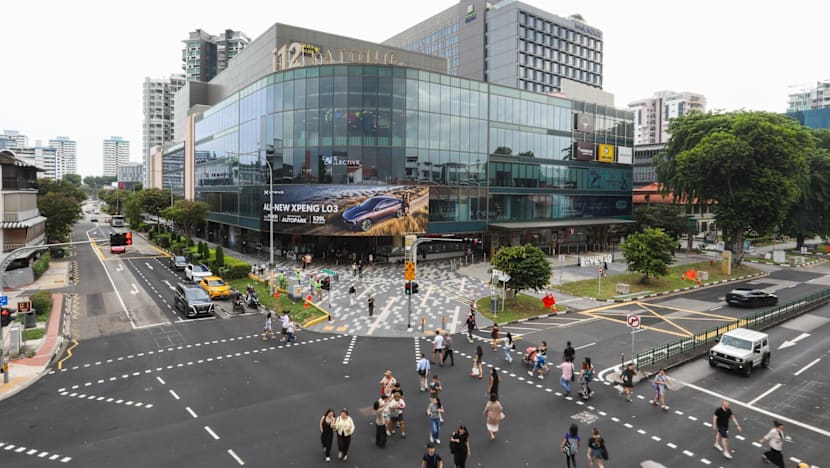
Safer, smoother, more fun: Joo Chiat's Shibuya-style crossing gets warm welcome from pedestrians, businesses
Key Points
Safer, smoother, more fun: Joo Chiat's Shibuya-style crossing gets warm welcome from pedestrians, businesses Residents and pedestrians are celebrating a faster, easier walk at the busy Joo Chiat Road junction, but some motorists are bemoaning longer waits and detours. SINGAPORE: Businesses and pedestrians welcomed a new “Shibuya-style” scramble crossing at Joo Chiat on Monday (Nov 16), although some voiced concerns about the impact on road traffic. The three-month trial at the junction of...
Safer, smoother, more fun: Joo Chiat's Shibuya-style crossing gets warm welcome from pedestrians, businesses
Residents and pedestrians are celebrating a faster, easier walk at the busy Joo Chiat Road junction, but some motorists are bemoaning longer waits and detours.
SINGAPORE: Businesses and pedestrians welcomed a new “Shibuya-style” scramble crossing at Joo Chiat on Monday (Nov 16), although some voiced concerns about the impact on road traffic.
The three-month trial at the junction of Joo Chiat Road and East Coast Road is part of ongoing efforts to improve traffic flow and enhance pedestrian safety.
During this time, pedestrians will be able to cross the road from all sides of an intersection, including diagonally, while vehicle movement in every direction is stopped for a short time.
Businesses were optimistic that the novelty of the crossing could bring more footfall to the area, even if temporarily.
"Katong-Joo Chiat continues to be a really exciting place, flooded with a lot of visitors. But really, because of (past car accidents), safety is a priority for us," said Mr Edmond Wong, president of the Katong-Joo Chiat Business Association.
Mr Wong helps run the rice dumpling store Kim Choo and was involved in discussions regarding the crossing.
While businesses told CNA it was still early to assess the overall impact on their business, the effect of the new crossing could already be felt.
Ms Cary Cheng, 64, who works at lifestyle shop The Wyld Shop, told CNA a customer had told her that morning that they had come to the area hoping to see "the Shibuya thing".
“Of course, we hope that (the crossing will) bring more people and traffic, but we don't know yet,” she said.
A NOVEL EXPERIENCE
When CNA arrived at around 10.30am, workers were still fixing the new traffic lights and marking the roads for the new pedestrian crossing. Traffic wardens were directing the flow of traffic, which grew heavier towards midday.
At around 11.30am, workers put up a sign stating “scramble walk on trial” at the traffic light in front of i12 Katong, prompting a few pedestrians to snap photos with their phones.
Around 2pm, the crossing was finally ready for use. CNA observed that pedestrians had to wait for up to 2 minutes and 5 seconds, and had about 35 seconds to cross.
The diagonal lane appeared to be well-utilised, although some pedestrians told CNA they were not aware that it was new.
A retiree who gave her name as Esther said she usually has to wait for about two minutes at each of the two traffic lights to get to the other side of the intersection diagonally.
The 70-year-old, who lives in Tokyo but resides in Marine Parade when she returns to Singapore, purposely stopped by the crossing on this day. She wanted to capture a video of the crossing to show her friends in Japan.
“Shibuya (crossing) is way better. But this is still better than nothing,” she said.
“The old way, (pedestrians have to) stop here, stop there … you have to wait for the lights," she said, adding that the new arrangement allowed her to more quickly and directly cross the junction diagonally.
Siblings Doris Lim and Kai Xiang Lim travelled all the way from Sengkang to see the new crossing. They arrived at around 12pm, had lunch in the area, then finally got to see the new system in action about two hours later.
“Very special, the design of the crossing,” said Ms Lim, 38, who works in the food-and-beverage industry. She added that they would come to Joo Chiat more often if they had the time to do so.
CONCERNS ABOUT TRAFFIC
Mr Tan Kay Chuan, 59, owner of AlibabaR, a bar in front of the intersection, reckoned footfall could increase in the first month due to the new crossing's novelty, though things might go back to normal after.
“It gives some safety to our place … and at the end of the day, it brings some fun element to this neighbourhood,” said Mr Tan, who is also the vice-president of the business association.
Still, some pedestrians who live in the area were concerned about how the new crossing would impact traffic conditions.
Resident Chan Shi Kai, 44, said pedestrians often crowd the junction, particularly on the corners where food establishments Awfully Chocolate and AlibabaR sit, while waiting to cross the road.
The new crossing could mean fewer people being “stuck in the corner”, but Mr Chan was uncertain about how drivers would be affected.
With the launch of the scramble crossing, the right turn from East Coast Road towards Joo Chiat Road is now permanently restricted.
Residents in the surrounding estates can still access their neighbourhood via alternative routes, LTA said in a letter to the area’s residents and business owners in October.
“Coming from the eastern side, we probably have to take Marine Parade Road and come straight through,” said the businessman.
Mr Jeremy Koh, 48, a long-time resident, said he would avoid the crossing as a driver once the trial kicks in.
“I decided it’s not worth the hassle … because you will have to wait longer,” he said, adding that he would have to take a few extra minutes to drive along Still Road or Marine Parade Road instead.
AlibabaR’s owner Mr Tan, who lives nearby, said traffic appeared to be “visibly smoother”, although cars would have to wait longer.
The closure of the right-turn lane also means his drive to work would take an additional five minutes.
However, said Mr Wong of Kim Choo, traffic also moves faster at green lights.
"There's no need for the vehicle to wait for the pedestrian crossing before they can make a left turn. So it's really smoother," he said.
"It's just the waiting time … we just have to get ourselves adjusted."
Marine Parade-Braddell Heights Member of Parliament Goh Pei Ming told CNA on Nov 11 that the initiative will be assessed to see if it becomes a permanent fixture.
The idea for the scramble crossing came from one of his grassroots leaders, said Mr Goh, who is senior minister of state for home affairs and for social and family development.
“Because this area is popular, this intersection is often busy. I have also observed instances where turning vehicles almost hit pedestrians,” he said.
MEASURING SUCCESS OF A SCRAMBLE CROSSING TRIAL
Scramble crossings are rare in Singapore, with just one at the junction of Robinson Road and Boon Tat Street, near the Lau Pa Sat hawker centre.
Singapore University of Technology and Design’s (SUTD) research assistant professor Samuel Chng said Joo Chiat is a “good place” to trial a scramble crossing, as a relatively compact junction with the mall, shophouses and eateries giving people reasons to cross in several directions.
"Think of someone holding a child’s hand or walking with an older parent. Even when the green man is on, part of their attention is on whether a turning driver has seen them," said Asst Prof Chng, who heads the Urban Psychology Lab in the Lee Kuan Yew Centre for Innovative Cities.
"Giving people a phase of their own in the traffic signalling takes away one decision they have to make in the middle of the road."
He added that the trial also builds on Joo Chiat’s recent car-free day, where people could walk at their own pace and spend time with neighbours.
“The crossing trial brings that idea into everyday life. A street becomes more liveable when an older resident feels comfortable walking to lunch, or when a parent feels at ease letting their child walk alongside them,” he said.
While assessing improvements to safety would be key, it would also be important to assess waiting times across a pedestrian’s entire journey, said Asst Prof Chng.
But in general, not all junctions will benefit from a scramble crossing, he said.
For instance, a junction with heavy footfall may gain little from a scramble crossing if most people already cross in one direction and the extra signal phase lengthens their wait, he noted.
Singapore previously trialled scramble intersections at Orchard Road in 2017 and 2006, but neither were made permanent.
Ms Ashlynn Loo, a director of land and concept development at the Singapore Tourism Board (STB), told CNA that the scramble crossing trial at the Orchard Road–Bideford Road junction in December 2006 was discontinued after six months as it did not meet the board's objective of “generating buzz and interest”.
The shorter-lived trial in 2017 at the Cairnhill Road–Orchard Road intersection aimed to serve a more functional purpose of providing pedestrians with easier access to activities on both sides of Orchard Road, Ms Loo said.
The trial, which ran every weekend and public holiday from Dec 16, 2017 to Jan 28, 2018, was introduced to complement STB’s mall activation programmes during the festive season, and was intended to conclude at the end of the activation period.
“During the trial, low pedestrian utilisation for the diagonal crossings and increased road congestion for motorists and public transport were also observed,” she said.
National University of Singapore’s (NUS) professor of geography TC Chang said a scramble crossing should not just serve “aesthetic purposes”, but bring convenience to pedestrians and add vitality to a place.
Apart from improving safety, the new scramble crossing also becomes part of placemaking – a people-centred approach to the planning and design of public space.
“You didn't really need to invest a whole lot of money to create some monument or create some fantastic artwork … You just have to change the traffic configuration,” he said.
Additional reporting by Fabian Koh
Joo Chiat's (PERSON)
Shibuya (LOCATION)
Joo Chiat Road (PERSON)
Joo Chiat (LOCATION)
East Coast Road (LOCATION)
Katong-Joo Chiat (PERSON)
Edmond Wong (PERSON)
Chiat Business Association (ORG)
Wong (PERSON)
Kim Choo (PERSON)
CNA (ORG)
Ms Cary Cheng (PERSON)
The Wyld Shop (ORG)
Katong (LOCATION)
Esther (PERSON)