
World News
Third US aircraft carrier arrives in Middle East as Trump keeps Iran war options open
Key Points
Third US aircraft carrier arrives in Middle East as Trump keeps Iran war options open Operating three aircraft carriers simultaneously in the Middle East is uncommon - Bookmark Become an Independent member to bookmark this article Already a member? Log in A third American aircraft carrier has reached the Middle East, U.S. Central Command announced in a social media post Monday, demonstrating naval force as President Donald Trump considers his next steps in the Iran conflict. The arrival of...
Third US aircraft carrier arrives in Middle East as Trump keeps Iran war options open
Operating three aircraft carriers simultaneously in the Middle East is uncommon
- Bookmark
Become an Independent member to bookmark this article
Already a member? Log in
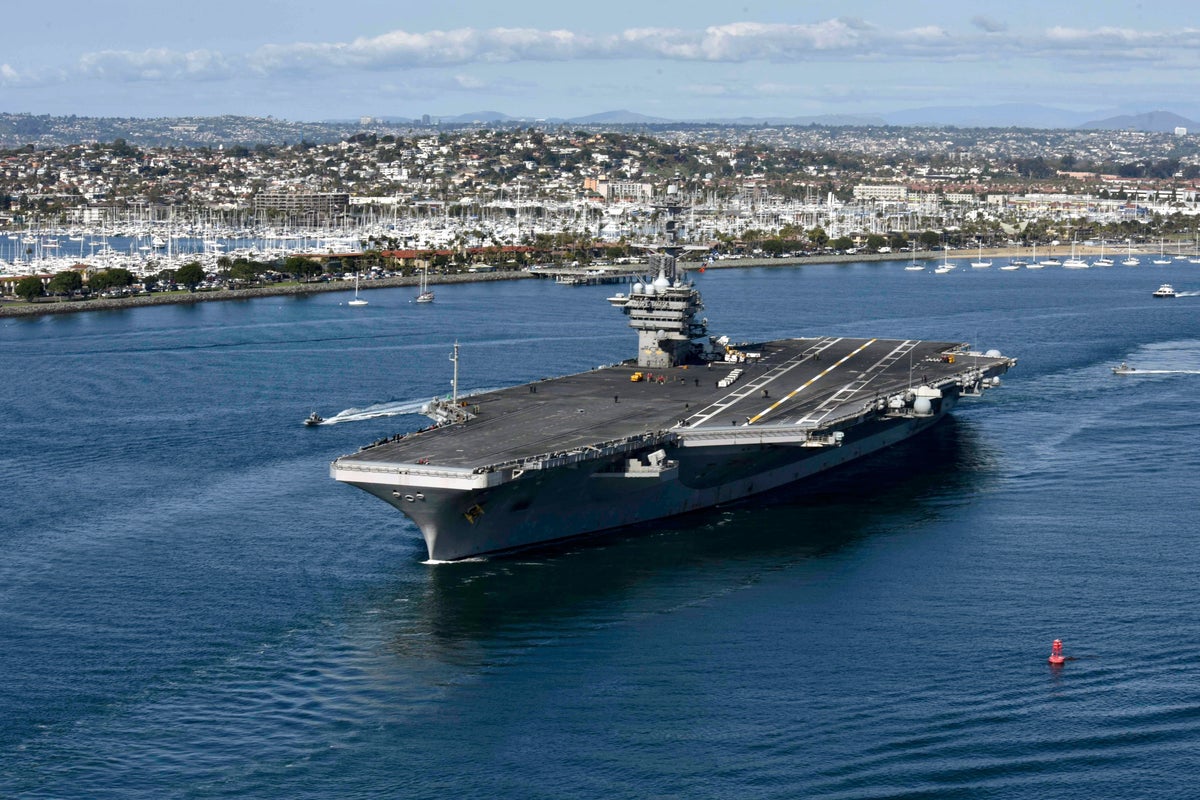
A third American aircraft carrier has reached the Middle East, U.S. Central Command announced in a social media post Monday, demonstrating naval force as President Donald Trump considers his next steps in the Iran conflict.
The arrival of the USS Theodore Roosevelt introduces thousands of troops to the region as Trump alternates between threatening further broad strikes on Iran and declaring that the more than eight-month-old war "militarily is effectively over."
Having departed San Diego in September, the Roosevelt and its strike force join the USS George H.W. Bush and USS George Washington, along with smaller Navy vessels enforcing a blockade on Iranian shipping.
Operating three aircraft carriers simultaneously in the Middle East is uncommon. The George H.W. Bush arrived in April and the George Washington in August. The U.S. Navy last positioned three carrier strike groups in the region in April, the first instance since 2003.
Alongside the three carriers, the U.S. naval force in the Arabian Sea includes 13 destroyers, two cruisers, and a littoral combat ship. Two additional destroyers are stationed in the Red Sea.
The Roosevelt deployed with the USS Makin Island amphibious readiness group, which includes the landing ships USS John P. Murtha and USS Anchorage, alongside roughly 2,000 Marines. Those ships have not yet reached the region.
The deployment follows midterm elections in which voters dealt severe losses to Trump's Republican Party, driven largely by opposition to the Iran war and its economic impact. The outcome led Vice President JD Vance to publicly break with Trump, writing on social media that "the reason we lost is the war."
Trump maintains the military campaign was necessary and has not ruled out renewing the conflict, which has remained stalled for months.
Last week, Trump warned Iran that the U.S. armed forces are "locked and loaded," adding that officials are observing Pickaxe Mountain, a site connected to Iran's nuclear program, for signs of activity.
"If something does not work out, I would not hesitate" to respond, Trump told conservative broadcast host Hugh Hewitt on Thursday.
However, Trump told reporters last week that additional major strikes were unlikely, declaring the war "militarily is effectively over" following a meeting with Qatar’s prime minister.
Trump also declared that Washington no longer needs a pact with Tehran, telling Vance — previously a key negotiator in ceasefire talks — to refocus on domestic anti-fraud efforts targeting Democratic-led cities and states.
Negotiations remain stalled over Iran's nuclear program, an element Trump insists must be included in any final deal. Tehran demands the U.S. first meet several conditions, including lifting the blockade restricting its crude oil exports.
Meanwhile, friction remains centered on the Strait of Hormuz, a key shipping channel where one-fifth of global oil passed prior to the conflict.
Commercial ships continue to face attacks and hazards, while U.S. forces have conducted limited strikes against Iranian targets near the passage and are escorting traffic through contested waters.
Iranian state television, citing naval divisions of the Revolutionary Guard and national army, warned shipping firms Monday that U.S.-escorted routes through the strait are hazardous due to mines.
Revolutionary Guard naval officials claimed mines have damaged six tankers since Sunday, causing oil pollution along the coast.
Elsewhere, a projectile struck a tanker attempting to navigate the strait, causing an engine room fire, though no casualties were reported, according to the United Kingdom Maritime Trade Organization.
U.S. Central Command stated it has redirected 150 merchant vessels and disabled five since June as part of the blockade.
Independent data from maritime tracking firm Lloyd’s List indicates that traffic through the strait remains under a third of prewar levels.