
Weather
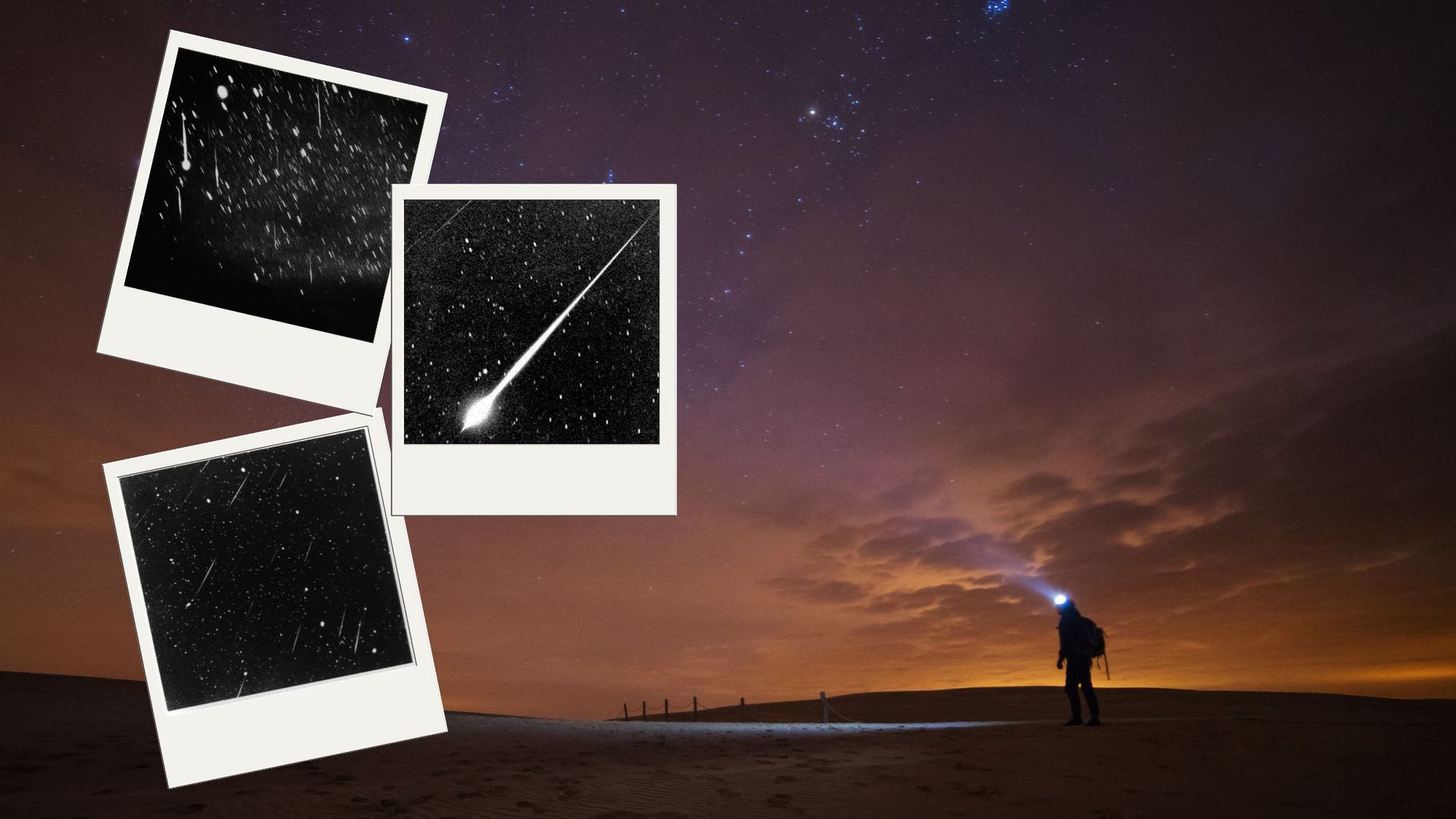
'It looked like every star in the sky was falling': Eyewitnesses remember the great Leonid meteor storm of 1966
Key Points
'It looked like every star in the sky was falling': Eyewitnesses remember the great Leonid meteor storm of 1966 It was a spectacle many regard as the greatest meteor display on record. Overnight Nov. 17-18, 1966, the Leonid meteor storm thrilled stargazers during one extraordinary night when the stars themselves looked as though they were falling from the sky. At the peak of the shower, observers at Kitt Peak National Observatory in Arizona estimated an astonishing 40 meteors per second...
'It looked like every star in the sky was falling': Eyewitnesses remember the great Leonid meteor storm of 1966
It was a spectacle many regard as the greatest meteor display on record.
Overnight Nov. 17-18, 1966, the Leonid meteor storm thrilled stargazers during one extraordinary night when the stars themselves looked as though they were falling from the sky.
At the peak of the shower, observers at Kitt Peak National Observatory in Arizona estimated an astonishing 40 meteors per second streaking across the sky. That's 2,400 shooting stars per minute, or a staggering 144,000 per hour. It was a spectacle that many regard as the greatest meteor display in recorded history.
It's hard to imagine what it was like to experience such a spectacle. But who better to tell us than those who saw it with their own eyes? To mark the 60th anniversary of the great Leonid meteor storm of 1966, we asked those who saw it to share their memories.
'One of the most loved and memorable nights of my life'
"I was around 9 years old at the time of the 1966 Leonid storm, living a few miles east of Roxie, Mississippi. We lived in a rural, dark, relatively remote area with almost zero outside lights.
"I and a couple cousins were spending the night at our Uncle and Aunt's house, staying up late, just fooling around outside like young kids do when living in the 'sticks'. As we walked down a road, I remember hearing an almost constant series of little whistling, zipping sounds. The sounds were similar to when you light a nylon rope on fire and as it burns, little flaming droplets drip down with a zippy sound.
"I looked up and the sky was filled with streaks of 'shooting stars' and I realized that was what made the sounds. I yelled at my cousins to look up and we could hardly believe what we saw. We all laid down on our backs and for a couple of hours just watched and listened to what seemed like 1000's of 'shooting stars' zipping and zinging overhead. I could even smell the sulphur-like odor from the burning little bits of space dust.
"I'm nearly 70 years old now but I'll never forget that experience. I always knew what I'd seen that night was special but not until much later in life, after the internet, did I realize just how lucky I was to have experienced that storm. That night was one of the most loved and memorable nights of my life and I'll treasure it forever."
'Students and faculty were pounding on doors to get people, including neighbors, to watch'
"I was an astronomy lab assistant at Southwestern College in Winfield, KS, in 1966, majoring in physics and math and the physics professor was sure that the Leonids would be an amazing shower worth the class time.
"The sky was clear. He called me early the morning of the 17th and told me to get to the campus. I can't remember the exact time as students and faculty were pounding on doors to get people, including neighbors,to watch.
"We were all lying in an open grassy area because that was the best way to see the whole sky. It was like a humongous fireworks display and lasted even as the sun began to rise.
"As years have gone by, I have felt grateful and privileged to have seen such a wonderful astronomical event."
'It looked like every star in the sky was falling'
"I was 18 and spent the night in El Paso, Texas, lying on the ground in my backyard and watching. It looked like every star in the sky was falling. It was amazing!"
'We watched them all night'
"I was 9 years old and was camping with my dad in the western mountains of California. We were set up to sleep outside, but on this particular night, we saw more meteors than I have ever seen before or since. We watched them all night and didn't get much sleep."
'It took your breath away'
"Brooklyn Center, Minnesota. 14 years old. Watched in our front yard. The sky was full. It took your breath away"
'I assumed they would all be as interesting'
"I was 3 years old at the time of the 1966 Leonid meteor shower. I remember very little at that age, but watching the sky fall that night was seared in my memory.
"My family was living in Troy, Alabama, at the time. My father, a professor of psychology, was a man of science with a special love of astronomy, which he passed onto his young son.
"He drove us several miles out of town until the skies were dark, without interference from the lights of the town. Troy was much smaller then and it was easy to find dark, clear skies.
"I remember that it was a little chilly that night. My father and I stretched out on the hood of the car, the warmth of the engine radiating against our backs.
"That night was my first meteor shower, and only many years later did I learn that year's Leonids were historic. Sadly, though I bore witness to the display, we missed the true event by several hours as I grew tired by 1:00 AM, and my father had to teach class in the morning.
"I remember many bright, colorful, and long-trailed meteors. Some left 'tails' that hung in the sky for several seconds. We only experienced the beginning of the event, but it is a core memory with my father.
"That night/morning spoiled me for future meteor watches; I assumed they would all be as interesting."
'I guess the party is over'
Not everyone was lucky enough to witness the great Leonid meteor storm of 1966. For some, the night was memorable for an entirely different reason.
Space.com columnist Joe Rao was just 10 years old at the time, and despite eagerly anticipating the display, the weather had other ideas.
"Standing in my backyard late on a Wednesday night in the Throggs Neck section of The Bronx, cursing the heavens. My grandfather stood at my side, just shaking his head and murmuring two words over and over: 'Too bad.'
"Clouds covered the midnight sky like a fresh coat of plaster, smearing my view of the Leonids. My mom, sister and grandmother, as well as my neighbors had long since trudged to bed, leaving only Grandpa and I to gaze at a charcoal gray sky totally devoid of stars."
Rao had been looking forward to the storm ever since a visit to New York's Hayden Planetarium, where astronomer Fred C. Hess had encouraged visitors to look out for what could be a spectacular display.
But when Rao and his grandfather ventured outside, there wasn't a single star in sight.
"After a few minutes, I sobbed to my grandfather, 'But they promised it was only going to be partly cloudy tonight.' To which he sadly replied, 'I guess the party is over.'"
What caused the great Leonid meteor storm of 1966?
The Leonid meteor shower occurs every November when Earth passes through a stream of debris left behind by comet 55P/Tempel-Tuttle, which orbits the sun approximately every 33 years.
As tiny particles of comet dust enter Earth's atmosphere at speeds of around 44 miles (71 kilometers) per second, they burn up and produce brilliant streaks of light we know as meteors, or shooting stars.
Most years, the Leonids produce relatively modest displays with around 10 to 15 meteors per hour under ideal viewing conditions. But occasionally, Earth encounters a particularly dense trail of debris, triggering a meteor storm.
Will we ever see another meteor storm like 1966?
The Leonids have a long history of putting on some spectacular displays, with significant storms recorded in 1833 and 1866. And 1966 wasn't the last time the Leonids put on an extraordinary show. In 1999, 2001 and 2002, the Leonids once again reached meteor-storm levels, producing thousands of meteors per hour at their peaks. The shows aren't over yet! With comet 55P/Tempel-Tuttle due to return in 2031, astronomers are already looking ahead to what the following years could bring.
A study released in August 2026 predicts potentially impressive Leonid displays in 2033 and 2034, with peak rates exceeding 1,000 meteors per hour. However, these forecasts remain uncertain, and a repeat of the extraordinary 1966 storm is far from guaranteed.
For now, we'll just have to wait and see.
Daisy Dobrijevic joined Space.com in February 2022, having previously worked as a staff writer for All About Space magazine. She completed an editorial internship with BBC Sky at Night Magazine and worked at the National Space Centre, communicating space science to the public.
Daisy holds a PhD in plant physiology and a Master's in Environmental Science. Based in Nottingham, U.K., she covers all things space, with a special focus on solar activity and space weather. She also has a keen interest in astrotourism and is always on the lookout for the next northern lights adventure.
She will join Hurtigruten as an onboard astronomer for a northern lights sailing in January 2027.
You must confirm your public display name before commenting
Please logout and then login again, you will then be prompted to enter your display name.