
Politics
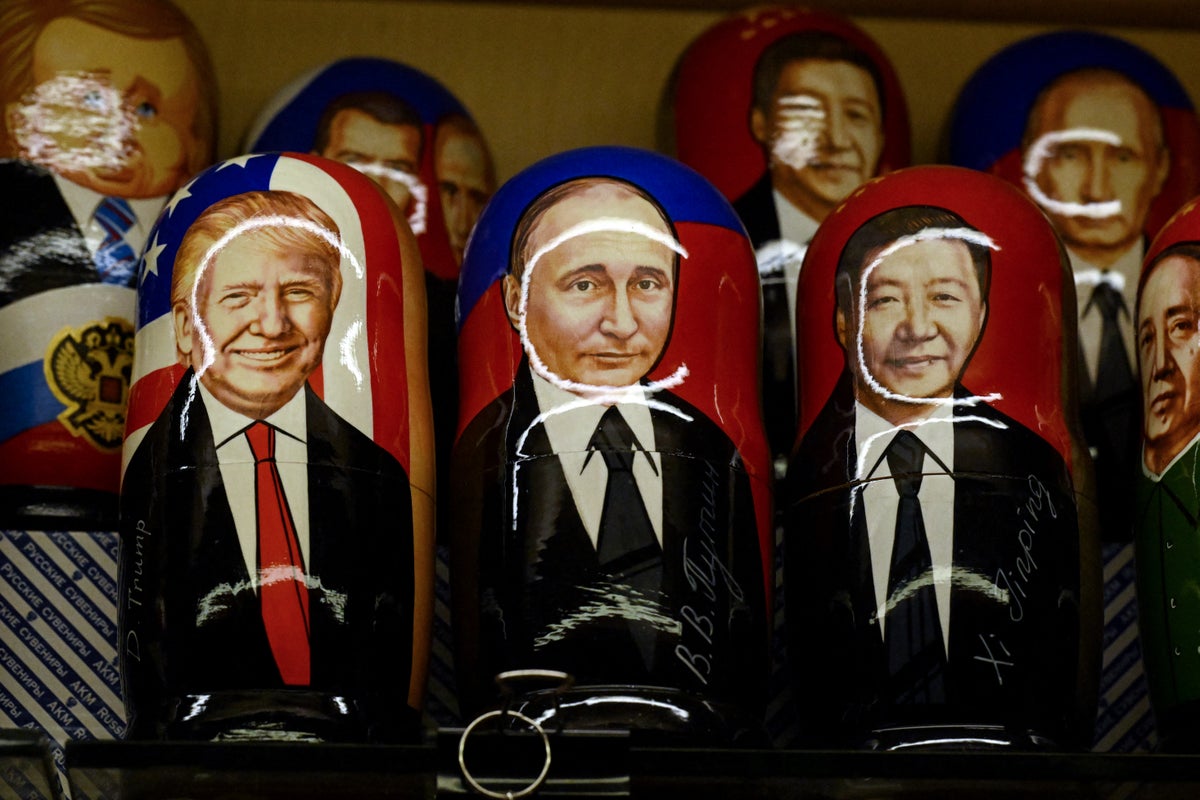
As Trump walks into a summit of strongmen, what can America’s lame-duck president hope to achieve?
Key Points
analysis As Trump walks into a summit of strongmen, what can America’s lame-duck president hope to achieve? Devoid of political capital, Donald Trump is embarking on a historic summit that may have no point apart from his own self-soothing, Andrew Feinberg writes - Bookmark - CommentsGo to comments Become an Independent member to bookmark this article Already a member? Log in His party just took the worst drubbing in a midterm election since Richard Nixon’s GOP after Watergate.
analysis
As Trump walks into a summit of strongmen, what can America’s lame-duck president hope to achieve?
Devoid of political capital, Donald Trump is embarking on a historic summit that may have no point apart from his own self-soothing, Andrew Feinberg writes
- Bookmark
- CommentsGo to comments
Become an Independent member to bookmark this article
Already a member? Log in
His party just took the worst drubbing in a midterm election since Richard Nixon’s GOP after Watergate. His approval ratings are lower than they’ve ever been, and his administration is girding itself for a barrage of long-delayed Congressional oversight while presiding over a series of high-profile infrastructure failures and outages that have left Americans on edge.
This, of course, means it’s time for President Donald Trump to get out of town for a while.
To be fair, the president isn’t fleeing the country to lay low in some no-extradition jurisdiction. On Monday he left the White House for a long-planned, four-day trip through Asia for a series of the multilateral confabs he has long detested.
On Tuesday he was in the Philippines for a sit-down with the “Quad” — a security dialogue between the U.S., Australia, India and Japan which has roots in the late George W. Bush era — on the sidelines of this year’s Association of Southeast Asian Nations. On Wednesday he’ll fly to Shenzhen, China, for the annual Asia Pacific Economic Cooperation leaders’ meeting.
But that’s not why he’s really going to Shenzhen.
The reason Trump is heading to China for the second time in six months is so he can finally attend the meeting the White House has been promoting for days: the first, three-way sit-down between the presidents of the United States, China and Russia.
It’s a trilateral meeting that Trump has craved for years.
Never quite comfortable with the democratically-elected leaders of America’s traditional allies, he has spent his decade-long stint atop the American political scene denigrating them while expressing a bizarre fondness for the likes of Xi Jinping and Vladimir Putin — men who made their bones crushing dissent, silencing adversaries, and either never having elections or rigging them with a wink and nod so as to never give up power.
Putin and Xi have long maintained a cozy, if slightly uneasy, relationship that is the inverse of the decades when the USSR was king atop the authoritarian world and China the understudy. Now the junior partner of the pair and a pariah in much of the world, Putin’s people have been buttering up the U.S. president by casting him as Franklin Delano Roosevelt in what Pyotr Tolstoy, who chairs the foreign affairs committee of Russia’s parliament, called a “new Yalta” - the 1945 conference at which FDR, Winston Churchill and Joseph Stalin settled the shape of postwar Europe.
Trump’s own team has set the bar far lower. During a briefing ahead of Monday’s departure from Washington, White House assistant press secretary Olivia Wales told reporters that Trump would raise “the reduction of nuclear weapons in the world, whose proliferation President Trump believes is very dangerous.”
That agenda item harkens back to Trump’s two ill-fated summits with North Korea’s Kim Jong Un — and to long before, when as a young real estate developer and budding media gadfly he openly mused about being drafted to handle nuclear disarmament talks with Moscow.
But on the same call, a senior U.S. official said the White House does “not expect to get to any kind of agreement,” and called Thursday’s meeting “the entry point, the first conversation.”
While this trio should be able to reconvene in approximately a month when Trump hosts the Group of 20 summit at his own Doral golf resort in Florida, it’s unlikely that any arms talks will get past that “entry point.”
The reality is there’s not much Trump can do as he makes the lame duck’s traditional pivot beyond America’s borders to become a self-styled foreign policy president in the mold of Jimmy Carter negotiating the Camp David Accords between Israel and Egypt or Bill Clinton’s work on the Good Friday Agreement to end The Troubles in Northern Ireland after three decades.
Two weeks ago, voters gave Democrats control of the House and the Senate in an election in which exit polls put Trump’s approval at 38 percent, which means starting January 3 the committees overseeing foreign policy, trade and intelligence will be run by people with no interest in advancing his own personal peccadillos.
Add to that Putin and Xi’s knowledge that the U.S. political system gives Trump just two more years in power, which means any agreement they might reach on anything will be picked over by a Congress that never signed off on it, and by a successor who may want to undo it, in a relatively short amount of time.
New START, the last treaty limiting the American and Russian arsenals, lapsed in February after Trump turned down Moscow’s offer to extend it in hopes of besting his predecessors by working out a tripartite deal that includes China’s comparatively tiny arsenal.
Asked whether Beijing would engage, the U.S. official said it was “time for China to sort of step up, you know, to the adult table, if you will, and have adult conversations about adult things,” and accused China of building its arsenal “very opaquely.”
But China has already answered through its foreign ministry which last month said trilateral talks would be “neither fair, reasonable nor realistic.”
Undoubtedly Xi and his aides know a president with less time and less support at home is a poor partner for a treaty that would take years to negotiate and would need two-thirds of the Senate to ratify.
So in the end, what Trump wants is the visual. The handshakes. The scenes with him and two of the world’s worst dictators seated together as peers.
For Putin and Xi, the point will be to push their idea of a “multipolar world” with a diminished America just one of a number of powers who divide the world up into the spheres of influence that were a feature of foreign policy more than a century earlier.
Trump doesn’t care about that — and it’s possible he doesn’t understand.
To him, this is a meeting between friends. And that will be enough.
Join our commenting forum
Join thought-provoking conversations, follow other Independent readers and see their replies
Comments