
Health
Grieving parents call for NHS changes as 20-second scan could have saved baby’s life
Key Points
Grieving parents call for NHS changes as 20-second scan could have saved baby’s life Jesse Parsons died at just three days ol from a rare umbilical cord complication - Bookmark - CommentsGo to comments Become an Independent member to bookmark this article Already a member? Log in Grieving parents are calling on the NHS to introduce a pregnancy screening that only takes 20 seconds to check for an abnormality after the tragic and preventable death of their newborn son. Steve and Hannah...
Grieving parents call for NHS changes as 20-second scan could have saved baby’s life
Jesse Parsons died at just three days ol from a rare umbilical cord complication
- Bookmark
- CommentsGo to comments
Become an Independent member to bookmark this article
Already a member? Log in
Grieving parents are calling on the NHS to introduce a pregnancy screening that only takes 20 seconds to check for an abnormality after the tragic and preventable death of their newborn son.
Steve and Hannah Parsons, both 34, have urged health authorities to change national policy to include a type of umbilical cord screening at the 20-week pregnancy scan to help prevent baby deaths.
Their son, Jesse Parsons, died at just three days old in July 2025 from a rare umbilical cord complication that could have been picked up if Mrs Parsons had the screening at 20 weeks.
The Parsons, from Sandhurst, Berks, were wrongly told Mrs Parsons had a low risk pregnancy throughout until she underwent an emergency Caesarean section after haemorrhaging at home.
The haemorrhaging and C-section happened due to undiagnosed Velamentous Cord Insertion (VCI) with associated Vasa Praevia, which are rare pregnancy complications.
Heartbroken Mr and Mrs Parsons say these issues can be detected with a Placental Cord Insertion (PCI) screening at a 20 week scan, which examines the position where the umbilical cord enters the placenta.
Mrs Parsons would have been deemed high-risk at 20 weeks and Jesse's death could have been prevented if she was given the screening.
The couple say the NHS already has the equipment for a PCI screening and it can take just 20 seconds.
"We are calling for routine screening and documentation of placental cord insertion at the 20 week NHS scan", the Parsons said. "This tells you if a pregnancy has a high risk umbilical cord abnormality such as Velamentous cord insertion, and also opens up the opportunity for targeted assessment for Vasa Praevia."
Mrs Parsons said: "My pregnancy was considered ‘textbook’ and low risk, by the NHS. But the reality couldn’t have been further from the truth.
"Our son Jesse was a perfectly healthy, full term baby, but a placenta and umbilical cord abnormality ultimately cost him his life - a preventable outcome which we know could have been identified through antenatal screening.
"To us, assessing placental cord insertion is 'low hanging fruit' and would go a long way towards preventing avoidable harm, stillbirths and neonatal deaths."
Mr Parsons said that it was 'frustrating and horrifying' that 'the opportunity to identify that Jesse needed saving was missed.'
Mr Parsons said: "Throughout Hannah's entire pregnancy, both the 12-week and 20-week scans showed everything was OK. His growth throughout the pregnancy was spot on.
"Ultimately, Hannah haemorrhaged at 41 weeks plus two days.
"On the morning of July 26, 2025, I woke up to the commotion that ensued, and of course we were rushed to the hospital.
"Jesse was delivered. He wasn't breathing when he was delivered because of the lack of oxygen.
"They had to resuscitate him for 13 minutes and after that they transferred him to the neonatal intensive care unit in Chertsey.
"No parent, no child should have to go through any of that."
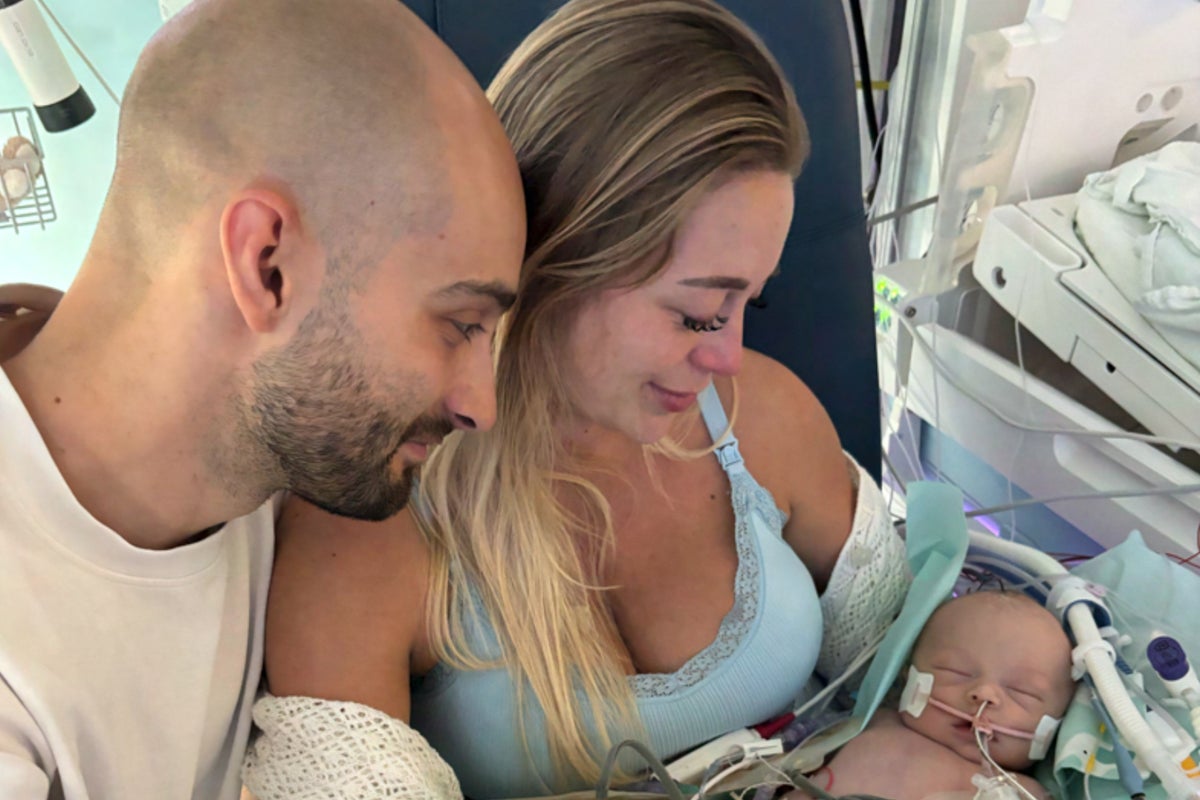
He added: "We were actually able to hold him properly for the first time since he was born and we held him until he passed away.
"That gives you a snapshot of what we went through. I have seen things and done things that no father should have to do. One is outliving your child."
Mr Parsons said that the 20-week scan Mrs Parsons had did not flag any issues with the umbilical cord.
He said that the UK National Screening Committee does not make it mandatory for sonographers to check where the umbilical cord is plugged in and the NHS follows this guidance.
He said: "[Velamentous cord insertion] is much easier to scan for. It takes 20 seconds to do and requires no extra equipment for the NHS to have.
"That is why it is so frustrating and horrifying that it is not mandatory.
"What caused Jesse to lose his life and pass away was an abnormality with the way that the umbulical cord connected to the placenta. There was nothing wrong with Jesse and his anatomy.
"They followed the current guidance and they didn’t find any issues with him. They gave us the ok and that everything was on track. The NHS follow the guidance from the UK National Screening Committee. That doesn’t mean that the guidance is correct.
“The problem is [because] they don’t check where the umbilical cord plugs into the placenta.”
Mr Parsons said that it had been difficult for the couple to accept that Jesse's death could have been prevented.
He said: "It naturally makes it more difficult when you know there is a solution. When you know this could have been picked up. When you know this is something that could have been prevented."
Mr and Mrs Parsons added: "Jesse did not die because medicine lacked the ability to save him. He died because the opportunity to identify that he needed saving was missed."
An inquest held in Surrey ruled that Jesse died from Hypoxic Ischaemic Encephalopathy, a lack of oxygen to the brain during birth, and from Vasa Praevia and VCI.
Vasa Praevia is a pregnancy complication where fetal blood vessels travel within the membranes close to or over the cervix, rather than being protected within the umbilical cord or placental tissue.
These exposed vessels are vulnerable to rupture, particularly when the membranes rupture, which can result in severe fetal blood loss.
VCI is an abnormal placental cord insertion in which the umbilical cord inserts into the fetal membranes rather than directly into the placenta.
As a result, the fetal blood vessels travel unprotected through the membranes before reaching the placenta, increasing the risk of complications.
VCI is a recognised risk factor for Vasa Praevia.
Dr Karen Henderson, Assistant Coroner for Surrey, said that on July 26, 2025, Mrs Parsons haemorrhaged at home due to fetal bleeding.
Jesse was transferred to the intensive care unit at St Peter's Hospital in Chertsey, Surrey.
Dr Henderson said: "Sadly, prior to delivery, Jesse had sustained a severe hypoxic ischaemic encephalopathy.
"Despite maximal intensive care support, he died at 00:13 hours on 30th July 2025 at St Peter's Hospital, Chertsey, having been transferred there for ongoing care."
In a Prevention of Future Deaths report Dr Henderson said that this could have been 'prevented' if it had been picked up on a 20-week scan as steps would have been taken to facilitate Jesse's delivery.
Dr Henderson said that Australia and New Zealand already implement routine screenings to check where the umbilical cord is plugged in and this had 'significant clinical benefit in terms of fetal survival.'
The report was sent to NHS England, the Department of Health and Social Care and the Royal College of Obstetricians and Gynaecologists.
Responding to the prevention of future deaths report, the Royal College of Obstetricians and Gynaecologists said: "The College recognises that antenatal detection of Vasa Praevia is associated with improved perinatal outcomes and that earlier identification in this case may have enabled interventions that would have prevented Jesse's death.
"It said updated Vasa Praevia guidance was due to be published in 2027."
The Department of Health and Social Care said there was currently 'no screening test for Vasa Praevia itself.'
It said: "Ultrasound can identify features associated with a higher risk - such as a low-lying placenta, a pregnancy following in vitro fertilisation, a multiple pregnancy, or the way blood vessels enter the placenta - but these features do not predict with a good degree of certainty that Vasa Praevia will be present during labour."
It added: "Any potential benefit must also be balanced against the harms of identifying pregnancies as high risk when Vasa Praevia would not in fact occur.
"This could lead to some women being offered a caesarean birth as early as at 34 weeks gestation, unnecessarily."
Mr Parsons said that the response from the Department of Health and Social Care showed that they weren't looking at the 'latest data' and they weren't looking at the 'central point' of the report as it focused on Vasa Praevia rather than Velamentous cord insertion.
Join our commenting forum
Join thought-provoking conversations, follow other Independent readers and see their replies
Comments