
Health
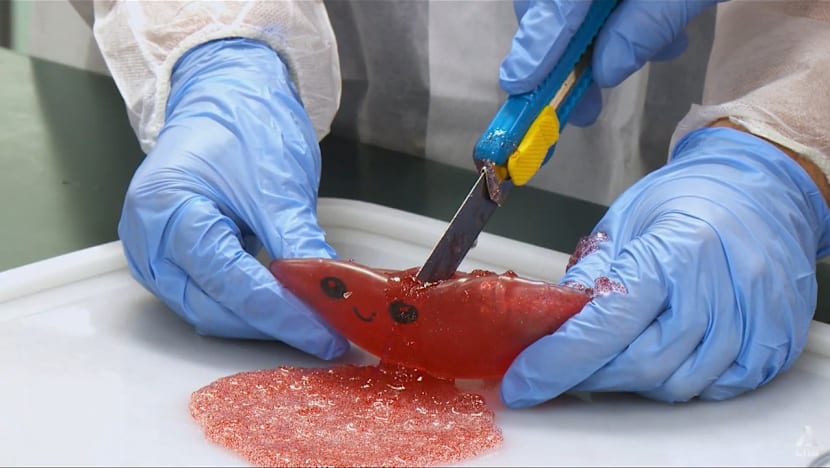
What’s really inside squishy toys? This is what Talking Point found after it sent 18 to a lab
Key Points
What’s really inside squishy toys? This is what Talking Point found after it sent 18 to a lab Squishies are a hit with children, but what happens when they leak or are left in direct sunlight? Experts identify potential hazards and precautions parents can take as a third of the toys Talking Point tested contain restricted chemicals.
What’s really inside squishy toys? This is what Talking Point found after it sent 18 to a lab
Squishies are a hit with children, but what happens when they leak or are left in direct sunlight? Experts identify potential hazards and precautions parents can take as a third of the toys Talking Point tested contain restricted chemicals.
SINGAPORE: Ten-year-old Dora has 127 squishy toys. Sometimes she brings one to bed to hold as she goes to sleep.
When one of her squishies popped, “it was like shaving cream” and “very sticky”, she said. “It just went all over my hand. And it was hard to come off.”
With 10 squishies, Lovelle has nowhere near the number Dora has, but she likes these toys no less. “They’re so special,” said the six-year-old.
Mishka, meanwhile, likes them because when she is “stressed” about something, she feels comforted squishing one. Life at age seven can be “very difficult”, she said with a grin.
Squishies are the latest craze among children today. They are easy to find — in shopping centres, neighbourhood shops and online — and can cost anywhere from about S$2 to S$30.
But there have been news reports about the risk of chemical exposure due to some of these toys. In August, the United States reported stopping nearly 356,000 non-compliant squishy toys entering at its ports.
In the same month, authorities in Thailand reported seizing nearly 20,000 squishy toys over chemicals such as volatile organic compounds — associated with cancer risk — and phthalates, which are linked to developmental issues and can affect hormone levels.
What is really inside the squishy toys that children in Singapore play with, and how safe are they, Talking Point viewers wrote in to ask.
So the programme sent 18 squishies — six from the children who were interviewed and 12 that host Steven Chia bought — to a testing laboratory to find out.
WATCH: We sent 18 squishy toys to a lab. Here’s what we found (22:38)
WHY ARE THERE POTENTIALLY HARMFUL CHEMICALS?
Squishy toys are all made of polymers, versatile materials that can make the toys spongy or stretchy, said Mervin Ang, an assistant professor in the National Institute of Education’s natural sciences and science education department.
In some squishies, there are also plasticisers such as phthalates. “Because it’s a cheaper option to use cheaper polymers that are hard,” he said, “phthalates are added deliberately by the manufacturer to make the plastic softer.”
For slow-rising squishy toys, which gradually return to shape after they are squeezed, manufacturers typically need not add phthalates because this type of squishy is made from polyurethane foam on the inside, which is naturally soft, he highlighted.
But if there are phthalates in squishies like these, they will probably be for the exterior material, he said. They may then leach into the interior.
“They aren’t locked into the plastic,” he explained. “So some of these phthalates can also be absorbed through the skin.”
Another category of squishy toys is the stretchy type, with a thermoplastic rubber exterior, for example, and gel-like material inside. Manufacturers can also make these squishies without using any phthalates, “if they choose the correct polymer”, Ang highlighted.
“Some polymers are inherently stretchy and soft,” he said, citing silicone as a synthetic polymer with flexibility. “But this often costs much more.”
What is not commonly found in squishy toys is benzene, he said. Yet benzene was the reason the United Kingdom in June recalled a Squeezy Dumplings toy originating from China. The toys’ outer layer contained excessive levels of the chemical.
It is an “unintended impurity” in the manufacturing process caused by, for example, the use of low-grade chemicals contaminated with benzene, Ang said. “The manufacturers just have to use … purer chemicals to make (squishies) so that they don’t have benzene.”
The chemical is “very volatile”, so it will evaporate. “But long-term exposure to benzene is known to be linked to blood disorders and leukaemia. Short-term exposure can cause dizziness or headaches,” he highlighted.
Should squishies have benzene or phthalates, children would be “particularly vulnerable because they play with these toys for an extended period of time”, he warned.
One other category of squishy toys is the squishy filled with liquid or gel. One such toy, the NeeDoh Original Groovy Glob, was reported to have a pH level of 2, which is as acidic as lemon juice or vinegar.
“If it gets into your eye, like how lemon juice gets into your eye, it’ll be pretty painful,” Ang said.
The worry here is that children may bite or sit on these toys, causing the outer shell to crack and exposing the filling, he added. The outer shell may also rupture in an aeroplane when the cabin pressure changes.
WHAT IF THEY ARE EXPOSED TO PROLONGED HEAT?
It is not just rough play or changes in air pressure, however, that could push a squishy toy to breaking point.
In the US in June, a squishy left in a car for more than four hours exploded when a 13-year-old girl squeezed it, causing third-degree burns on her arms and legs. The temperature that day reached about 34 degrees Celsius.
So, what happens if a squishy is left in a parked car in Singapore, where the daily maximum temperature averages about 31°C to 32°C and can exceed 34°C?
Valerio Isoni, an associate professor in the Singapore Institute of Technology’s food, chemical and biotechnology cluster, directed Chia to place three sealed bags, each containing 100ml of water, in his car: on the dashboard, front passenger seat and back seat.
The water mimics the filling for squishy toys well, said the chemist. The temperature that afternoon was about 32°C, and after three hours, the bag of water left on the dashboard recorded the highest temperature: 60°C.
This demonstrated how hot a squishy’s liquid or gel filling can become when left in a car under the sun. “The temperature can affect both the outer structure of the toy and also the inner part,” said Isoni. “The filling will start changing internally.”
He then replicated these conditions a squishy would experience in the hottest part of the day — by leaving three different squishies in a laboratory oven, heated to 60°C, for three hours.
When the time was up, the toys were much softer than before but looked intact. That was only half of the experiment, though. The second part was to see how they would hold up after being squeezed.
The first squishy felt as if it was “going to burst”, said Chia, who was wearing gloves as he squeezed it a few times. But it held together. So did the second, “more liquidy” toy. But the third one burst.
One of the variables in this test was the thickness of the skin of the toys, even as the squishies looked similar, pointed out Isoni.
He advised parents to stop children from picking up a squishy left in a car parked in the sun. “Let it cool down first and then … take the toy instead of letting the child go for it,” he suggested.
If the filling leaks out, how bad it could get depends on whether it goes on the eyes or on the skin, he added.
“It could be as gentle as some skin irritation, or it could be more severe, … causing burns or long-term effects.”
LAB RESULTS REVEALED
As for the tests to find out what is inside the 18 squishy toys Talking Point took, the lab did not detect any benzene. Six toys, however, had restricted phthalates, namely Di(2-ethylhexyl) phthalate, Dibutyl phthalate and Diisononyl phthalate (DINP).
The permissible phthalate limit in Singapore is 1,000mg/kg. And the phthalates detected in five of the toys were within this limit. But the sixth toy had a DINP value of 1,726mg/kg, which is about 1.7 times the limit.
“Based on scientific studies, DINP may affect the children’s reproductive development as well as their liver function,” said Winter Kong from SGS Testing and Control Services, which tested the toys.
He stressed, however, that the lab result only showed the concentration of DINP in the toy and that no conclusion could be drawn about the risk to any one child.
“We don’t know the exact … intake of the DINP,” he said, citing the way children play with the toy — whether they put it in their mouth or wash their hands after playing and before taking food — as having an impact.
But the potential for exposure to DINP might be high, he added.
The toy in question came from Mishka’s collection, and she was “shocked” when she heard there was a potentially unsafe chemical inside. She also wondered what was inside her other squishies.
Her mother was equally surprised. “I thought squishy toys were safe for kids,” said Clyde Lasafin. But she “can’t say no” to squishies for Mishka because her daughter will “save money to buy her own toys”.
“We’ll be careful next time — check the importers or read some information and then make sure it’s safe for kids.”
Mishka, who also usually sleeps with her toys, still wanted to play with her squishies, except the same pink Fun Cube she had as the sample Talking Point had taken for testing. “Throw (it) in the dustbin,” she told Chia.
Her family had bought the made-in-China toy from Kiddy Palace a few months ago, said Lasafin.
When Talking Point wrote to Kiddy Palace about the lab result, it replied with a statement saying it has pulled the toy from its stores, quarantined the stock and is now offering refunds.
The company added that it was working with its suppliers to make sure all its products comply with regulations.
For consumers, it may be time to pay attention to the warnings on squishy toy packaging, said Chia.
“It usually says things like, ‘Don’t use excessive force’ or ‘Don’t leave them in a car (in) direct sunlight’ (or) ‘Check for tears or leaks.’ And there’s a good reason for that.”
Watch this episode of Talking Point here. The programme airs on Channel 5 on Thursdays at 9.30pm.