
Environment
Observers concerned over alleged 'holes' in WA emissions monitoring
Key Points
Critics say methane plumes at Chevron's Gorgon LNG project expose gaps in greenhouse gas monitoring In short: An analyst and an engineering expert say the plumes of methane recorded via satellite at Chevron's Gorgon project are the tip of the iceberg. The imaging has raised questions about federal and state emissions regulations. Regulators are continuing to investigate, but officials have not said whether the emissions have stopped.
Critics say methane plumes at Chevron's Gorgon LNG project expose gaps in greenhouse gas monitoring
In short:
An analyst and an engineering expert say the plumes of methane recorded via satellite at Chevron's Gorgon project are the tip of the iceberg.
The imaging has raised questions about federal and state emissions regulations.
What's next?
Regulators are continuing to investigate, but officials have not said whether the emissions have stopped.
Observers are warning that massive methane plumes detected at one of Australia's biggest oil and gas projects are symptoms of a much larger problem.
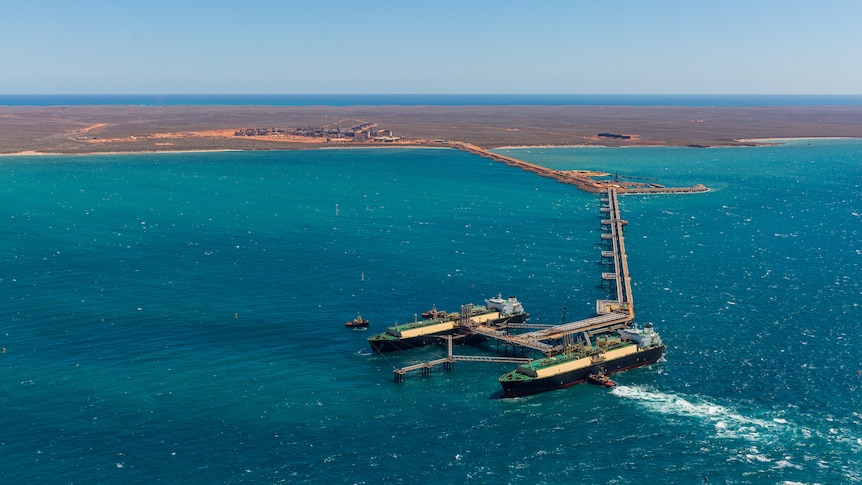
Clouds of the greenhouse gas were picked up by five consecutive satellite passes over Chevron's Gorgon LNG facility off Barrow Island in Western Australia's Pilbara.
It triggered a formal alert to Chevron in late August by the United Nations Environment Programme.
But WA's Department of Water and Environment Regulation (DWER) says it did not become aware of the notification until September 28.
A spokesperson initially said the department was still trying to "understand what compliance or regulatory measures may be required", before confirming an investigation some days later.
Energy analyst Kevin Morrison, from the Institute of Energy Economics and Financial Analysis (IEEFA), said the response was "telling".
"Had this not been picked up on the satellite data, it's very unlikely it would have been recorded in any official emissions statistics," he said.
"We've had indications from satellite and other monitoring equipment that the emissions from Australia are actually 2 to 3 times higher."
Safeguard shortcomings
The methane emissions sparked a protest outside Chevron's Perth offices on Monday, with the WA Greens labelling the state's emissions monitoring regime as "broken".
Environment Minister Matthew Swinbourn told WA Parliament this week the matter remained under investigation, and that Chevron had advised DWER there were no on-site incidents on the day of the August detection at Gorgon.
While day-to-day monitoring is the responsibility of the state, operators like Chevron must record their emissions annually under the National Greenhouse and Energy Reporting (NGER) scheme.
Rather than using instrument measurements, however, the output is calculated with a formula set by the federal Climate Change Regulator.
"It's done on an estimation, based on a sum, an algorithm," Mr Morrison said.
"The numbers we get are not a true reflection of what's been actually pumped up into the atmosphere."
Mr Morrison said the process — even when tailored to the specifics of a project — vastly under-reports the fugitive emissions that escape during LNG production.
He added the incident at Chevron was just the tip of the iceberg, with methane emissions across Australia's gas and coal sectors more than doubling the official estimates.
"This is an industry practice,"he said.
Mr Morrison also questioned the credits administered under the Commonwealth's Safeguard Mechanism, which could be purchased by companies to ensure they were hitting legislated targets.
Gorgon surrendered 478,000 credits to meet its safeguard baseline at the end of the last financial year, having notched 8.76 million tonnes of carbon dioxide emissions and 252,000 tonnes of methane emissions.
Mr Morrison said buying credits was not the same as making genuine reductions.
"The Safeguard Mechanism is a get-out-of-jail card … companies can pretend that they've lowered their emissions by buying these offsets," he said.
Regulator backs scheme
A 2023 review of the reporting scheme concluded it was performing well despite posing 25 recommendations for improvement.
"The government has amended the NGER scheme to enhance the accuracy and transparency of reported fugitive methane emissions," a spokesperson for the federal Department of Climate Change, Energy, the Environment, and Water (DCCEEW) said.
"In April this year, this data reported that total methane emissions from all Safeguard facilities are equivalent to 22.7 million tonnes, down from 23.1 million tonnes the year before."
Chevron said it continued to work with authorities, including DWER, and provide information as required.
"We take our environmental obligations seriously and are committed to managing emissions from our operations in accordance with relevant regulatory requirements," the company said.
Satellite monitoring
A 2026 interim report by a Fugitive Methane Expert Panel appointed by Climate Change Minister Chris Bowen found satellites should play a more central role in identifying anomaly events, such as leaks, by major emitters.
While Australia helps fund networks like the UN's International Methane Emissions Observatory, of which Chevron is also a partner, these alerts are non-binding and information sharing between federal and state regulators is limited.
Chevron played down the effectiveness of space-borne monitoring in previous statements to the ABC.
"Satellite observations capture a single moment in time and have a wide range of uncertainty," the spokesperson said.
Last month, researchers published a year-long blind test of methane observations by satellite and found Tanager-1, responsible for the detections at Chevron's Gorgon plant, never missed emissions or triggered a false positive.
Co-author and professor of energy science engineering at Stanford University Adam Brandt said the Gorgon observations were worthy of public confidence.
"One would not expect to see this kind of emission in normal operations,"he said.
Dr Brandt noted the satellite, operated by non-profit Carbon Mapper, was "quite conservative" and "best-in-class".
"With five separate detections, the chance that they are seeing something that doesn't exist is extremely small," he said.
"This is almost certainly a real plume."
WA (LOCATION)
Chevron (ORG)
Gorgon LNG (ORG)
Gorgon (ORG)
Australia (LOCATION)
Barrow Island (LOCATION)
Western Australia's (LOCATION)
Pilbara (LOCATION)
the United Nations Environment Programme (ORG)
Department of Water and Environment Regulation (ORG)
DWER (ORG)
Kevin Morrison (PERSON)
the Institute of Energy Economics and Financial Analysis (ORG)
IEEFA (ORG)
Perth (LOCATION)