
Breaking News
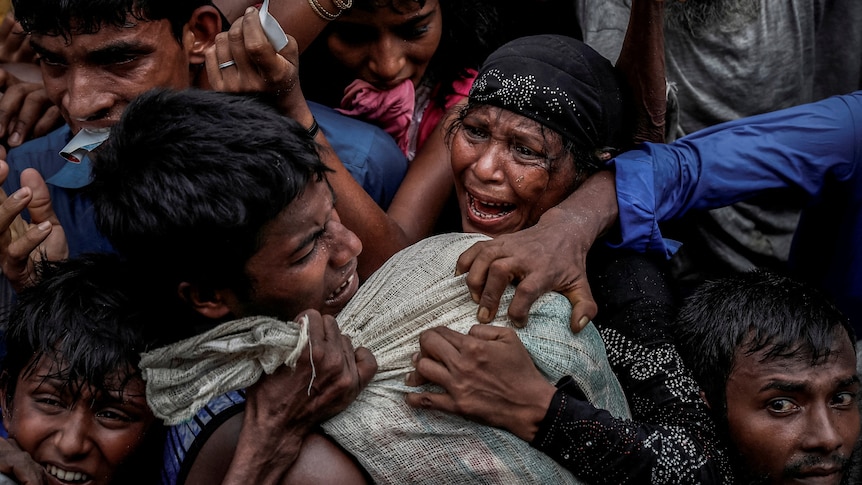
Breaking: Myanmar committed genocide against Rohingyas, UN court says
Key Points
Myanmar committed genocide in Rohingya massacres, UN court finds in historic verdict The top United Nations court has ruled that thousands of killings and widespread sexual violence by Myanmar's security forces against the Rohingya Muslim minority population in 2017 amounted to state-sponsored genocide. The decision, delivered seven years after the case was filed by predominantly Muslim Gambia, marked only the fourth time since the Nazi Holocaust that an international court ruled that the...
Myanmar committed genocide in Rohingya massacres, UN court finds in historic verdict
The top United Nations court has ruled that thousands of killings and widespread sexual violence by Myanmar's security forces against the Rohingya Muslim minority population in 2017 amounted to state-sponsored genocide.
The decision, delivered seven years after the case was filed by predominantly Muslim Gambia, marked only the fourth time since the Nazi Holocaust that an international court ruled that the legal threshold to prove genocide had been met.
It was the first time the court held a state responsible for genocide.
"The court finds that Myanmar's security forces killed thousands of Rohingya civilians, perpetrated widespread acts of sexual violence as well as acts of extreme violence against children and attacked fleeing Rohingya," presiding Judge Yuji Iwasawa said in a reading of the decision.
The panel found "that the Republic of the Union of Myanmar has committed genocide against the Rohingya group in Northern Rakhine State."
Genocide has rarely been proven in international courts because judges must find that crimes were committed with the specific intent "to destroy, in whole or in part" a national, ethnical, racial or religious group.
It carries major implications for the genocide case against Israel over its war in Gaza, which South Africa filed at the court in 2023.
A campaign of 'clearance'
Muslim-majority The Gambia filed the case with the backing of the 57-member Organization of Islamic Cooperation.
The Rohingya are not from The Gambia, and no atrocities took place there, but under international law any state can bring a case at the ICJ if it believes another country has violated the Genocide Convention.
The case centred on a violent military campaign in Myanmar's western Rakhine state almost a decade ago, after a Rohingya militant group carried out guerrilla-style attacks on army posts.
The army responded with massive "clearance operations" that targeted Rohingya villages. Survivors described a sweeping campaign of massacres, rape, arson and looting in northern Rakhine that forced more than 740,000 people to flee to Bangladesh, according to the United Nations and human rights groups.
Nur Sadek, a 15-year-old student living in Ngan Chaung village, said he witnessed soldiers gun down his neighbours.
"Their homes were being burned, people were being chased, and they started shooting. They did not care whether they were women, children, or elderly people. And due to the fear of being shot or killed, people started fleeing," he told the ABC.
Survivors from the village of Tula Toli told journalists that unarmed civilians were executed and children thrown into a river.
Satellite images later showed the village had been razed. The nonprofit Médecins Sans Frontières estimated that at least 10,000 people died in the pogrom, and hundreds of Rohingya villages were burned to the ground.
The Gambia also said sexual violence, including mass gang rape and genital mutilation, was integral to the campaign and was itself evidence of genocidal intent. It pointed to the extreme brutality of the attacks, official tolerance for hate speech, and Myanmar's failure to investigate the alleged atrocities.
Antonia Mulvey, a UN investigator on the Myanmar-Bangladesh border from 2017 to 2018, probed sexual violence and crimes against Rohingya children.
"I recall one woman, a mother like I am, who recounted how she was eight months pregnant. She was stripped naked by the Myanmar military soldiers. She was hung from a tree, and she was repeatedly raped by nine soldiers. Her unborn child died," she told the ABC.
Ms Mulvey, who is now the Executive Director of Legal Action Worldwide and worked with Rohingya witnesses and victims after the genocide case was filed, said women and girls were targeted with brutal sexual violence in public, gang rape and sexual enslavement.
"Myanmar's argument in brief was that it was a lawful counter-terrorism operations under which they killed men," she said.
"No counter-terrorism operation in any country at all allows for sexual violence."
Myanmar's defence
Myanmar rejected the allegations throughout the seven-year legal process, arguing that the 2016–2017 operations were counterterrorism measures in response to attacks by the Arakan Rohingya Salvation Army (ARSA).
The military insisted the Rohingya had burned their own homes and that there was no direct evidence of genocidal intent.
It also disputed evidence and reports gathered by UN agencies, humanitarian organisations and journalists, including the fact-finding mission's reports, which were presented to the court.
Aung San Suu Kyi, Myanmar's civilian leader at the time and a Nobel laureate, dismissed the allegations, saying refugees may have exaggerated abuses and that the international outrage was based on "unsubstantiated narratives". She travelled to The Hague in 2019 to defend Myanmar in person.
In 2021, her elected government was toppled in a military coup led by military chief Min Aung Hlaing, and she has been held in detention ever since.
The International Court of Justice said Myanmar had an obligation to compensate the Rohingya for the violations it had committed, to be determined at a later date.
Myanmar must also allow the "safe and dignified return to their place of residence and the reunification of families for the Rohingya displaced as a result of Myanmar's wrongful acts," it said.
These orders are legally binding, but the ICJ's judgment is not linked to any criminal trial, and no individuals will be held accountable or go to prison.
"One of the features of the international legal system is that we don't have much in the way of enforcement of judicial decisions," said William Schabas, a professor of international law at Middlesex University in London and an expert on genocide and international criminal law.
"It's a great shortcoming, and quite frankly, if someone were to propose that there be a mechanism to enforce the judgements, I think most states wouldn't sign up for it."
However, if Myanmar fails or refuses to comply, the matter can be referred to the UN Security Council to help with enforcement.
"One of the problems at the Security Council is getting the five permanent members to agree. I don't know whether that would even be possible in the case of Gambia versus Myanmar, and it certainly wouldn't be possible in the case of South Africa versus Israel," Professor Schabas said.
A benchmark for Gaza
For many observers, the judgment's significance extends well beyond Myanmar.
It offers the strongest hint yet of how the court might approach the South Africa v Israel case, which alleges that Israel committed genocide against Palestinians in Gaza. Israel denies the charge.
"Without wanting to diminish the suffering of the Rohingya in Myanmar, the question of the Palestinians and Israel has been at the centre of the global agenda since the United Nations began," Professor Schabas said.
"Everybody knows that the pronouncements by the court will ricochet into the South African case."
A related case, Nicaragua v Germany, filed in March 2024, alleges that Germany failed to prevent genocide in Gaza by providing aid, including military equipment, to Israel.
The Myanmar ruling is likely to shape both cases, although the court is not expected to make its decisions for many years.
Refugees welcome ruling as sign of 'hope'
For the more than one million people forced to escape Myanmar's brutal campaign against the Rohingya, the ruling is a milestone.
"We have been waiting for decades to be recognised for our suffering and what we have gone through. And we have not seen anyone in the world take a step to stop this," said Nur Sadek, 24, who has been a refugee for almost a decade now.
He said he was forced to leave his family and make the dangerous boat journey from Bangladesh to Malaysia in 2022 after gangs kidnapped him for ransom in the Rohingya camps.
"I am staying in Malaysia in a country where they do not recognise refugees," he said.
"I have no right to get an education. I can't get work. I have very limited health care; I can't decide my own future.
"That's why the legal proceedings in the ICJ give me hope that the situation might change in our country so that we can go back some day."
ABC/wires
Loading
Myanmar (LOCATION)
Rohingyas (ORG)
UN (ORG)
Rohingya (ORG)
United Nations (ORG)
Rohingya Muslim (ORG)
Muslim (ORG)
Gambia (LOCATION)
the Nazi Holocaust (EVENT)
Yuji Iwasawa (PERSON)
the Republic of the Union of Myanmar (LOCATION)
Northern Rakhine State (ORG)
Israel (LOCATION)
Gaza (LOCATION)
South Africa (LOCATION)