
Politics
How the Victorian election will shape the future of Melbourne's suburbs
Key Points
Competing visions for housing supply at the Victorian election ballot box An unassuming vacant lot in a leafy Brighton street — bare except for an abandoned shed and some weeds — has become a lightning rod for debate over the future of Melbourne's suburbs. Signs fixed to gates, public bins and even a vehicle trailer have become prolific in the affluent bayside suburb, each protesting a six-storey apartment building proposed under a planning application lodged with the council in July....
Competing visions for housing supply at the Victorian election ballot box
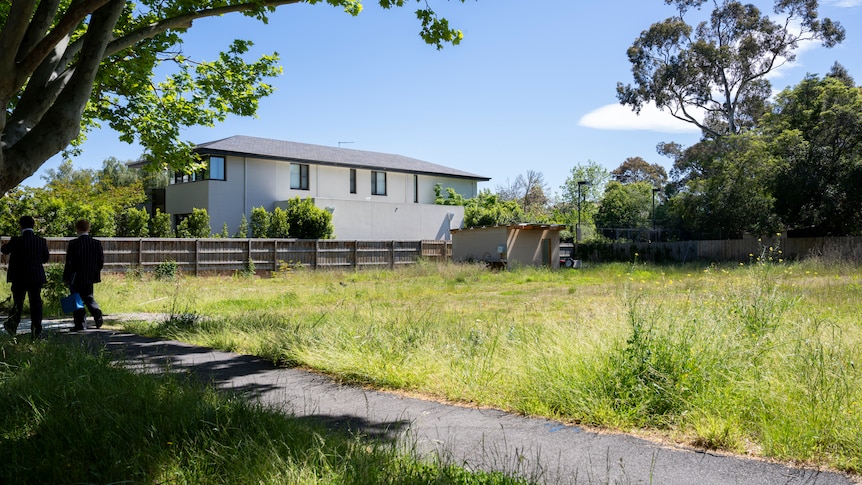
An unassuming vacant lot in a leafy Brighton street — bare except for an abandoned shed and some weeds — has become a lightning rod for debate over the future of Melbourne's suburbs.
Signs fixed to gates, public bins and even a vehicle trailer have become prolific in the affluent bayside suburb, each protesting a six-storey apartment building proposed under a planning application lodged with the council in July.
Neighbours say the plan betrays the gentle housing growth already taking place and threatens to change Lindsay Street for good.
Martin Rieschieck, and Andrea, who declined to provide her surname, fear the development would overlook bedrooms on one side and block sunlight on the other.
"People have zero privacy. It's just not reasonable," Martin said.
The building's height has been enabled under recent reforms to Victoria's planning framework. While Bayside City Council will decide the application's future, it says the state government's changes have reduced its ability to respond to community concern.
While the changes have been credited with progressing Victoria's state and national housing targets, they have also spawned significant opposition, with community groups arguing the reforms will harm amenity and stretch infrastructure in middle-ring suburbs across Melbourne.
Despite few major housing-related announcements from either major party during the election campaign itself, Martin and Andrea are far from the only voters who see housing as a major issue at the ballot box.
"There's a huge gap or a huge shortfall in terms of the infrastructure costs needed to improve sewerage, stormwater, roads, schools, parks. Who will foot the bill?" Andrea asked.
While both parties have named greater housing supply and ownership as key priorities, they promise different pathways, with Labor's infill development pitted against opposition proposals targeting the city's CBD and its outskirts.
To fill in, or build up and out?
After accusing some councils in sought-after areas of dragging their heels, the Labor government has spent the three years since the release of its Housing Statement working to unlock supply and speed up planning approvals in well-connected areas.
Its activity centres plan has allowed buildings of 10 or more storeys in designated areas along major public transport corridors, as well as buildings of three to six storeys (depending on lot size) in surrounding catchments.
By contrast, the opposition has vowed to fast-track existing development plans for dozens of outer suburban growth corridors and wind back the Development Facilitation Program, which has bypassed councils to fast-track thousands of home approvals.
It will also extend the Capital City Zone (already home to some of the nation's highest population densities) beyond the CBD to allow greater density in the city-hugging suburbs of Collingwood, Fitzroy, North Melbourne, Parkville and Fishermans Bend — some of which are captured by the activity centres program already.
The activity centres would be axed, with housing delivery instead guided by council plans.
While some of those plans appear to encourage high-density building in the same areas already, some housing advocates have warned scrapping the activity centres could remove significant housing capacity.
"These are the places where homes should be prioritised," Jonathan O'Brien from YIMBY Melbourne said.
"These are the places where many, many people would like to choose to live."
Could that removal be offset by building elsewhere?
While almost all of the 60 centres were only finalised this year, Labor says the reforms will unlock capacity for more than 300,000 homes in the next 25 years.
Analysis from the Grattan Institute has found about 110,000 of those are currently commercially feasible, while reforms to speed up townhouse approvals (which a Liberal government would review) could realistically deliver another 400,000 homes.
The institute's housing lead, Andrew Barker, said the opposition's "up and out development" approach was certainly capable of delivering more housing supply and diversity at scale.
"But there are trade-offs," he said.
"Servicing a new home in an established suburb with infrastructure can be more than $50,000 cheaper, on our estimates, than servicing the same home on the urban fringe.
"Developers far away from public transport networks also create more congestion on Melbourne's already busy roads."
To that end, the opposition has vowed to ensure developers' infrastructure contributions are spent locally, after complaints the funding has been diverted to other areas in the past.
Labor's housing policy announcements also include the Commonwealth-backed delivery of 25,000 new homes for first homebuyers, while the opposition will sell several pieces of government land to developers for housing, including at least one earmarked for Labor's new homes.
Lack of tax reforms criticised
Irrespective of planning, development bosses say the campaign has done little to overturn Victoria's reputation as a costly state to build housing in.
In this context, the Urban Development Institute of Australia (UDIA) has labelled the repeal of reforms that provide certainty by limiting appeal rights as "concerning".
"The key issue with feasibility is the tax settings,"the UDIA's Linda Allison said.
"You can have the best planning framework in the world, but if the project doesn't stack up, it's still not going to get built."
The opposition did not directly respond to a question from the ABC asking if it had modelled housing capacity under its plans, but said home building had fallen in spite of Labor's reforms.
Asked how its plan would deliver housing choice, the Liberal Party said it would work with councils to ensure a mix of housing types were delivered under their housing plans.
The Grattan Insitute's Mr Barker said making local councils responsible for housing ran the risk of uneven delivery if some municipalities pushed development elsewhere.
He said there was more than just home ownership at stake, with rental growth slowing in the wake of the work so far.
"To continue that success is going to require more housing supply and allowing building both up and out, so it is good to see both major parties acknowledging the importance of housing supply," Mr Barker said.
Loading...
Victorian (ORG)
Melbourne (LOCATION)
Brighton (LOCATION)
Lindsay Street (PERSON)
Martin Rieschieck (PERSON)
Andrea (PERSON)
Martin (PERSON)
Victoria (LOCATION)
Bayside City Council (ORG)
Labor (ORG)
Housing Statement (ORG)
the Development Facilitation Program (ORG)
the Capital City Zone (LOCATION)
Collingwood (LOCATION)
Fitzroy (LOCATION)