
Politics
Trump’s symbolic summit: From the Politics Desk
Key Points
Welcome to From the Politics Desk, a daily newsletter that brings you the NBC News Politics team’s latest reporting and analysis from the White House, Capitol Hill and the campaign trail. In today’s edition, Andrea Mitchell dives into the fallout from President Donald Trump’s trilateral meeting in China. Plus, Sarah Sternhagen explains why Republicans weren’t far off from suffering even deeper midterm losses.
Welcome to From the Politics Desk, a daily newsletter that brings you the NBC News Politics team’s latest reporting and analysis from the White House, Capitol Hill and the campaign trail.
In today’s edition, Andrea Mitchell dives into the fallout from President Donald Trump’s trilateral meeting in China. Plus, Sarah Sternhagen explains why Republicans weren’t far off from suffering even deeper midterm losses.
— Adam Wollner
Trump’s summit with Putin and Xi was light on results, but heavy on symbolism
Analysis by Andrea Mitchell
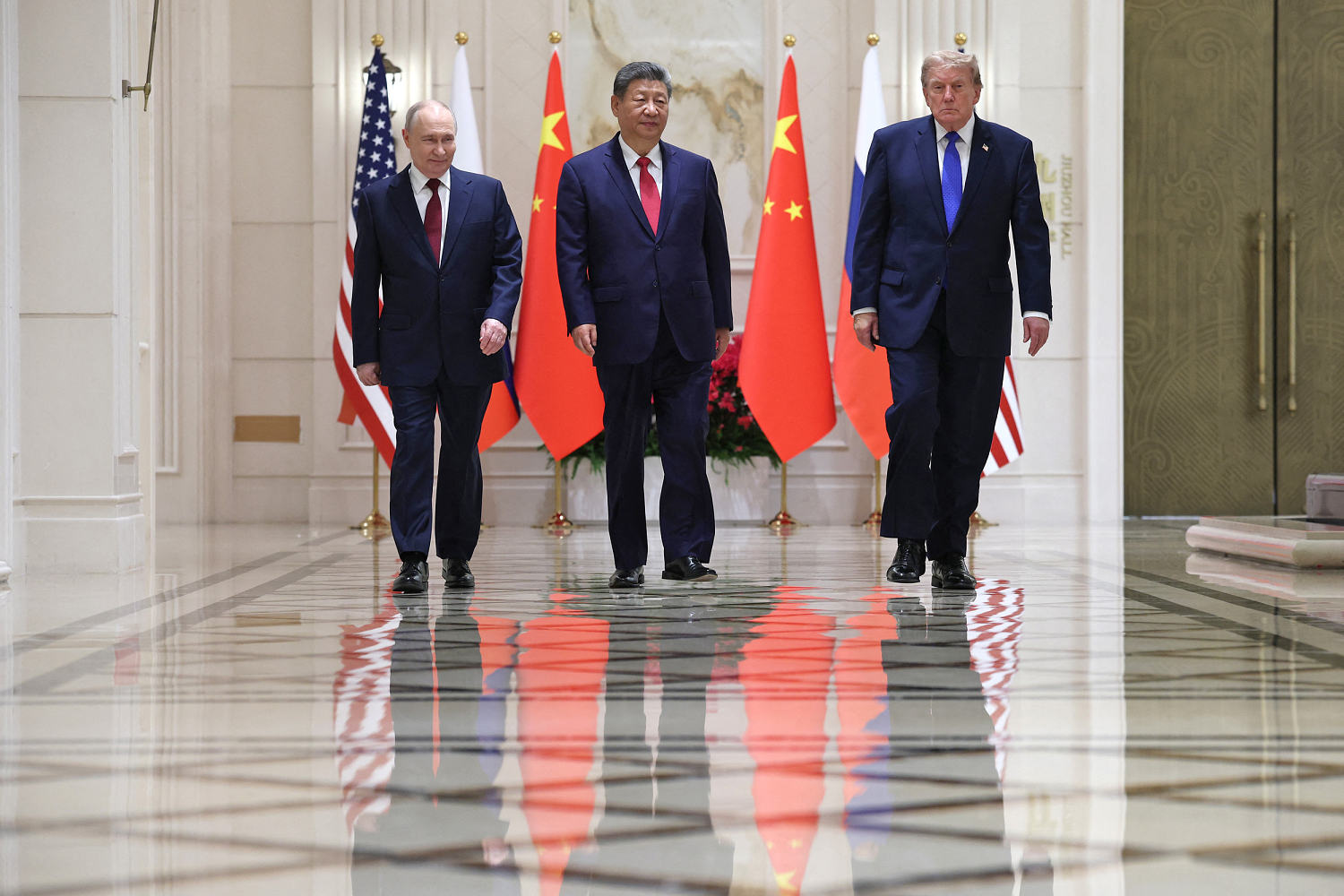
It was an image the White House heralded as historic: an American president holding a summit with the leaders of China and Russia, the three commanders of the world’s largest nuclear arsenals. To some, it had echoes of Yalta in 1945, when Franklin D. Roosevelt, Winston Churchill, and Joseph Stalin divided Europe, with post-war consequences lasting nearly a half-century.
This time, substantively, there were no concrete results. But it did send a signal across the globe to see President Donald Trump, the leader of the world’s foremost democracy, standing shoulder to shoulder with Chinese President Xi Jinping and Russian President Vladimir Putin without even paying lip service to human rights, press freedoms or political prisoners. Afterward, China and Russia issued statements that didn’t dispute the absence of agreements. There was no progress on nuclear proliferation, trade or critical minerals.
Trump’s warm embrace with Xi in Shenzhen can be justified by the importance of maintaining a constructive dialogue between the world’s two most powerful economies. Much harder to justify in the eyes of NATO allies is Trump’s affectionate greeting for Putin, calling the invader of Ukraine, “my friend.” Poland’s Prime Minister Donald Tusk posted on X, “God protect us from such friends.”
Perhaps appearing side by side with the two strongmen — both, in effect, leaders for life — was designed to bolster a U.S. president politically weakened by a tsunami-sized midterm defeat, and frustrated by two wars he promised to end quickly. In the case of Ukraine, Trump pledged during the 2024 campaign he could solve the war in one day after taking office. After joining Israel last February in attacking Iran, Trump said the conflict would be over in several weeks.
After leaving China, Trump joined a call with his two envoys, Steve Witkoff and son-in-law Jared Kushner, who were in Berlin to meet with Ukrainian officials and an eight-member European negotiating team working on security guarantees and an economic reconstruction plan for Ukraine. Ukrainian President Volodymyr Zelenskyy told NBC News’ Richard Engel of Trump meeting with Putin and Xi without him, “You can’t decide about some country, even a small country, without this country.”
Addressing his nation today, Zelenskyy said the U.S. representatives were going “to provide the necessary information about the U.S. president’s negotiations” and that “we and the Europeans share a clear common position: matters concerning Ukraine must be decided with Ukraine’s participation, and matters concerning Europe must be decided with Europe’s participation.”
FOR SUBSCRIBERSTrump responds to Elon Musk’s ‘I’m not MAGA’ comments
FOR SUBSCRIBERSZelenskyy’s view from the outside
FOR SUBSCRIBERSTrump responds to Elon Musk’s ‘I’m not MAGA’ comments
FOR SUBSCRIBERSZelenskyy’s view from the outside
But prior to the China meeting, European leaders had been assured that Trump, Putin and Xi would not deal with Ukraine without Europe. Punctuating the challenge, Russia attacked Kyiv and other Ukrainian cities during the Shenzhen summit and the hours after. Ukraine drove home its resistance by attacking a key bridge linking Russia with Crimea, a project heavy with strategic and symbolic importance to Putin.
Trump recently repeated his belief that Zelenskyy could have prevented the war — apparently ignoring that Putin invaded a sovereign state in violation of past nonaggression pacts. And U.S. negotiators have been pressuring Ukraine for concessions, although Putin has given no indication he is ready to compromise. The Shenzhen summit will likely reinforce the Russian leader’s confidence that he can count on support from Trump.
How the blue wave could have been even bigger
By Sarah Sternhagen
The 2026 elections were already devastating for Republicans, with the party losing a net of at least 42 House seats.
But it was close to being much worse for the party. Among the House Republican candidates who managed to win, 26 of them did so by less than 3 points. It’s a number that’s much higher compared to recent midterms, as the chart below illustrates. For instance, in 2018 — another blue wave year — half as many (13) GOP House candidates won their races by less than 3 points.
Put another way, only 41 House Republicans won at least 60% of the vote this year. By comparison, more than four times as many (174) House Democrats surpassed that threshold. In the 2022 midterms, when President Joe Biden’s low approval rating weighed down his party, 126 Democratic House candidates still managed to take at least 60% of the vote, while 153 Republicans did.
☑️ Latest race call: Republican Nick Begich won the race for Alaska’s at-large House district after a ranked choice tabulation, a rare bright spot for his party. That leaves Democrats with 257 seats and Republicans with 173. NBC News’ Decision Desk has yet to project a winner in five remaining House races, including two in Louisiana that are going to December runoffs.
🗞️ Today's other top stories
- 🌎 As MAGA world turns: Trump warned tech titans against breaking too hard from the movement he’s built up, telling NBC News in a phone call that he doesn’t think it’ll end well for them. His comments came after Elon Musk — who spent nearly half a billion dollars to elect Republicans in the midterm elections — said at The New York Times’ DealBook Summit that he’s “not MAGA.”
- 👷 Coalition building: Winning Working People Action has launched a $10 million effort to dig into research and message-testing designed to help Democratic presidential contenders reach out to working-class voters. Read more →
- 💲 2028 watch: Progressives who viewed California’s Proposition 40 as flawed think its defeat will help clear the way for a push for a national wealth tax heading into the next election cycle. Read more →
- 🤝 How to win friends: Lobbyists told NBC News they’re not that worried about White House chief of staff Stephen Miller’s new rules meant to restrict their influence, saying they have plenty of other ways to operate. Read more →
- 👟 Gotta be the shoes: High school valedictorians across the country will receive Nike shoes after a request from incoming Democratic Sen. Scott Colom of Mississippi. Read more →
That’s all From the Politics Desk for now. Today’s newsletter was compiled by Adam Wollner.
If you have feedback — likes or dislikes — email us at [email protected]
And if you’re a fan, please share with everyone and anyone. They can sign up here.
Trump (ORG)
the Politics Desk Welcome (ORG)
the NBC News Politics (ORG)
the White House (ORG)
Capitol Hill (ORG)
Andrea Mitchell (PERSON)
Donald Trump (PERSON)
China (LOCATION)
Sarah Sternhagen (PERSON)
Republicans (ORG)
Adam Wollner Trump’s (PERSON)
Putin (PERSON)
Xi (PERSON)
American (ORG)
Russia (LOCATION)