
UK News
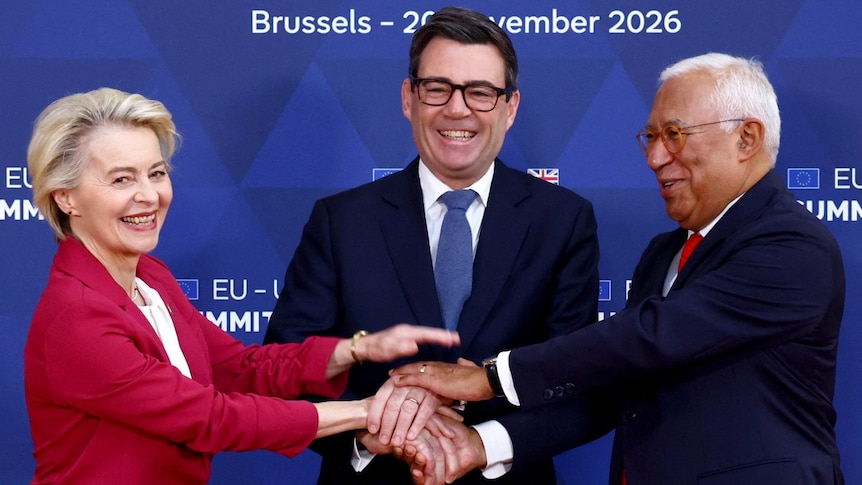
Key takeaways from UK-EU summit: Idea of Britain rejoining still on table
Key Points
Key takeaways from UK-EU summit: Idea of Britain rejoining still on table Leaders from Britain and the European Union say they have agreed several new deals in Brussels, as the United Kingdom's Prime Minister Andy Burnham attempts to reshape his country's relationship with its closest neighbours. At a landmark summit in Brussels on Friday, local time, Mr Burnham met European Commission President Ursula von der Leyen and European Council President António Costa to discuss multiple issues....
Key takeaways from UK-EU summit: Idea of Britain rejoining still on table
Leaders from Britain and the European Union say they have agreed several new deals in Brussels, as the United Kingdom's Prime Minister Andy Burnham attempts to reshape his country's relationship with its closest neighbours.
At a landmark summit in Brussels on Friday, local time, Mr Burnham met European Commission President Ursula von der Leyen and European Council President António Costa to discuss multiple issues.
They also signed several agreements that, if implemented in full, would remove Brexit red tape for some students, farmers and businesses on both sides of the channel.
It has been 10 years since the UK's Brexit referendum was held, and more than six since Britain actually left the EU.
The British PM has made it clear rejoining the bloc one day is not off the table.
Here are the key takeaways from the meeting.
Several deals 'done' already
Less than an hour after arriving at the summit in Brussels, Downing Street declared the UK had done several deals with the EU which could make life easier for British farmers, students and businesses.
The agreements still require final approvals in the UK and EU parliaments.
They would allow for 100,000 Europeans aged under 32 to travel, work and study in the UK each year. The same number of Brits would have the same rights in Europe, although there are still sticking points to iron out (particularly around the tuition fees charged to European students in the UK).
Meanwhile, a food deal agreed will slash paperwork and remove routine border checks for farmers and retailers exporting to the continent. A third agreement on carbon would link UK and EU emissions trading schemes.
Mr Burnham claims the deals could add 0.5 per cent to the UK's GDP. It's not clear exactly when they will come into effect.
Burnham's visit significant in itself
The deals signed are significant, but the fact Mr Burnham is in Brussels resetting Britian's relationship with his European partners smiling and shaking hands is arguably just as important.
While these agreements remain within the so-called "red lines" set by Mr Burnham's predecessor Sir Keir Starmer (things the UK can do to change its relationship with the EU without putting it to a referendum), the British PM has become the first leader since the Brexit vote to reopen debate about a possible return to the union.
Analysts see this meeting as an important step to Britain strengthening ties with its closest neighbours and it is entirely plausible Mr Burnham could be back in Brussels before long negotiating further deals or even discussing what a return to EU looks like.
That pathway though will be complicated and test just how much the UK wants it and whether it's willing to accept the terms Europeans offer to bring the UK back into the fold.
'A good day for Britain and Europe'
Mr Burnham told a news conference in Brussels most Brits wanted closer ties with the EU.
"People can see the status quo is not working. It's not good enough for Britain," he said, describing the past 10 years since the Brexit referendum as "a decade of drift".
"This is a good day for Britain, and this is a good day for Europe," he said.
Mr Burnham said his country needed to consider what the right long-term relationship with the EU was, and that he would seek "informal brainstorming" about what that could look like with colleagues in Europe in the next year.
At the same news conference, Mr Costa told reporters that Mr Burnham was "always welcome" in the EU. His deliberately vague statement got a laugh in the room for its dual meanings (Mr Burnham being welcome on the continent, and his country being welcome to rejoin the bloc).
Idea of rejoining or closer ties will face opposition
While it's true some opinion polls now say a majority of Brits favour rejoining the European Union, the realities are much more complex than that.
There remains a vocal and committed opposition to any such move in the UK (even the idea of closer ties with the bloc, without rejoining fully).
This point was underscored when the Godfather of Brexit, Nigel Farage, held a press conference in Brussels shortly after Mr Burnham's remarks with EU leaders.
Mr Farage, is a powerful political operator. He is an MP and leader of the right-wing populist Reform UK party, and enjoys significant support around the country.
On Friday, he told LBC the deal was "not a reset, it's a reverse" and told GB News Mr Burnham had "no mandate whatsoever" to align Britain more closely with the bloc.
Meanwhile, Kemi Badenoch, the UK's Opposition Leader and head of the centre-right Conservative Party, has previously said rejoining the EU will not "solve all our problems".
[Image text:] EL
MM
Brussels-20
ember 2026
EU-
MMI7
J
DEL
-UMN