
Politics
Far from home and family, islanders find community in SA's food bowl
Key Points
Far from home and family, PALM workers find community in SA's food bowl In short: Businesses in SA's Riverland offer specific services for thousands of PALM scheme workers. The annual influx is an economic boost to the region, with the citrus harvest coinciding with tourism's off-season. Business owners hope more support services and activities will be launched.
Far from home and family, PALM workers find community in SA's food bowl
In short:
Businesses in SA's Riverland offer specific services for thousands of PALM scheme workers.
The annual influx is an economic boost to the region, with the citrus harvest coinciding with tourism's off-season.
What's next?
Business owners hope more support services and activities will be launched.
Blue and white strips of fly screen flap in the breeze as island reggae music spills out on to the street.
In the afternoon sun, a group of weary workers laugh and joke as they tuck into lunch: fish lolo, goat curry and taro.
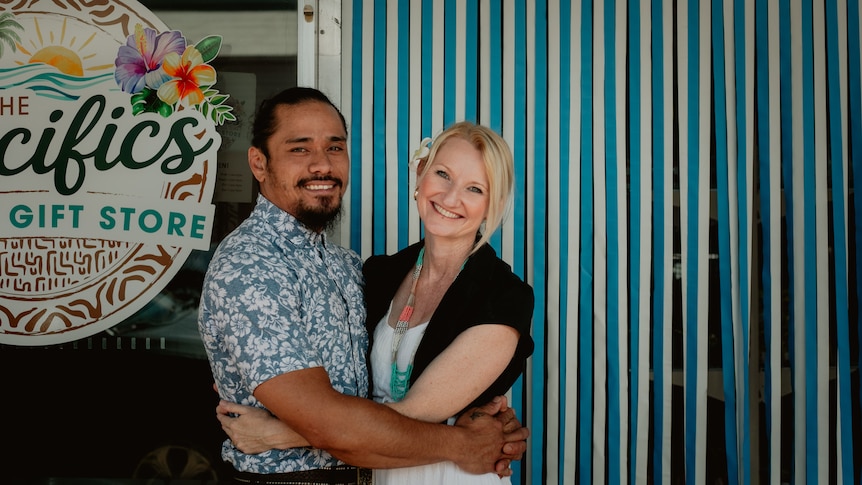
The shop, with its street dining, is officially called the Pacifics Food and Gift store but for Pacific Australian Labour Mobility (PALM) scheme workers, it is a home away from home.
The PALM scheme draws on labour from nine Pacific Island countries and Timor Leste to fill short- and long-term workforce shortages, predominantly in the agricultural industry.
It was not that long ago store owner, Sione Fahoko, was one of those workers. He remembers what it was like to arrive in South Australia's Riverland and, not knowing anyone, he felt isolated.
It was 2020 when he first came to Australia from Tonga. Three years later he met his wife Helen at a local pub.
Mr Fahoko's life looks very different now, swapping long days in the sun picking fruit to owning and running his own shop with his wife, Helen; the two of them creating the very place he could have used when he first arrived in the country.
"It's all for my little family and all for my Pacific people," he reflected.
"We want them to come [here] and feel like they come home from home."
Creating a village
More than 32,000 men and women were employed through the PALM scheme this year, which promotes economic growth for participants and their families.
But Mr Fahoko said he was worried about the social wellbeing of workers who felt disconnected from their culture while away from home.
"There is nothing to do. We just fish and drink," he said.
It's a sentiment shared by other Pacific Islanders, feeling both homesick and ill from the drastic change in diet.
"When I first met my wife, I feel sick, I feel broke most of the time," Mr Fahoko said.
"I asked my wife, I begged my wife, 'Love, can you please go hunting for Pacific food?'"
For Helen Fahoko, opening the store has also opened her heart to her husband's culture and she has been proud to see the impact it has had on the people who walk through the doors.
Cooking meals from his home country has also allowed her to connect more deeply with him and see him in his element.
"We just love seeing [customers] come in and be like, 'Oh my gosh, it's like being at home in my village'," she said.
"They definitely need something to make them feel a part of this community and not just that they're here to work and get their money.
"[Sione] gets quite excited about it because he's able to be like, 'This is me providing our home food to my own Pacific brothers and sisters'."
Big boost to small businesses
In the next town over, PALM workers have also become a mainstay of Tushar Patel's supermarket and laundromat business at Renmark.
After 4pm most days, a flock of white transit vans pull up outside his shop, signalling a rush hour he has grown accustomed to.
To serve this customer base, Mr Patel has added specialty grocery items and also expanded his money transfer options, from one platform to three to better cater for different home countries.
"Winter is always slow for any retailers … [during] that time they [PALM workers] come here and they push your business up. That's very important," he said.
"When they have a pay day, probably a hundred or more customers [come in]."
Charity by the container full
Nearby, Annette Axon helps run the Renmark opportunity shop, the proceeds from which go towards community organisation Renmark Paringa Independent Living, which builds units for the aging population.
The charity store manager said their business has been welcomed, and she has befriended many PALM workers.
"They're in nearly every day, every week and they just want everything," she laughed.
"They buy things like clothes and shoes to send home in shipping containers because it's very expensive over there to get anything, apparently."
For many workers who first arrive in the region, Ms Axon said her shop was often their first port of call to buy jackets and blankets to handle the colder winter.
"They're walking around with dressing gowns and beanies on and they're quite happy to just be comfy and they're not shy," she said.
"It's been a blast having them come in all year. They go home and then some of them come back and they're so lovely, so polite."
Back at the Pacific store, Mr and Ms Fahoko dream about expanding their small business.
Additionally, Mr Fahoko has his sights set on starting a touch football competition, to give Pacific Islanders more fun when they are not working.
"I'm very happy," he said.
"I'm so excited to live with my beautiful wife in Australia and run our business."
[Image text:] cifics
HE
GIFT STORE
SA (ORG)
Riverland (ORG)
PALM (ORG)
the Pacifics Food and Gift (ORG)
Pacific Australian (ORG)
Labour Mobility (ORG)
Pacific Island (LOCATION)
Timor Leste (LOCATION)
Sione Fahoko (ORG)
South Australia's (LOCATION)
Australia (LOCATION)
Tonga (LOCATION)
Helen (PERSON)
Fahoko (PERSON)
Pacific (LOCATION)