
Business & Finance
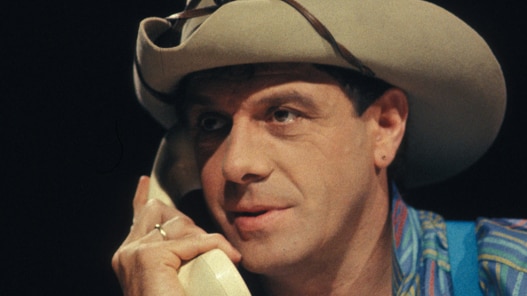
Molly was the original gatekeeper whose taste in music shaped our own
Key Points
analysis Molly Meldrum's refined musical brain told us what music was worth our time Every cause needs a champion. For many artists in the 1970s and 80s, that champion was a Stetson-wearing television host with a larrikin mentality and a deep love of music. "One tick of a box from Molly could mean your whole career," Peter Wilmoth, the author of Glad All Over: The Countdown Years 1974-1987, told the ABC in 2009.
analysis
Molly Meldrum's refined musical brain told us what music was worth our time
Every cause needs a champion.
For many artists in the 1970s and 80s, that champion was a Stetson-wearing television host with a larrikin mentality and a deep love of music.
"One tick of a box from Molly could mean your whole career," Peter Wilmoth, the author of Glad All Over: The Countdown Years 1974-1987, told the ABC in 2009.
Tour promoter Michael Gudinski once said Meldrum had done more for Australian music than anyone else. Music journalists Toby Creswell and Samantha Chenoweth described him as "the single most important person in the Australian pop industry for 40 years".
But when he implored his viewers to "do yourself a favour", he didn't just change the fortunes of artists.
He changed, and moulded, the musical tastes of a generation of Australians in a way that, in the 21st century, feels unique.
Crafting an Australian sound
Molly's expertise — he was always Molly in public, never Ian — came partly from his time working in the studio as a producer, which was his first love.
As he explained to ABC Radio National in 2013, Molly wanted a guitar melody after the chorus on Russell Morris's 1969 song The Real Thing, but the studio musician wasn't around — so Molly used his voice to mimic the sound of a guitar.
Listening back, he liked it so much he got Morris to re-do it. They never replaced the mimic with an actual guitar. You probably remember it as the "oo-mow-ma-mow-mow" part.
"It's probably the stand-out bit of the song," Molly said.
On that track, Molly employed phasing, a new studio technique at the time. He also got various people to ad-lib imitations of historical speeches for the collage at the song's end.
"I don't think in his wildest imagination Russell ever dreamed or thought what I was going to do to that song," Molly said.
The Real Thing went to number one and became an Australian classic.
Morris told the ABC in 2013: "To be totally honest and fair, the whole architecture of the whole song was Ian's. And without Ian, it never would have been anything like it turned out to be."
An advocate for unsung artists
After winning Eurovision in 1974, Swedish band ABBA were struggling to maintain relevance, with their second single, I Do, I Do, I Do, not generating much buzz.
"But we have our Australian friends to thank for the fact that we came back," the band's Benny Anderson said in an interview a few years ago on Channel Seven.
According to Anderson, Molly heard an early cut of Mama Mia and started boosting the Swedish group on Countdown, which had just begun airing.
The band subsequently blew up in Australia, scoring multiple number ones, before going worldwide.
Having covered both the Australian and British pop scenes as a correspondent for music magazine Go-Set in the late 1960s and early 70s, Molly knew what was good.
And he would advocate for it on Countdown, in his idiosyncratic way — what Wilmoth called Molly's "incapacity to get through a sentence without all these tributaries and estuaries and all these lovely bits that didn't make sense".
"We loved Molly, and we loved the fact that he was never critical," Wilmoth said.