
Science
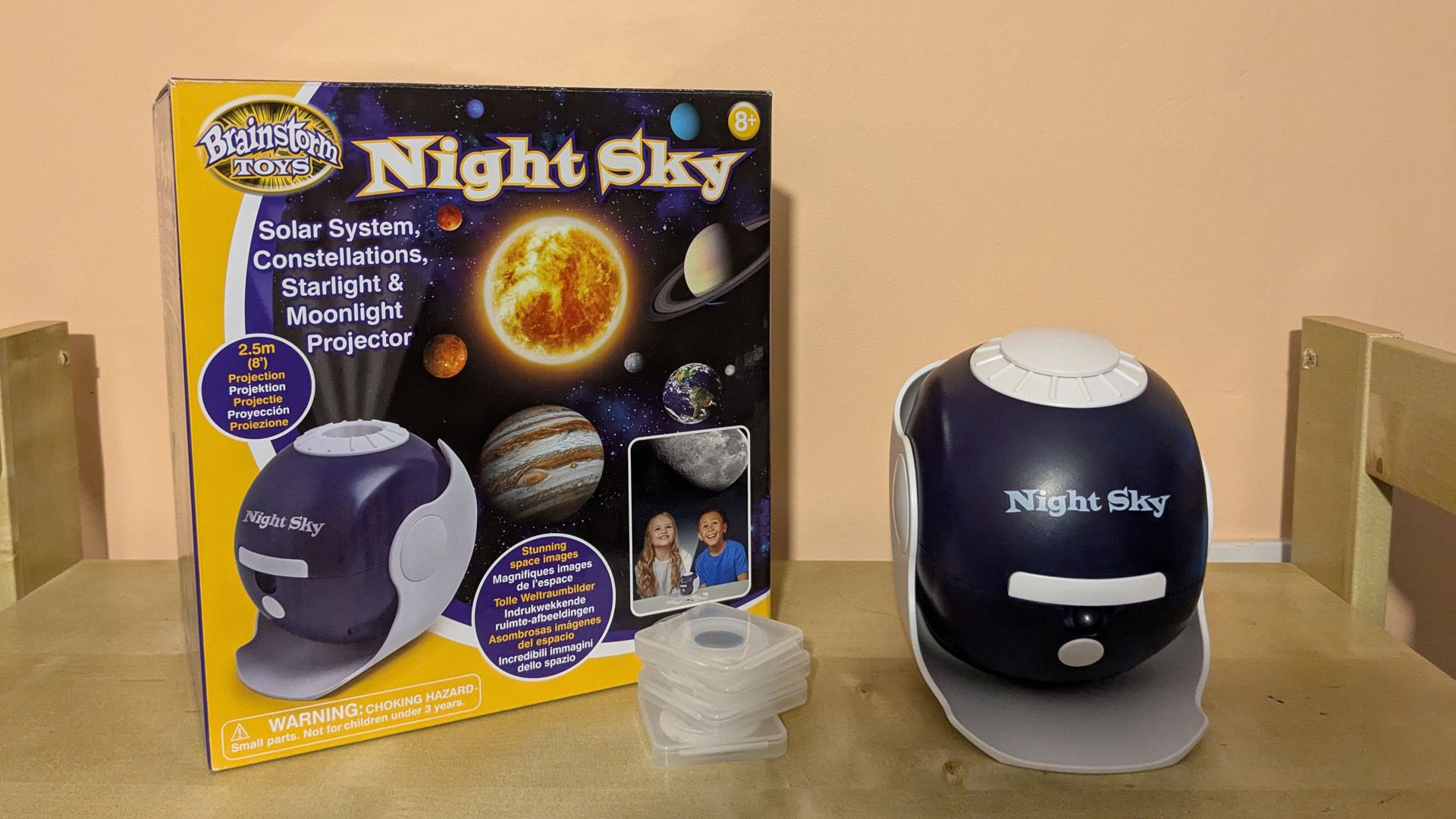
I’m planning my first dark sky trip, and all because this educational star projector showed me what I’m missing
Key Points
This projector is a handy, budget-priced tool for educating young stargazers, especially when it comes to teaching them about constellations. It’s easy to use and offers excellent image quality for its size — it’s just disappointing the selection of slides is so limited. Reasons to buy - + Child-friendly and easy to use - + Educational value - + Clean, crisp images - + Compact, portable design Reasons to avoid - - No extra slide packs - - Fixed 30-minute shut-off - - Requires three AA...
Space Verdict
This projector is a handy, budget-priced tool for educating young stargazers, especially when it comes to teaching them about constellations. It’s easy to use and offers excellent image quality for its size — it’s just disappointing the selection of slides is so limited.
Reasons to buy
- +
Child-friendly and easy to use
- +
Educational value
- +
Clean, crisp images
- +
Compact, portable design
Reasons to avoid
- -
No extra slide packs
- -
Fixed 30-minute shut-off
- -
Requires three AA batteries (not included)
Why you can trust Space.com
I didn’t expect much as I unboxed the Brainstorm Night Sky; after all, I’m significantly older than this educational star projector’s target audience. Perhaps I’d come away with a sense of wonder and delight, coupled with mild irritation at having to hunt down three AA batteries to power it.
Instead, I was filled with envy as the Brainstorm Night Sky reminded me just what I was missing, thanks to the rigors of light pollution. A few minutes after powering it down, I was already making plans for my first dark sky trip, yearning for a view that rivaled the Brainstorm’s cosmic images.
Brainstorm Night Sky Projector review
Whatever your age, the Brainstorm Night Sky is so simple to use
Draw the curtains, press the Night Sky’s single button (tilting the projector and twisting the focus as appropriate) and it projects a circular image onto a ceiling or wall. Press the button again and the projection slowly begins to rotate, slowly but stutter-free. It really is that simple to operate and, aimed at budding astronomers aged eight or above, it's reasonably lightweight without feeling flimsy.
Weight: 14.8 oz (420 g)
Bulb type: Non-specified
Laser: No
Control: On-unit
Rotation: Yes, one speed
Projection area: Up to 8.2 ft (2.5 m)
Sleep timer: Yes (30 mins)
Power: 3x AA batteries
Speaker: No
I was initially a little surprised by the size of the projection: at up to 8.2 feet (2.5 m) wide it’s not going to fill an entire ceiling. It also switches off after 30 minutes, a limit that can’t be disabled, so if you’re looking to put on your own space-themed party this is not the projector for you. But it’s on point for home education and, priced from $49.99, the Brainstorm Night Sky projector won’t break the bank.
There’s minimal distortion around the edge of the images; the planets are spherical from the word go, unlike some projectors where I’ve had to tweak them to stop Mars turning into an egg. And I never once had to crane my neck because half the solar system had been projected onto a bookcase.
This projector revealed what light pollution had taken from me
The Brainstorm Night Sky model I tested comes with four slides, each with a case to protect them from smudges and sticky fingers. You place one into the provided slide housing then insert that into the projector. There’s the moon, the solar system, and two showing the Northern Hemisphere’s night sky, as seen from Hawaii (a key location for astronomy).
I can appreciate the educational value of the first couple, even if I am still seething at Pluto being demoted back in 2006. But it was the latter pair of slides that really opened my eyes to what I could be seeing over my head.
I can spot maybe 10-20 stars from my backyard, cloud cover permitting; thanks to light pollution, that’s it. Even though the best stargazing apps can show me what I should see, when I step outside, all I typically see with the naked eye is the odd pinprick in the void.
But as soon as I inserted that third slide, a striking stellar display appeared above my head, with more stars than I could hope to count. Even knowing that Hawaii’s night sky stretches far further than eight feet across, the difference between this view and the one from my house was like night and day. Brainstorm claims this slide features over 20,000 stars, though that’s likely referring to the source photo rather than the projected image.
The fourth slide — the same crisp starscape but with every visible constellation labelled — was almost as attention-grabbing. Educational value aside, it drove home that I couldn’t see the majority of these star patterns to name them, my local night sky is that polluted.
Knowing what I was missing out on made me determined to take my stargazing further afield. Some of the best smart telescopes can lessen the impact of light pollution, but stepping away from skyglow is the most effective option. Hawaii’s a little far to travel, but I’ve already started looking into local dark sky sites. I just need to grab a pair of the best binoculars for stargazing, hop on my bike and I’m ready to go.
The Brainstorm Night Sky is a solid, budget-priced educational tool, but it has one drawback
The Brainstorm Night Sky’s projections are crisp enough that you can easily make out every constellation name, but they could be a hair brighter. The Ainael Meter Galaxy Projector, for example, delivers more illumination.
If you want to use the Brainstorm Night Sky to relax, the rotate function gives its projections an oddly hypnotic effect, and the device is whisper-quiet to boot. And while Brainstorm doesn’t specify battery life, one set of rechargeables lasted me for several days.
Unfortunately, the Brainstorm Night Sky's slide collection is a little limited. There are two models, a blue version with four slides (the one I tested) and a gray version with six slides (featuring additional space shuttle and black hole images). The included instructions state you can purchase an additional slide disc showing the Southern Hemisphere’s stars, but that’s a maximum of seven images. Nor is this projector compatible with the slides from the Brainstorm Deep Sky Projector
It’s a little disappointing given that Brainstorm has clearly put thought into the projector’s educational value. Those instructions double as a poster of the solar system, and children can use a “secret code” (printed on the instructions) to explore more astronomy facts on the company’s website.
Offering extra slide packs, of the kind you can buy for the Pococo Galaxy Projector, would give it more long-term appeal. As is, I can see its novelty and educational value diminishing over time, at which point you can upgrade to one of the best star projectors.
If you’re not bothered by the lack of expandability, the Brainstorm Night Sky’s price, image quality and ease of use still make it a useful tool for kindling a child’s interest in astronomy, or as a budget-friendly gift for junior stargazers. It’s certainly spurred me into action — how much is a plane ticket to Hawaii, anyway?
Chris is a freelance journalist who, aside from covering games and gaming-related tech, has a taste for horror, sci-fi and the post-apocalyptic. As well as Space.com, you can find his work at GameSpew (where he’s the weekend editor) and more. You can follow him on Twitter @MarmaladeBus.
You must confirm your public display name before commenting
Please logout and then login again, you will then be prompted to enter your display name.
[Image text:] Night Sky
TOYS
Solar System,
Constellations,
Starlight &
Moonlight
Projector
8
.5m
Proyeccion
Night Sky
Stunninges
Indru
del e
WARNING:CHOKING HAZARD-
A
Night Sky