
World News
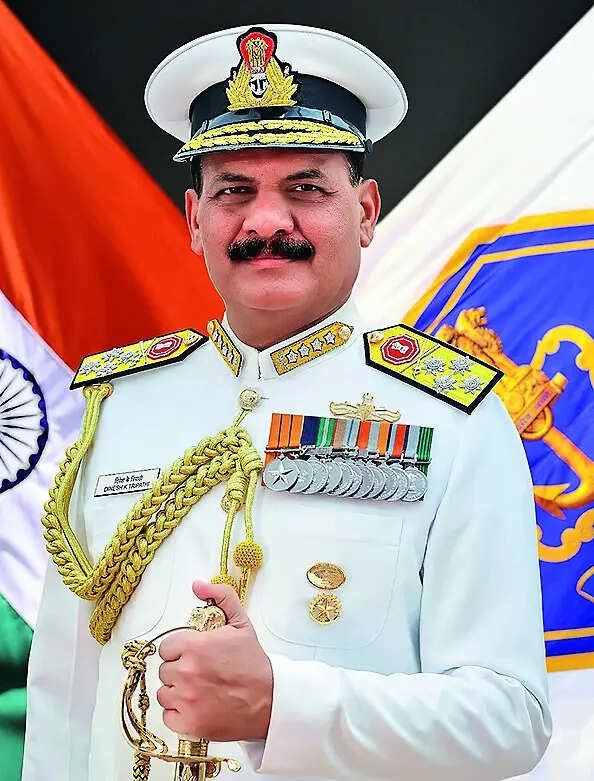
Navy delivered blow to Pak's economy during Op Sindoor: Admiral Tripathi
Key Points
Submarine deal with Germany in a few months with tech transfer; Navy delivered blow to Pak's economy during Op Sindoor: Admiral Tripathi Admiral Dinesh Kumar Tripathi, who led the Indian Navy during Op Sindoor and spearheaded operations to safeguard India’s energy vessels during the Gulf conflict, is also credited with the Navy’s technological transformation, fleet modernisation and unprecedented maritime operations. On the eve of his completion of his over two-year term as 26th Chief of...
Submarine deal with Germany in a few months with tech transfer; Navy delivered blow to Pak's economy during Op Sindoor: Admiral Tripathi
Admiral Dinesh Kumar Tripathi, who led the Indian Navy during Op Sindoor and spearheaded operations to safeguard India’s energy vessels during the Gulf conflict, is also credited with the Navy’s technological transformation, fleet modernisation and unprecedented maritime operations. On the eve of his completion of his over two-year term as 26th Chief of Naval Staff since April 30, 2024, Admiral Tripathi spoke exclusively to TOI’s Surendra Singh.Q1. Pakistan is acquiring eight advanced Hangor-class subs from China in a major fleet modernisation program. We can build nuclear subs but we need foreign collaboration for assembling conventional subs in India. Why? When can we expect India to ink the sub deal with Germany to raise our sub fleet?A. The undersea domain remains central to maritime deterrence and operational capability. Naturally, the Indian Navy continues to accord very high priority to submarine capability enhancement. Nuclear submarines and conventional submarines involve different operational philosophies, technologies, and distinct industrial ecosystems. While India has made remarkable progress in strategic nuclear submarine capability, certain advanced conventional submarine technologies still require collaborative development and technology partnerships.India's submarine-building journey has always been a phased one, designed to build national capability step by step. Our approach has been to build that ecosystem progressively through technology transfer, indigenous design growth, and domestic manufacturing capacity.
Q4. Keeping in mind the attacks on India-bound oil tankers during the Iran war, does the Indian Navy have a long-term plan, like setting up naval bases in the Gulf, to secure our maritime trade route?A. India’s economic growth and energy security are closely linked to safe and secure maritime trade routes, and the Gulf region and Strait of Hormuz remain amongst the world's most critical energy corridors. The Navy’s immediate priority has been to ensure safe passage through the Strait of Hormuz and the wider Arabian Sea through presence, surveillance, and escort when needed. The core challenge is not only the threat of attack, but also the volatility created by regional conflict, shipping disruption, insurance escalation, and uncertainty for energy flows.Our long-term plan to secure these maritime trade routes has been to strengthen maritime domain awareness, operational reach, and partnerships, rather than rely on any single fixed solution. At present, our operational philosophy is based on a comprehensive framework anchored on sustained operational presence, continuous Mission-Based Deployments, forward deployments, access arrangements, logistics agreements, and flexible operational reach across areas of strategic interest. We maintain a continuous presence in critical shipping lanes, such as maintaining one ship continuously in the Gulf of Aden for anti-piracy duties since 2008. Furthermore, our Information Fusion Centre - Indian Ocean Region (IFC-IOR) has established linkages with partner countries to coordinate operational responses and ensure persistent awareness across the entire region.Importantly, maritime security today requires collective effort, cooperative frameworks, and rapid response capability. India therefore continues to work closely with regional partners and friendly navies through closer cooperation, coordinated patrols, and logistics partnerships to ensure safe, secure, and stable seas. The aim remains to secure critical trade routes through flexibility, reach, and persistent awareness. Maritime security and energy security are inseparable. Persistent forward presence enhances both deterrence and reassurance.Q5. With China increasing its bases in the Indian Ocean Region, what steps should the Indian Navy take to play a dominating role in the region?A. The Indian Ocean Region is witnessing increasing strategic contestation and greater extra-regional presence. The Indian Navy continuously monitors all developments relevant to India's maritime security environment closely and remains laser-focused on maintaining our combat edge.However, the Indian Navy's efforts are not aimed at any specific nation, nor do we frame our objectives merely around "dominating" the region. Our overarching goal is to ensure the absolute security of India's maritime interests and contribute to a stable, free, open, and inclusive Indo-Pacific.To achieve this, our approach remains capability-driven and focused on several strategic steps. First, we are augmenting our force levels and a balanced fleet structure, remaining firmly on course to become a 200-plus ship Navy by 2035. Second, we have consistently maintained high operational tempo and persistent operational reach through mission-based deployments and comprehensive maritime domain awareness, keeping our ships and aircraft in near-continuous presence at critical choke points and across the Indian Ocean Region. Finally, India has significantly deepened regional maritime cooperation and capacity building under the vision of MAHASAGAR. We have expanded bilateral and multilateral exercises, logistics agreements, coordinated patrols, and operational engagements with friendly foreign countries to strengthen interoperability and collective security.Central to this is the IFC-IOR, which serves as an important regional maritime coordination and information-sharing platform involving multiple partner countries and agencies. Ultimately, influence in the maritime domain is built through capability, credibility, partnerships and sustained presence. In strategic terms, India must remain the most capable, most responsive and most trusted maritime power that regional navies trust in times of crisis, which is where our first-responder role, HADR capability and partnership ethos matter most. Maritime influence is built through capability and credibility.Q6. Under your command, the Navy has witnessed the transition into a future-ready force through the active integration of AI and quantum technology? What are your expectations from the Navy and the Indian govt?A. Modern warfare is undergoing profound technological transformation, and future conflicts will increasingly be shaped by AI-enabled systems, autonomous platforms, cyber capability, quantum technologies, data-centric operations, and decision superiority. The future battlespace will reward forces that can integrate technology, operational concepts, and human capability seamlessly, which is why the Indian Navy has focused on becoming a technologically adaptive, data-enabled, operationally agile, and future-ready force.The transition toward a future-ready force has been immensely supported by national initiatives like 'Make in India', the Technology Development Fund (TDF), and Innovations for Defence Excellence (iDEX). Currently, the Indian Navy owns 35% of the challenges under iDEX, driving massive innovation within our startup and innovation ecosystem. In terms of AI, we established the Indian Navy Incubation Centre for Artificial Intelligence (INICAI) and the CRYSTAL AI Data Centre and Lab in Bengaluru, which are already running around 45 use cases across operations, logistics, administration, situational awareness, predictive maintenance, target classification, decision support, and language processing. For Quantum technologies, we are partnering with Indian deep-tech startups to explore the development of indigenous systems, with work on secure communications and quantum positioning forming part of our broader effort to operate confidently in contested and GPS-denied environments.My expectation from the Navy is that it remains an adaptive learning organisation, willing to absorb technology quickly and operationalise it responsibly. I am confident that the govt and the wider ecosystem will provide continued and sustained support for indigenous R&D, faster procurement pathways, advanced manufacturing, dual-use technologies, and sustained investment in secure digital and maritime infrastructure. We must continue to build sovereign technological capability in critical domains. Our focused, concept-based induction of these technologies will enable the Navy to remain combat-ready, credible, cohesive, and future-ready with the decisive asymmetric and technological edge needed for the decades ahead. Technology alone will not win wars, integrated capability will. AI and autonomous systems are becoming central to future maritime warfare.
End of Article