
Business & Finance
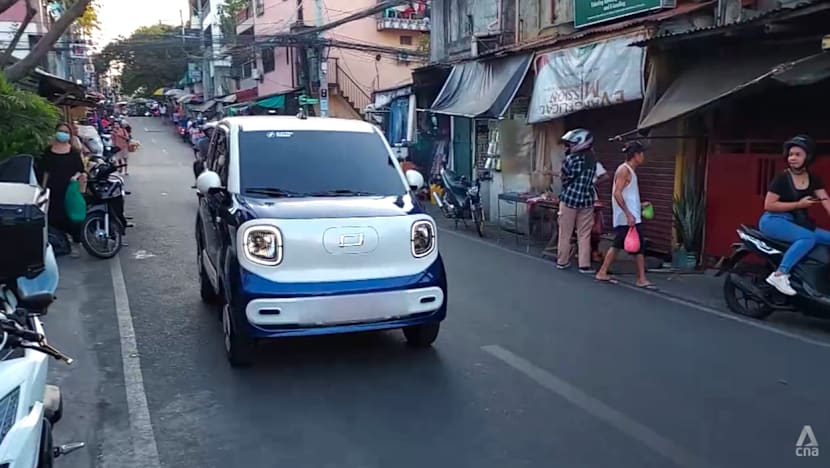
Philippines sees surge in EV demand as high fuel prices drive shift
Key Points
Philippines sees surge in EV demand as high fuel prices drive shift EV sales in the Philippines jumped 36 per cent in the first quarter this year as motorists sought alternatives to soaring petrol prices. For Rommel Aceron, driving is a daily necessity. The Manila resident spends long hours on the road, shuttling from one city to another for work, running errands and acting as his family’s personal chauffeur.
Philippines sees surge in EV demand as high fuel prices drive shift
EV sales in the Philippines jumped 36 per cent in the first quarter this year as motorists sought alternatives to soaring petrol prices.
MANILA: For Rommel Aceron, driving is a daily necessity. The Manila resident spends long hours on the road, shuttling from one city to another for work, running errands and acting as his family’s personal chauffeur.
That heavy usage has made his recently-purchased electric vehicle an increasingly valuable investment.
''In one whole day, with one single charge, when (I get) home, I still have 40 to 50 per cent (of battery life left),” he told CNA.
The switch from traditional internal combustion engine vehicles has also significantly reduced his transportation expenses at a time when fuel prices have surged.
''Instead of me spending 8,000 pesos (US$130) per month for gasoline, now I’m just spending a few hundred pesos,” Aceron said.
With local gas prices having more than doubled since March following the conflict in the Middle East, many Filipino motorists are beginning to see the benefits of switching from conventional vehicles to electric ones.
The energy shock has helped fuel a sharp rise in EV sales across the Philippines. Industry data shows EV sales jumped 36 per cent year-on-year in the first quarter of 2026.
However, the growing popularity of EVs has also exposed challenges, including limited supply and an inadequate charging network.
Mike Lim, founder and CEO of EV Supreme, said sales at his Metro Manila dealership have increased eightfold since the oil crisis began.
“Some way, somehow we have to find an alternative solution in terms of mobility, transportation and commuting. Probably one way to resolve (the soaring fuel prices) is by using electric vehicles,” he said.
According to the Department of Energy (DOE), around 14,000 EVs were sold in the first quarter of 2026 alone – almost half of the 32,000 units sold throughout all of 2025.
DEMAND SURGE, SUPPLY BOTTLENECKS
The rapid increase in demand has caught many industry players by surprise, creating supply bottlenecks and long waiting lists for buyers.
“Most of the brands have a waitlist now, because nobody anticipated (demand) to be (so high),” said Willy Tee Ten, president of the Electric Vehicle Association of the Philippines.
To address the shortage, dealers are actively seeking additional vehicle allocations from overseas manufacturers. Many attended the recent Beijing International Auto Show to secure more supply.
The Philippine government has set an ambitious target of achieving 50 per cent EV adoption on the country's roads by 2040. To encourage the transition, authorities are offering incentives, including specialised car loans.
LACK OF CHARGING INFRASTRUCTURE
While EVs offer lower operating costs and reduce carbon emissions, major obstacles continue to deter Filipino consumers, including high upfront purchase prices and insufficient charging infrastructure.
Under the government's EV roadmap, more than 7,000 charging stations are expected to be installed nationwide by 2028. Currently, only about 900 are operational.
Patrick Aquino, director of the DOE's Energy Utilization Management Bureau, said strong private-sector interest exists. However, regulatory and accreditation requirements can delay projects by at least six months before construction can even begin.
Industry observers note that expanding the number of charging stations is only part of the solution. Many existing facilities rely on slower charging technologies, raising concerns among motorists about convenience and driving range.
For commercial operators, charging times remain a significant concern.
''It’s different when you use gasoline or crude than when you use electricity. Because when you have low battery, you need to recharge and that (takes) time,” said Glenford Philip Artuz, a transport network vehicle service operator.
As EV adoption accelerates, both government and industry stakeholders face mounting pressure to expand infrastructure, improve charging efficiency and secure vehicle supply.
Without those improvements, experts warn it could be difficult for the Philippines to achieve its long-term electrification goals.
Philippines (LOCATION)
EV (ORG)
MANILA (LOCATION)
Rommel Aceron (PERSON)
CNA (LOCATION)
Aceron (ORG)
the Middle East (LOCATION)
EVs (ORG)
Mike Lim (PERSON)
EV Supreme (ORG)
Metro Manila (LOCATION)
the Department of Energy (ORG)
Willy Tee Ten (PERSON)
the Electric Vehicle Association of the Philippines (ORG)
Beijing International Auto Show (EVENT)