
Business & Finance
Why The Macallan remains one of the world’s most coveted single malt whiskies
Key Points
Why The Macallan remains one of the world’s most coveted single malt whiskies From sherry-seasoned oak casks in Spain to its striking Speyside distillery, The Macallan has built a whisky world around patience, provenance and luxury. Scotland has always known how to command the global stage, lending its dramatic landscapes and finest exports to everything from Hollywood blockbusters to peak-TV dramas. At The Macallan Estate, that cinematic prestige is palpable.
Why The Macallan remains one of the world’s most coveted single malt whiskies
From sherry-seasoned oak casks in Spain to its striking Speyside distillery, The Macallan has built a whisky world around patience, provenance and luxury.
Scotland has always known how to command the global stage, lending its dramatic landscapes and finest exports to everything from Hollywood blockbusters to peak-TV dramas. At The Macallan Estate, that cinematic prestige is palpable. Hosted by Rachel Walters, the distillery’s director of operations, a dinner at its TimeSpirit restaurant feels like a scene out of Wuthering Heights. The dining room overlooks a sweeping vista of lush green lawns, framed by trees basking in the springtime sunshine. Somewhere between dessert and the final glass, you realise that while Scotland dominates screens worldwide, some of its most revered Speyside spirits are the ones poured right in front of you – and none captures the imagination quite like The Macallan.
Set against the banks of the River Spey, The Macallan has elevated whisky into the realm of haute luxury with unusual precision: sherry-seasoned oak casks, painstaking maturation, and releases so rare they now trade like fine art. To understand what makes it singular, one must travel not further into the Highlands, but far south, to the sun-bleached chalk plains of Andalusia. The soul of this Speyside whisky was, in a sense, born in Spain.
In the Sherry Triangle, that ancient territory defined by Jerez de la Frontera, El Puerto de Santa Maria and Sanlucar de Barrameda, the land itself is the first ingredient. The soil here is albariza: startling, almost lunar white, dense with calcium carbonate and compressed fossils of prehistoric seas, yet porous. It reflects the punishing Andalusian sun back onto the vine while holding moisture deep in its chalky core through nearly three hundred days of annual sunshine. From this improbable earth grows the Palomino Fino grape: neutral, unremarkable on its own, yet precisely because of that neutrality, a perfect vessel for what the land and the winemaker wish to express.
But to speak of Sherry in the abstract is to miss the particular humanity behind The Macallan’s casks. The distillery looks instead to Valdespino, and Valdespino is something rarer than a supplier. It is a living inheritance.
Founded in 1264, it is among the oldest operating bodegas in Spain, its history pre-dating Columbus, the printing press and the unification of the Spanish crown. For most of those seven and a half centuries, it has remained a family enterprise: intimate in scale, ferocious in standard. Its crown jewel is the Pago de Macharnudo, a single elevated vineyard widely regarded as the grand cru of the Sherry Triangle: pure albariza where the chalk runs deepest and the Palomino vines yield fruit of uncommon concentration. Fermentation here still takes place in oak, a practice now rare elsewhere in Jerez, preserving a textural depth from the very first moment of vinification. Nothing has been optimised for speed or volume. Here’s a fun fact: Valdespino is the only Jerez bodega to be a member of Grandes Pagos de Espana, an association of bodegas that make single-vineyard wines.
The Macallan recognised a kindred philosophy. In 2023, Edrington, The Macallan’s parent company, acquired a 50 per cent holding in Bodegas Grupo Estevez, Valdespino’s parent company, securing supply and aligning two operations separated by a thousand miles but animated by the same instinct. Through that partnership, Valdespino seasons new oak casks, both European and American, with premium Oloroso for an average of eighteen months to two years before a drop of Scottish spirit touches them.
Once fortified beyond 17 per cent alcohol, the Palomino-based Oloroso surrenders itself to oxygen. The result is oxidative ageing: slow, deliberate, transformative. The wine darkens and acquires layers of dried fruit, roasted nuts and warm spice, what Walters, over dinner, called simply “liquid Christmas cake”. The casks are then shipped north to Speyside, carrying within their grain the flavours of white Andalusian soil, centuries of cellar knowledge, and the quiet alchemy of a grape that chose, in its neutrality, to become everything.
Kirsteen Campbell, The Macallan’s master whisky maker, speaks of this process with a precision that is also, unmistakably, a form of reverence. The work, she notes, begins not when the spirit is distilled but years before: sourcing, toasting and Sherry-seasoning each cask demands five to six years of preparation before a single drop of new-make spirit is introduced. Up to 80 per cent of The Macallan’s final flavour, and 100 per cent of its natural colour, originates from those casks. The distillery’s new-make spirit arrives as a canvas. The cask is the painter.
That spirit begins, as all single malt must, with barley. At Easter Elchies, the home estate where the distillery has stood in various forms since 1824, the barley is mashed and fermented before encountering the instrument that will most define it before wood takes over: copper.
The Macallan’s stills are short and wide by industry standards, deliberately so. Taller stills produce lighter spirits, heavier compounds falling back before the cut. Shorter stills allow those robust congeners to travel through, contributing a richness that longer-necked distilleries may not replicate in the same way. The copper, as the wash is heated, strips sulphur compounds from the liquid, cleaning the spirit before it reaches the condenser. A second distillation in the spirit still produces the heart of the run: clear, concentrated, between 60 per cent and 70 per cent alcohol, and almost secondary to the cask work that awaits it.
The distillery that houses this process is itself an extraordinary object. Completed in 2018 at a cost of £140 million (US$188.38 million; S$240.57 million) and designed by Rogers Stirk Harbour + Partners, the building was commissioned as “a cathedral to whisky,” in the words of Edrington, The Macallan’s parent company. Approached through a choreographed landscape of barley fields and a dedicated oak arboretum, the building reveals itself slowly, its undulating roofline echoing the ancient earthworks of the Scottish landscape. That roof is alive: 3,620 sq m of native meadow grasses and wildflowers growing above 1,750 glued laminated timber beams, the structure supported by 700 tonnes of steel.
Inside, production cells are arranged in open plan so that visitors can observe every stage of the whisky-making process simultaneously – mashing, fermentation, distillation – as though the building itself is making an argument about transparency in a trade that has historically preferred mystique.
To taste across The Macallan’s age expressions is to understand that time, here, is not merely a number on a label. It is an argument.
The Double Cask 15 Years Old is where many serious encounters with The Macallan begin, and which I had the privilege to sample. The marriage of European and American oak, both sherry-seasoned and each pulling in a slightly different direction, creates a tension that resolves, on the palate, into something harmonious and precise. On the nose, there is dried fruit and baked apple, balanced with notes of chocolate and smooth oak. Then on the palate, sweet raisin and sultana build with cinnamon and nutmeg, mingled with creamy vanilla, a freshness that lifts what might otherwise become heavy. It is less a sensorial journey than a conversation: two woods, two climates, one Andalusian grape, and fifteen Scottish winters arriving simultaneously at the same conclusion. The finish is medium, with lingering oak and spice.
The Macallan Sherry Oak 18 Years Old features a single malt whisky matured exclusively in hand-picked, sherry-seasoned European oak casks from Jerez for richness and complexity. It has a rich profile of dried fruits, ginger and dark chocolate, ending with a sweet orange and spice finish, complemented by a light mahogany natural colour. The finish lingers with dried fruits, ginger and oak. It is, for me, the most complete expression in the range.
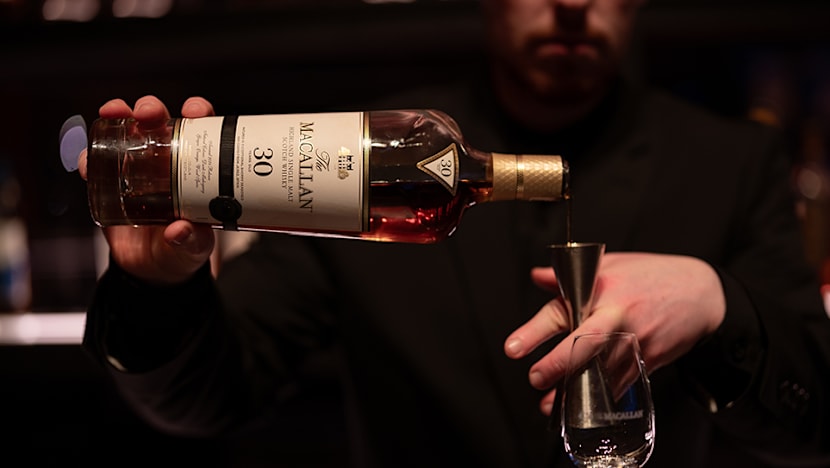
Then, there is the 30. Where younger expressions balance and brighten, the Single Malt 30 Years Old simply presides. Three decades of dialogue between spirit and wood have moved past negotiation into something more like fusion. Matured in sherry-seasoned European oak casks and released annually in small, carefully curated batches, The Macallan’s new-make spirit is transformed into a single malt whisky of exceptional richness and complexity, revealing notes of wood spice, stem ginger and orange. The dried fruits are no longer notes so much as textures, absorbed into the whisky’s very structure. The spices have become architectural. On the palate, you taste rich fruit cake and prunes with stem ginger, cinnamon and orange essence leading to gentle toasted oak, and the finish is long and rich with oak, spice and orange.
What unites all three expressions, beyond the shared grammar of European and American oak and beyond the Valdespino Oloroso that seasons the casks, is an insistence on natural colour. “No caramel addition, no artificial adjustment,” said Campbell. The colour in the glass is the colour of time: of Andalusian chalk and Spanish cellar air and the slow migration of Sherry from wood fibre into Speyside spirit across years that can only be waited through, never hurried. Walters added, “We’re intentional about how we craft our whiskies. We’re in this for the long game.”
The commercial record confirms it. In November 2023, a bottle of The Macallan Valerio Adami 1926, drawn from a single legendary cask with a label designed by the Italian pop artist, sold at Sotheby’s London for £2.18 million, the highest price ever recorded at auction for a bottle of whisky. It was not an anomaly. Earlier releases from the same cask had already crossed the million-pound mark.
What drives these numbers is not merely scarcity, though scarcity is real and carefully managed. It is the convergence of everything the brand has spent two centuries constructing: genuine craft, traceable provenance, and a production philosophy resistant to shortcut. A 30-year-old Macallan is the accumulated product of six years of cask preparation in Jerez, three decades of maturation in Speyside, and the institutional knowledge of a distillery that has, at every stage, chosen the slower and more expensive path. The brand has also expanded its luxury appeal to a spectrum that may not be whisky-first, through collaborations with Bentley Motors, Lalique, Cirque du Soleil, Stella and Mary McCartney, and the James Bond 007 franchise. The Lalique collaboration was notable for The Genesis Decanter, released in 2018 to celebrate the opening of the new distillery, containing a 72-year-old spirit and presented in a uniquely wide and flat Lalique decanter. This is the language of fine art: a work with a clear line of attribution, from soil to glass.
As dinner eventually clears and the conversation winds down, the liquid that remains in the glass is amber, unhurried, carrying within it the chalk plains of Andalusia, the copper stills of Speyside and the patience of decades. The Macallan’s spirits, like its gorgeous cinematic landscapes, will impress upon your memory long after the night ends.
CNA Luxury travelled to The Macallan Estate in Speyside at the invitation of The Macallan.
Macallan (ORG)
Spain (LOCATION)
Speyside (ORG)
Scotland (LOCATION)
Hollywood (LOCATION)
The Macallan Estate (ORG)
Rachel Walters (PERSON)
TimeSpirit (ORG)
Wuthering Heights (LOCATION)
vista (ORG)
the River Spey (LOCATION)
Highlands (LOCATION)
Andalusia (LOCATION)
the Sherry Triangle (LOCATION)
Jerez de la Frontera (ORG)