
World News
From sketch plans to 3D scans: How could new tech change the way Singapore police solved a murder case?
Key Points
From sketch plans to 3D scans: How could new tech change the way Singapore police solved a murder case? Ten years ago, police used sketches and photographs to reconstruct the crime scene in the Tanah Merah Ferry Terminal murder. But how could 3D scanners and drones have changed the way police solved the case?
From sketch plans to 3D scans: How could new tech change the way Singapore police solved a murder case?
Ten years ago, police used sketches and photographs to reconstruct the crime scene in the Tanah Merah Ferry Terminal murder. But how could 3D scanners and drones have changed the way police solved the case?
SINGAPORE: When a woman's body was found partly submerged in a deep, narrow drain at Tanah Merah Ferry Terminal, Deputy Superintendent of Police (DSP) Tan Boon Kok's priorities were clear: find out who the victim was and identify the suspect.
His team started interviewing witnesses and establishing what happened. They found two possible crime scenes: the drain and a cleaner's room.
Inside the room was a gruesome sight – blood splattered on walls and on objects near a makeshift bed, as well as a cardboard sheet on top of the bed.
Some stains were smudged, as though someone had tried to wipe them away. Others were left untouched.
DSP Tan's team took photo after photo, building a visual record of the scene. With these, they later sketched the crime scene to figure out what transpired.
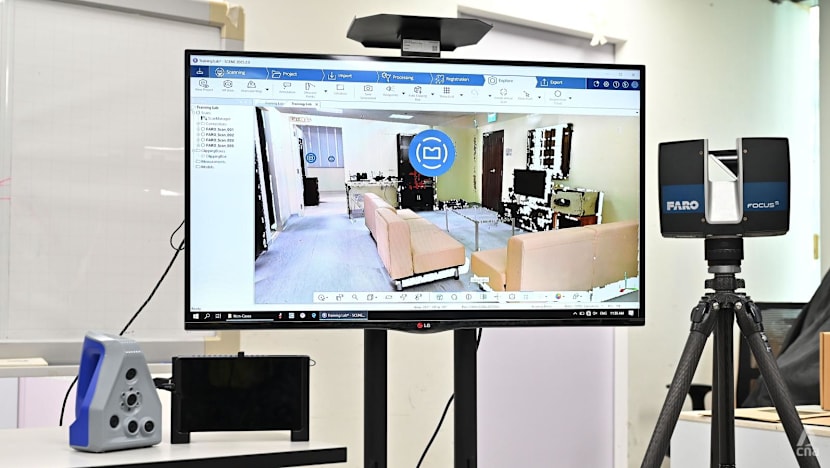
That was 10 years ago. Today, the process looks entirely different – a 3D scanner can capture the room in a few sweeps and generate a detailed model.
DSP Tan drew these comparisons during an interview with the media on Monday (Jun 8). He was joined by senior crime scene specialist Toh Ah Hong, who was also part of the team that investigated the Tanah Merah murder case.
"Back in 2016, the scene was documented with photography and sketch plans, which were two-dimensional," said Mr Toh, who is from the Home Team Science and Technology Agency (HTX).
He was deployed to the forensics division of the Singapore Police Force's (SPF) Criminal Investigation Department (CID).
"With current 3D scanning technologies, we can produce a digital twin of the scene, which allows us to revisit the scene anytime to take additional measurements, for example.
"In fact, for this case, we revisited the scene several times to take further measurements – such as the distance from the cleaner's room to the drain where the body was found – which could have been augmented through 3D scans," he said.
If the crime scene is large, drones flying up to nearly 60m high can capture high-resolution shots of the entire area and all the details.
"Forensic officers don't expect an unmanned aerial vehicle (UAV) deployment every day," said Mr Wong Jun Yan, who is also a senior crime scene specialist from HTX.
"(They) are purposefully deployed in cases where the crime scene is huge and photos by ground photographers won't be able to capture enough details in a single shot."
On Monday, Mr Wong demonstrated some of the police's forensic techniques, such as 3D scanning and a mixed reality training system, aimed at improving investigations.
Responding to CNA's queries, the police said 3D evidence can be used for legal proceedings and that 3D data creates a highly accurate digital record of crime scenes.
This allows for a holistic and comprehensive view that enhances understanding and interpretation of the scene, they added.
THE MURDER
Madam Maimunah Awang was reported missing one day before her body was discovered at the ferry terminal where she worked as a cleaner.
She had stab wounds on her shoulder, but with no signs of disturbance around the drain, it was likely the assault had taken place elsewhere.
The police thoroughly examined the cleaners' room, where they found more blood under the makeshift bed.
The police seized items that could have been used as weapons, including grass cutters, even though there were no bloodstains on them.
A separate team canvassed closed-circuit television recordings within the ferry terminal and obtained the movement records of both Mdm Maimunah and the suspect Ahmad Muin, who also worked as a cleaner.
Ahmad Muin had walked towards the cleaners' room shortly after Mdm Maimunah, and he was later seen leaving hurriedly and boarding a taxi. The police found out that he had gone to Woodlands Checkpoint and left Singapore.
The Singapore police applied for a warrant of arrest and with help from the Royal Malaysia Police, they found Ahmad Muin at his hometown in Malaysia. He was extradited to Singapore.
He admitted to killing Mdm Maimunah using a grass cutter in the cleaner's room. He also took her gold necklaces because he needed money for his upcoming marriage.
"Like any investigation, we did not go in with a theory we were trying to prove. We were guided by the evidence uncovered in the course of investigation," said DSP Tan, who is officer-in-charge of the Special Investigation Section in CID.
"Everything we gathered was assessed, verified, and checked against information we had. We looked at where the victim had been, who she'd been in contact with, and what had unfolded in the lead-up to the incident."
Ahmad Muin was sentenced to life imprisonment and 18 strokes of the cane in November 2020.
CHALLENGES
One of the immediate challenges in the case was retrieving Mdm Maimunah's body from a drain that was about 2m deep and relatively narrow. Her body was also partially submerged in water, which made collecting evidence particularly challenging.
"Forensic evidence on Mdm Maimunah was compromised, making it difficult to recover material that could link the involvement of the suspect to Mdm Maimunah before her demise," said Mr Toh.
It was also a challenge trying to identify places where they could find fingerprints and DNA.
Another obstacle was establishing an accurate sequence of events from the multiple sources of information to form a complete account that could withstand scrutiny in court.
"This case involved a large operational environment with many different areas, access points, and movements taking place over time. Within compressed time, we had to piece together what happened before, during and after the incident by examining a wide range of information and carefully reconciling findings from different sources," said DSP Tan.
"Prioritising what needs to be done first was also an art. Towards this end, the investigators and forensic crime scene specialists had to work hand-in-glove as the forensic findings helped validate timelines, corroborate information, and better understand what had occurred at the scene."
To overcome these challenges, officers had to approach the scene systematically and methodically to maximise evidence recovery and ensure that they covered any potential forensic leads.
For example, the bloodstains in the cleaners' room were collected to identify the victim and documented for a process known as bloodstain pattern analysis.
This may help investigators establish where the attack initially occurred, how the injuries were inflicted, and whether the body was subsequently moved, said Mr Wong.
"Crime scene specialists can distinguish between the primary and secondary crime scenes, identify signs of dragging or repositioning, and detect possible attempts to clean or alter the scene.
"This enables a clearer reconstruction of both the assault and the subsequent handling of the body, potentially useful when corroborating or disproving accounts given by persons involved," he added.
FORENSIC TECHNOLOGY
Today, the Singapore police has several new forensic tools at its disposal, such as 3D scanning, drones and mixed reality training for bloodstain pattern analysis.
The police said that 3D scanners have transformed the way complex crime and traffic accident scenes are documented, offering an "unprecedented level of precision and completeness".
The forensic division uses this to capture detailed spatial information, generating highly accurate three-dimensional representations of physical environments, the police added.
The division got its first terrestrial 3D scanner in 2013, marking an early shift towards advanced crime scene documentation, the police said in response to CNA's queries. This allowed for more comprehensive and accurate capture of scenes to better support investigations.
But the 3D scanner was not deployed in the 2016 Tanah Merah case. "The deployment of 3D scanners is a considered decision, determined by the specific characteristics of the scene and the objectives of the investigation," said the police.
"Rather than being a default tool for every case, it is used selectively to maximise forensic value."
The current suite of terrestrial and handheld 3D scanners was operationalised in 2019. The forensic division then acquired a high-resolution 3D scanner in 2020.
On how 3D scanning has improved crime scene investigations, Mr Wong said forensic specialists traditionally relied on measurement tools and on-site sketching to document scenes.
"This was time-consuming and demanded sustained concentration, as there was often only one chance to capture key measurements accurately," he said.
These days, 3D scanners can be used for different scenarios, allowing scenes to be documented more comprehensively compared with traditional photography.
Static scanners capture general scenes in detail, handheld scanners can capture tight spaces, while high-resolution scanners may be used to record minute details such as fingerprints.
"By leveraging 3D scanners for more efficient documentation, crime scene specialists can prioritise other operational tasks at the scene, while detailed sketch plans can be generated post-scene with millimetre-level accuracy," he said.
3D scanners have also significantly aided investigations in several cases where pellets were fired at the windows of residential units.
"As the extent of scenes was immense, 3D scanning significantly improved the speed and coverage of documentation by capturing the observed damages in greater detail," he said.
"This enabled subsequent virtual revisits and analyses of the potential trajectories to derive possible locations of the perpetrator."
The forensic division also uses a mixed reality training system to improve bloodstain pattern analysis training for crime scene specialists.
Bloodstain pattern analysis training usually laboriously involved the physical recreation of bloodstain patterns using synthetic blood, followed by hands-on analysis – messy, time-consuming, and labour-intensive processes, said the police. Hands-on analysis involves projecting strings from individual bloodstains to determine where they converge.
SPF and HTX developed the mixed reality technology to complement and strengthen existing training methodologies. Mixed reality goggles were operationalised in 2022 for the training.
The training system integrates digital elements into both virtual and physical environments, where for instance, virtual bloodstain patterns can be placed over physical objects or fully simulated within a digital scene.
This allows flexible and repeatable training scenarios.
Trainers can also construct customised virtual crime scenes by incorporating furniture, bloodstain patterns and weapons, while trainees can process these scenes in an immersive environment by identifying and marking evidence, taking measurements and capturing photos.
Last year, drones were used for forensic operations. They provide a comprehensive aerial perspective of crime scenes, making them particularly useful for large or complex environments.
With a pool of trained pilots, drone forensic operations strictly adhere to airspace regulations and are done in close coordination with relevant agencies to ensure safety and compliance, said SPF.
Using advanced cameras and sensors, the drones can capture high-resolution images and spatial data for more accurate documentation and information about the crime scene.
Aerial images can also be processed to produce 2D and 3D maps for forensic reconstruction.
Drones can be deployed to hazardous or inaccessible areas, reducing operational risks to crime scene specialists.
"In outdoor environments, UAVs can rapidly capture the initial state of scenes, preserving critical evidence before it is altered or disturbed," the police said.
CAN AI REPLACE INVESTIGATORS?
Giving his take on the use of technology and artificial intelligence, Mr Toh said that these are "double-edged swords" as perpetrators can exploit AI to carry out crimes in increasingly sophisticated ways.
But technological advancements in AI have also made crime scene equipment more accessible and capable of delivering faster and more accurate results.
"These improvements enable investigators to process crime scenes more effectively and efficiently, ultimately enhancing the quality of forensic investigations," said DSP Tan.
"So what will change in the future? I would say we are moving towards a more tech-centric world, where investigators and forensic officers alike will need to continue harnessing technology to stay ahead of an increasingly tech-enabled criminal landscape.”
DSP Tan added that AI can help with administrative tasks, data-driven insights and improve information sharing with investigators and forensic officers involved in a case, especially under tight timelines.
"However, the core investigative craft – judgment, empathy, on-site perception and strategic decision-making – remains firmly in the hands of human investigators," he said.
Investigators are still needed to logically assess what happened at crime scenes, he said, adding that he was unsure if AI is able to detect non-verbal behaviour that may come up during interviews.
"By leveraging AI as a supportive partner rather than a replacement, we can have more efficient, evidence-rich investigations while preserving the essential human touch that solves complex, major crimes," he added.
The fundamentals of major investigations have remained the same over the years, he said. This includes carefully processing the scene, identifying relevant exhibits, recovering and preserving evidence, and conducting thorough interviews and ground enquiries.
"The fundamental synergy between investigation officers (IOs) and forensic crime scene specialists has also remained the same.
"New technologies do not replace this synergy between IOs and forensic crime scene specialists but allow us to work better by enabling quicker and more information exchange, and new ways to appreciate the scene more holistically," he said.
Singapore (LOCATION)
the Tanah Merah Ferry Terminal (LOCATION)
Tanah Merah Ferry Terminal (LOCATION)
Tan Boon Kok's (PERSON)
DSP Tan's (ORG)
Tan (PERSON)
Jun 8) (PERSON)
Toh Ah Hong (PERSON)
Tanah Merah (LOCATION)
Mr Toh (PERSON)
the Home Team Science and Technology Agency (ORG)
the Singapore Police Force's (ORG)
Criminal Investigation Department (ORG)
UAV (ORG)
Wong Jun Yan (PERSON)