
World News
More than selling shoes: What Chinese sportswear giant Li-Ning is buying with Stephen Curry deal
Key Points
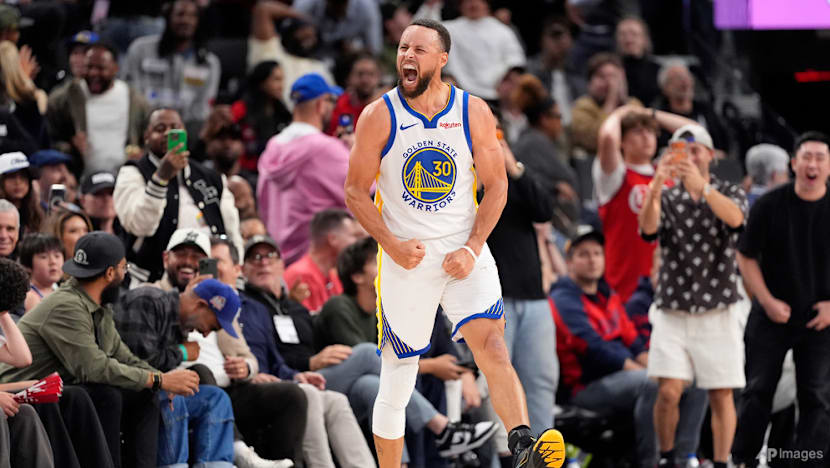
analysis East Asia More than selling shoes: What Chinese sportswear giant Li-Ning is buying with Stephen Curry deal Li-Ning’s reported US$400 million deal isn’t just about selling sports shoes, analysts say - it’s about leveraging one of basketball’s biggest and most influential athletes to raise its global profile. Golden State Warriors star Stephen Curry transformed basketball from beyond the arc. Now, he is betting on another frontier: China’s booming sportswear aspiration.
analysis East Asia
More than selling shoes: What Chinese sportswear giant Li-Ning is buying with Stephen Curry deal
Li-Ning’s reported US$400 million deal isn’t just about selling sports shoes, analysts say - it’s about leveraging one of basketball’s biggest and most influential athletes to raise its global profile.
SHANGHAI: Golden State Warriors star Stephen Curry transformed basketball from beyond the arc. Now, he is betting on another frontier: China’s booming sportswear aspiration.
The prolific NBA three-point shooter is making a long-range move of a different kind, recently signing a 10-year endorsement deal with Chinese sportswear giant Li-Ning reportedly worth more than US$400 million - one of the biggest partnerships between an NBA star and a Chinese brand, sports observers say.
But beyond the headline figures, this is a deal that’s more than just about money for both parties, add observers.
For Curry, it opens the door to China’s massive domestic consumer market.
An athlete's decision to sign with a Chinese brand comes down to "commercial opportunity, belief in the brand's vision, product quality and the ability to make a meaningful impact", said Adrian Staiti, APAC president of CAA Sports.
Curry also already has "a strong connection with fans" in China, he added.
For Li-Ning, it represents the brand’s boldest push yet into the United States - leveraging one of basketball’s biggest and most influential athletes to raise its global profile.
“Curry is one of the most globally influential athletes of our time,” Li-Ning said in an email to CNA, confirming the partnership.
It added that it looked forward to working with him to “advance the global development” of both it and Curry’s signature brand - and said the collaboration would be built on “long-term brand co-creation”. It, however, declined to disclose financial terms and details, citing commercial sensitivities.
Basketball would be "the foundation and starting point" of the partnership, the company said, before extending into golf and other sport and lifestyle categories.
Sports and brand analysts told CNA that the deal underscores how far Chinese sportswear companies have come.
Once seen as lower-cost alternatives to Western names like Nike and Adidas, Chinese brands such as Li-Ning and Anta now compete head-to-head with them for China’s vast domestic market and are increasingly setting their sights overseas.
Curry’s signing with Li-Ning “signals confidence rather than ambition”, said Mark Greeven, professor of management innovation and strategy and dean of Asia at IMD Business School.
“A decade ago, Chinese sportswear companies were trying to catch up. Today, they see themselves as legitimate global competitors,” Greeven told CNA.
The deal is “less about selling more shoes” than “buying global relevance, credibility and brand equity”, he said.
Chinese brands have also become much stronger at “product development, supply chain responsiveness, digital marketing and understanding local consumers”, Greeven said, adding that the most successful ones have “moved beyond (banking on) pure nationalism” and are now about “emotion and culture”.
Staiti, the APAC president of CAA Sports, said the deal is the latest in a broader trend of Chinese brands investing heavily in elite athletes and global sports properties.
It stands out from other elite athlete signings because of both Curry’s stature and the scale of the reported agreement.
“Stephen Curry is one of the most influential athletes in the world, and a partnership of this magnitude sends a strong signal about where Li-Ning sees its future growth,” he said.
The deal is "undoubtedly significant", he added, given Curry's stature and the reported scale - but stopped short of calling it a turning point.
"Chinese sportswear brands have been investing in elite athletes for many years," Staiti said, pointing to Anta's deals with the likes of fellow basketballers - Kevin Garnett, Klay Thompson and Kyrie Irving.
What sets this deal apart, he said, is "(Curry’s) unique global profile and cultural relevance", as he cited a certain former tennis star.
"In many ways, it reminds me of Roger Federer's partnership with Uniqlo. The value extends well beyond an athlete's playing career, and Curry's influence is likely to remain strong for decades.”
Not everyone is convinced the money will pay off.
Chiang Jeongwen, a professor emeritus at the China Europe International Business School, has watched Li-Ning bet on NBA stars before - Shaquille O'Neal, then Dwyane Wade, now Curry.
"Curry's name and image will undoubtedly generate attention, but attention alone will not justify a US$400 million investment," he told CNA.
"To earn that money back, Li-Ning will need to sell an enormous number of shoes." Ultimately, he added, "consumers buy products, not endorsements".
ONE OF CHINA’S “MOST POPULAR” FOREIGN ATHLETES
For Li-Ning, Curry’s appeal goes beyond his achievements on the court.
The 38-year-old is one of the most recognisable and popular foreign athletes in China, Staiti said - a country with “one of the largest and most passionate basketball fanbases in the world”.
The numbers bear that out. China is the NBA’s biggest market outside the US.
In 2024, 52 per cent of Chinese online users surveyed said they watch NBA games, according to S&P Global Market Intelligence, against 23 per cent in the US and about 10 per cent in Europe.
The game is also played everywhere from big-city courts to village half-courts, and the domestic CBA league draws a wide following of its own.
Online, avid Chinese fans share Curry’s game highlights and performances and have reacted with excitement to the news of his Li-Ning endorsement.
“What more is there to say? Good times for Curry fans (in China),” wrote a basketball fan on Weibo, adding that he was looking ahead to “all kinds of products over the next 10 years”.
Another asked: “Does this mean Stephen Curry will come to China more often now?”
Curry is "definitely the basketball star of today's generation", said Elisa Harca, co-founder and chief executive of Red Ant Asia, a China-focused marketing agency headquartered in Hong Kong.
"He's relevant globally … Even if you're not a basketball fan, you'd also know who he is. He's a global superstar."
But his standing in China rests on more than just fame, she added.
“Chinese fans are obsessed with basketball and are always looking for the best of the best,” she said.
Curry "trains hard, he works hard and seems to have good values ... a really safe bet in terms of talent and values", she said.
The choice, for Li-Ning, was "almost a no-brainer", she added.
“If they were looking to sign a mega star with resonance - globally and locally - Curry is one that fits all those characteristics.”
To an athlete weighing a 10-year commitment, money is only part of the calculation, she added. "Ten years is a long time in a basketball player's career progression," she said. "Is he still going to be playing in 10 years, or is he going to be moving on to other things?"
Still, a 10-year deal struck with a 38-year-old is a long bet - Curry is unlikely to be playing for most of it.
Harca, for all her optimism, acknowledged the risk. "Anything worth doing in life has a risk," she said.
For Li-Ning, US$400 million is “a massive bet on one person”.
“If Curry gets injured, retires early, or fades culturally, the contract bleeds value fast with no exit," she added
For Curry, the danger runs the other way.
"What makes Li-Ning cool in China doesn't automatically translate to US or European consumers," Harca said - adding that he "could end up with strong China numbers and weak global traction".
Similarly, CAA’s Staiti said the bigger danger is execution, not age.
Icons like Curry "stay relevant, engaged, influential" long after they stop playing, he said.
Where a deal like this falls down, he added, is "where the talent loses significant relevance or, more probably ... where the brand doesn't activate and merchandise the talent enough to make the content break through and resonate".
On the hesitation that Curry probably had to overcome before agreeing to the deal, CAA’s Staiti said it is usually "around scale, distribution and long-term brand perception".
But the risk has paid off before. Dwyane Wade's partnership with Li-Ning struck when Chinese brands had a far lower international profile and was viewed as "a bold move" - but later became "one of the most successful athlete-brand collaborations in basketball".
The terms have also shifted, Harca added.
"It's not a matter of the Chinese brand being the underdog any more. It's the Chinese brand coming with an interesting vision and funds to be able to make it happen," she said.
EVOLUTION OF CHINESE SPORTSWEAR BRANDS
A decade ago, securing an athlete of Curry's stature would have been a stretch for a Chinese sportswear company.
Homegrown brands, however, are no longer viewed as lower-cost alternatives to their Western rivals, experts say. Today, they compete head on with global giants like Nike, Puma and Adidas at home - in a sportswear market worth tens of billions of dollars and considered one of the largest and most competitive consumer arenas in the world.
Chinese sportswear giant Anta overtook Nike in China in 2022, while Li-Ning has now emerged as the country's third-largest sportswear brand, according to data provider Euromonitor.
Nike’s China sales have come under pressure, Reuters reported - falling at around 21 per cent in the second quarter of 2025.
Li-Ning, meanwhile, has continued to grow. The company holds about 10 per cent of China's sportswear market as of 2025, according to Euromonitor - and increased revenue by roughly 31 per cent between 2021 and 2025.
The shorthand explanation for their rise is guochao, the wave of national pride that made buying Chinese a statement.
But that is only part of the story, Greeven said.
"This whole guochao movement helped, but I don't think it's the root cause," he said.
"National pride created attention. But that obviously does not create repeat purchases. Product quality and value are the drivers,” Greeven said.
Chinese brands “are not the underdog any more”, said Harca, co-founder of Red Ant Asia.
“It’s very appealing for international stars to be approached by Chinese brands now - comparable to being approached by Nike and Adidas,” she added.
Chinese brands have also moved beyond competing on price, she added.
“They’re now viewed as aspirational brands with credibility in design and performance. In some cases, they're even seen as more relevant than the Western brands,” Harca said, noting that Nike and Adidas have faced challenges in recent years “around quality and style” as well as growing pressure from both domestic and international competitors.
“It’s changing the game in terms of choice for consumers.”
DIFFERENT ROUTES ABROAD
A Chinese brand chasing global status has two broad routes, analysts say - either build its own name abroad over time, or buy in by acquiring established Western brands.
Two leading Chinese sports brands are taking different routes abroad.
Anta has bought its way onto the global stage: it runs the China business of FILA, the Italian-founded, South Korean-owned label, led the 2019 consortium that acquired Amer Sports - owner of Arc'teryx, Salomon and Wilson - and in early 2026 agreed to pay about US$1.8 billion for a 29 per cent stake in Germany's Puma, becoming its largest shareholder.
Li-Ning, which has largely grown the Li-Ning brand itself rather than buying foreign labels, is instead building its own name - and the Curry deal is its biggest bet on doing so.
The two are "very different strategies", said IMD’s Greeven.
Building a global brand "requires long-term investment in identity, storytelling, and consumer trust", while acquiring one "is a portfolio strategy, which can generate international scale much faster", he said.
It is "difficult to do both at the same time", he added. "Most companies end up doing one or the other."
For CAA’s Staiti, the question is what each route actually buys.
A superstar partnership is "primarily a brand-building investment that creates trust, relevance and consumer connection", he said - while an acquisition is "usually about gaining market share, capabilities or distribution".
Both can work, "but they solve different business challenges".
Chris Pereira sees the purpose of the Li-Ning deal as "a shortcut towards local market recognition and trust".
"The next step for Chinese brands is to go from a high-quality, high-end image to trust - and to becoming cool," said Pereira, founder and chief executive of communications and consulting group iMpact.
"In the next three to five years, you're going to see Chinese brands become cool in the local market."
He framed it against the way Western brands have long worked.
"If you bought Nike or Adidas 20 years ago, you were wearing them so you could show the logo," he said.
"You don't really think about the quality; you're buying the name, and it represents your lifestyle."
The aim of a signing like Curry's, he said, is to attach that kind of meaning to a Chinese brand.
THE HARDER TEST ABROAD
Chinese sportswear brands may have established themselves at home, in one of the world's largest and most competitive sportswear markets. Abroad, analysts say, the challenge is only beginning.
The Curry partnership gives Li-Ning “a powerful platform to build from”, said CAA Sports APAC president Staiti - but even a global superstar can only take a brand so far.
“No single endorsement deal is enough on its own,” he said.
While an athlete can generate attention and credibility, “long-term success still depends on product quality, distribution, marketing execution and consumer trust”.
Chiang, professor emeritus at the China Europe International Business School, is unconvinced that the Curry deal alone can establish Li-Ning as a truly global brand.
“Star endorsements can create awareness and generate initial excitement, but they rarely change consumer perceptions on their own, especially in mature and highly competitive international markets,” he told CNA.
The bigger obstacle, he argued, is infrastructure.
“Outside China, Li-Ning lacks infrastructure. Distribution is weak, brand recognition is limited, and you cannot buy its shoes at Foot Locker,” he said.
Li-Ning intends to close that gap, including through standalone Curry Brand stores in the United States. But Chiang argues the challenge is not where the company comes from.
“This is not about Chinese versus non-Chinese. It is about whether Li-Ning has built the brand infrastructure in a given market,” he said.
“They have it in China. They do not yet have it in the US or Europe.”
Sportswear is also a uniquely difficult category to export, said Chris Pereira, founder and chief executive of communications and consulting group iMpact, because unlike most products, it's worn rather than owned.
Chinese brands such as Pop Mart and BYD have won over overseas consumers, he noted - but those products sit around your life rather than on you.
"That's very close to your lifestyle: you're driving it, you're placing it at home or in the office," he said.
"But if you're going to put something on your body, it's really a statement of your values and who you are as a person."
That makes trust and cultural relevance harder to build than in many other industries.
"Their sector is one of the most difficult in which to build global trust," Pereira said, referring to brands such as Li-Ning and Anta.
Even so, he believes the trajectory is clear.
“It's only a matter of time before someone buys an Anta shirt or a pair of Li-Ning shoes because it's cool - and not necessarily because they think it's the best quality.”
The US market remains the toughest test. Li-Ning attempted an expansion there around 2010 before retreating a year later. In 2022, US Customs and Border Protection officials moved to detain Li-Ning goods at US ports over allegations involving North Korean labour in the company’s supply chain - which the brand rejected as “incorrect” and “misleading”.
Yet consumers in the West still buy Chinese products “and have for many years”, said IMD’s Greeven.
“The question is whether a brand can build an identity that stands independently from politics. A company like Li-Ning has to compete on product, design and innovation - not national origin,” he added.
For Chiang, it comes back to the product.
"Success in the sporting goods industry still comes down to one thing: making products that athletes and consumers genuinely prefer over the alternatives," he said. "Marketing can open the door, but product quality is what keeps customers coming back."
Pereira framed the deal as a long bet, and reached for his own childhood to explain it.
"Growing up in the 80s and 90s, I saw Japanese brands everywhere," he said. "If you grow up seeing superstars working with Chinese brands, in the next five or 10 years those young people will gradually have a more positive view of Chinese brands. That's a generational investment."
Harca, co-founder of Red Ant Asia, agrees that perceptions are shifting.
The anti-China sentiment that characterised parts of the trade-war era has softened among younger consumers, she said, replaced in some corners of social media by growing fascination with Chinese products, culture and technology.
Yet Chinese sportswear brands remain far from household names overseas.
“Foreigners are obsessed with Brand Korea - K-pop, skincare and Blackpink headlined Coachella,” Harca said.
“Brand China isn't there yet. But it's coming.”