
Education
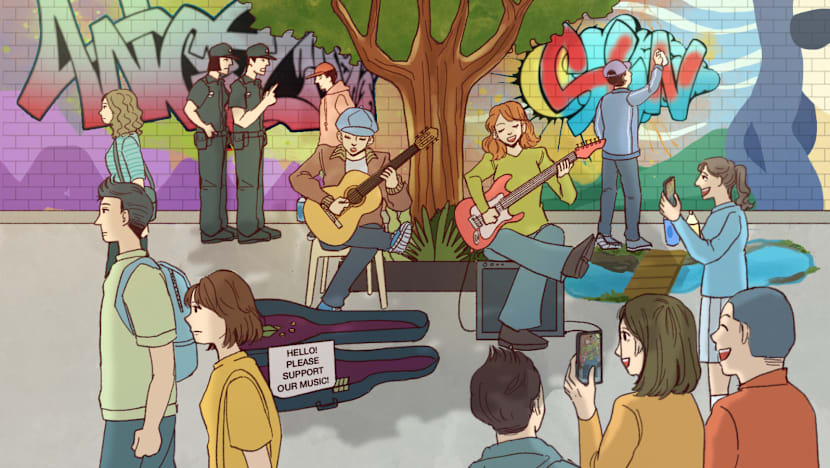
Amid shifts in public attitudes, street art in Singapore is still caught between acceptance and control
Key Points
Amid shifts in public attitudes, street art in Singapore is still caught between acceptance and control As murals, busking and other forms of street art become increasingly common in Singapore's public spaces, artists say acceptance has grown to some degree. Yet, they can't shake off the sense that such art remains carefully curated and managed. Veteran visual artist and art educator Mohammed Zulkarnaen Othman has had about 20 years of experience in the visual arts both in Singapore and...
Amid shifts in public attitudes, street art in Singapore is still caught between acceptance and control
As murals, busking and other forms of street art become increasingly common in Singapore's public spaces, artists say acceptance has grown to some degree. Yet, they can't shake off the sense that such art remains carefully curated and managed.
Veteran visual artist and art educator Mohammed Zulkarnaen Othman has had about 20 years of experience in the visual arts both in Singapore and overseas.
He specialises in art with graffiti-like aesthetics, and over the years he's seen how Singapore's street art scene has flourished with murals and artwork now colouring the once-bare walls of the island's streetscape.
Yet, even today, he still receives the occasional negative remark while executing his works.
"I was spray painting a mural in a school, when a primary school student asked me if I was vandalising the wall," the 40-year-old said, describing an incident that occurred a few weeks ago.
Mr Zulkarnaen said the interaction – far from the first time he's received such a comment – reflects how public attitudes in Singapore towards street art are still rather narrow-minded, with passers-by more likely to view graffiti art and murals with suspicion than appreciation.
A recent incident showed the same tension at play: Last month, a temporary drawing that power-washing artist Marcus Pang was creating on a pavement outside Mountbatten MRT station was removed following a complaint from a member of the public.
The public debate that followed carries echoes of a 2024 controversy over a mural of a samsui woman smoking a cigarette. The Urban Redevelopment Authority (URA) initially ordered the removal of the cigarette from the drawing, reportedly following feedback from a member of the public.
While the authorities later revised their stance and allowed the mural to remain intact after taking in diverse views from across Singapore, the building owner was fined S$2,000 for going ahead with the artwork without prior approval.
Sometimes, street art is removed simply because it contravenes Singapore's rules around where such artwork can be placed. Earlier this year, URA ordered the removal of a batik mural commissioned by a shop owner at 59 Arab Street, saying that with the exception of those on Haji Lane, murals are not allowed on the front facades of conserved shophouses.
This is because the artwork might obscure key architectural and heritage features, and affect the established character and ambience of the historic district.
Street performers say they, too, sometimes, clash with the public.
Mr Evan Goh, 39, who busks a few times a week, has gone viral several times in recent years after being harassed by passersby who were unhappy with his performance or his repertoire of songs. One of them even took back the tip he had given the street musician.
Art practitioners and observers who spoke to CNA TODAY said these incidents show how even as visual and performance arts populate more spaces in public today, Singapore still has some way to go in fully embracing street art.
The authorities have opened up more spaces for such art, with the proliferation of buskers in public spaces and murals in heritage areas being obvious examples, and more businesses are commissioning street art, too.
Nonetheless, Singapore's approach to such art is carefully curated, they said, which in turn has shaped public perception towards it, making people more cautious and sceptical towards spontaneous expressions of creativity in their environments.
They contrasted the recent reactions towards such art here with the warmer reception they have received in cities elsewhere, from Covent Garden in London, United Kingdom, to the Bukit Bintang crossing in Kuala Lumpur, Malaysia.
For authorities in Singapore, where cleanliness is a prized virtue, the management of street art poses a tough balancing act – when artistic freedom and vibrancy butts up against the need for order, what should give way?
MORE STREET ART AROUND, BUT WHERE'S THE EDGINESS?
Even as Singapore has maintained its strict stance against vandalism and public nuisance, it has over the years made moves to embrace street art in its own way.
Artists and observers noted that commissioned murals are becoming more prevalent in public spaces all over the island.
One of the most notable platforms for such artwork is the Art in Transit programme, overseen by the Land Transport Authority and billed as "Singapore's largest public art showcase".
Launched along the North-East Line in 1997, it has expanded across all rail networks, with more than 500 artworks contributed by commissioned artists and through programme partners.
The National Arts Council (NAC) collaborates with artists, venue owners and public agencies to promote art in public spaces, including supporting community-led art projects.
In response to CNA TODAY's queries, the council said: "Together, these efforts make it easier for Singaporeans to encounter and appreciate the arts first-hand, while fostering greater community engagement and interaction, and giving artists more opportunities to reach new audiences."
There is no centralised authority issuing permits for wall or pavement murals in public spaces. For instance, any such planned artwork on common spaces at public flats may require approval from the relevant town council or the Housing and Development Board.
Murals on conserved buildings require endorsement from the building owner and URA's approval. URA's guidelines on murals stipulate, for example, that the artwork cannot obscure key architectural and heritage features of the building and "must be appropriate to the character of the building and area".
Meanwhile, buskers have to audition with the NAC in order to receive a Letter of Endorsement before they busk.
The busking scheme was introduced in the 1990s with only three approved locations, but now there are more than 90 such spots.
Buskers said that it has also become more convenient to book busking locations, which can be done online and with greater flexibility than before, though there are still 15 busking spots that require balloting.
Circus act busker Jonathan Goh, 30, added that NAC now makes it a point to hold regular feedback sessions with registered buskers.
When he first started busking 10 years ago, such sessions happened on an ad hoc basis, as and when buskers asked to speak to the agency, said the co-chair of the Buskers' Association of Singapore.
Singer and songwriter Odelia Foong, who started busking in 2024, is one of the fledgling artists who have benefited from Singapore's greater acceptance of street art. She busks a few times a week at different locations, depending on their availability.
The 27-year-old freelance fashion stylist said busking allows her to gain experience in public engagement and test reception for future songs, while getting some "monetary encouragement". She has also taken part in a few grassroots performances, such as National Day and countdown party events in a few neighbourhoods, which helped her gain new fans.
Touching on the incident involving power-washing art outside Mountbatten MRT station, Mr Zulkarnaen the visual artist noted that SMRT received some flak for removing the artwork. But what these critics may have overlooked is that SMRT and other public transport operators have in fact provided substantial amounts of space for art, he said.
"Almost all train stations in Singapore today have artworks. SMRT for example has been doing that for the past 20 or 30 years," said Mr Zulkarnaen, who is also known by his artist moniker ZERO.
Such moves have certainly granted local street artists more space to practise their craft and given them access to a wider audience, but some of them lamented that the highly regulated nature of Singapore's street art scene makes it less organic and spontaneous than that of other cities.
It has also shaped an overly cautious attitude towards the arts, even among clients who are looking to commission artwork and artists themselves, they said.
Graffiti artist and muralist Muhammad Taufiq Rosle, 38, said some of his prospective clients would question every shape and shade in his proposed artwork, overthinking how it might be perceived by the public.
"For example, they'll ask: 'Why is this blue? Why is this yellow? Why is this oval slanted, it looks like something is crushing it?'," said Mr Taufiq, who is also known by his artist moniker Boon Bakes.
"They are more concerned about how the public might interpret the work, rather than what the artist is conveying."
Even if they might not feel entirely comfortable with that level of scrutiny, artists said they understand that as these murals are being displayed out in the open, they do have to weigh other factors aside from their own vision and intention.
As street artist Sam Lo, 40, said: "Because the works are in public spaces, this implies a shared interest with the public, and the artist has a social responsibility to create work for the public."
As such, he added, many artists himself included "police themselves" by avoiding the depiction of things such as cigarettes, nudity and profanity. They also steer clear of sensitive topics like lesbian, gay, bisexual, transgender and queer (LGBTQ) themes or politics in their works, said Mr Lo, who also goes by SKL0.
The results are evident in the subjects depicted on the walls of Singapore's public spaces. For example, he noted, the artworks typically depict themes of nostalgia or obvious and popular icons like its food and hawkers.
This is no bad thing, he added, though he also wishes that some of Singapore's street art could include a level of critique or exploration of social issues and be more thought-provoking.
"Although these artworks are beautiful and colourful, I fear that we are seeing less character and what's unique to the artist's voice," he said, adding that if Singaporeans see murals depicting only certain themes, it is natural then that they would expect all street art to showcase similar designs.
Agreeing, Mr Zulkarnaen said that having an overly homogeneous street landscape will mean the public will continue being uncomfortable when confronted with spontaneity or thought-provoking pieces that do not conform with the narratives that they are used to.
Buskers have to abide by certain guidelines too, noted theatre practitioner and former arts Nominated Member of Parliament (NMP) Kok Heng Leung.
The terms and conditions for a busker's Letter of Endorsement from NAC expressly prohibits them from engaging in behaviour or speech that advocates for lifestyles "seen as objectionable by the general public" or carry a political or religious agenda, among other things.
Also, any performance that attracts an arts entertainment classification rating above "General" cannot be staged outdoors, said Mr Kok, the founder of theatre company Drama Box.
"If you try to do it outdoors, the authorities would expect you to shield up the entire performance, which is contrary to the point of doing it outdoors."
Street art has a rebellious origin, tracing back to youths who tagged or spray painted walls and trains to express themselves, notes Ms Audrey Wong, the lead for the Masters in Arts and Cultural Leadership programme at LASALLE College of the Arts, University of the Arts Singapore.
"Often, this kind of street art had socio-political messages, or social protest messages," said Ms Wong, who is also a former arts NMP.
"So, once the government or corporations start to commission street art, they become tamer and less provocative, and some artists might feel that the new street art and murals that we see around Singapore are less edgy."
Contrast this against the most famous street artist in the world, Banksy. The UK-based artist is known for pointed political messages in his works, which are executed in secrecy and often take aim at corporations and governments.
Mr Zulkarnaen pointed to another, very different, example that he encountered in Paris while attending an urban art fair last year. A French artist known by the pseudonym Invader has throughout many years planted ceramic tile mosaics modelled after 8-bit video game art from the 1970s and 1980s all over the city.
His art has gained worldwide fame simply because it is fun, turning the streets of Paris into a giant scavenger hunt.
"The moment you stepped out of the exhibition, people went around looking for Invader's pieces on the streets," Mr Zulkarnaen said, likening their search to the once-viral mobile game Pokemon Go.
"I had an American friend who actually walked around 30km to track down all of Invader's artwork."
CULTURE VS ART
Meanwhile, in Singapore, Mr Taufiq the muralist lamented that there are only four or five public walls that artists like him can paint on and experiment with, without having to seek prior permission.
The result is that art on these walls is frequently painted over by the next muralist or graffiti artist looking for a blank canvas to play with.
"You might need six to 10 spray cans to paint one mural, which would amount to about S$80 (US$62)," said Mr Taufiq. "Imagine a cash-strapped youth spending that amount of money and effort to create an artwork, and the next day it gets painted over by the next person because there are so few walls where you can do such paintings."
For this reason, his collective of artists frequently travels to neighbouring cities such as Bangkok, Kuala Lumpur and Jakarta, where they have more space to experiment and hone their craft without restrictions, he said.
More than that, they are often greeted with enthusiasm, he added. In Jakarta, for example, his group goes knocking on doors to ask building owners if they can paint art on their walls.
"They not only welcome you, they even prepare food and drinks for you as you work, and sometimes passers-by or their neighbours would approach us and say: 'Please do my wall next'."
Part-time busker Mohammad Firdaus Osman, 31, pointed to the busking scene at Bukit Bintang in Kuala Lumpur as another example of how street art, when it is allowed to flourish freely, can even bring in economic value.
He noted that some busking bands there, such as Genji Buskers and Abang Bob Sentuhan Buskers, have become so well-known that fans have travelled from around the world to watch them perform on Malaysia's streets.
Artists and observers said the warmer reception received by street art in these other cities can be boiled down to culture.
Mr Kok noted that in bigger countries, communities are more used to organising themselves and making decisions at the grassroots level.
So they may also be more accustomed to and welcoming of such ground up and spontaneous creations of art without the prior approval of a top authority. Any agreement or disagreement is negotiated directly between the artist and local community there.
"In Singapore, the moment you start to do something like that, the authorities will be called in," he said.
Speaking on CNA's Deep Dive podcast earlier this week, Assistant Professor George Wong from Singapore Management University added that Singaporeans have been socialised to the idea that there are authorities overseeing public spaces, and that these authorities have to be consulted over everything that happens there.
And this culture of appealing to the authorities can, in some ways, be traced back even earlier into our upbringing, said the professor of sociology.
"In school, kids are taught: 'You don't confront, you engage with authority, speak to a teacher, someone with some kind of power'," he said. "And over time, we bring this into our everyday lives as well, in work spaces, in community and all that."
Ms Angeline Tong, the chief experience officer of art consultancy HOL Experiences, said that when a piece of art comes into conflict with members of the public, it does not represent "a flaw to be solved", as artwork in a shared space would naturally be read in different ways.
"The caution that sometimes meets new work, I feel, is less about a dislike of art and more about a discomfort with the unexpected," she said.
"Because we are used to public space being curated, the first question tends to be not 'do I like this?' but 'is this meant to be here?'. The hesitation is often about process and propriety rather than the work itself."
IS AN UNTETHERED STREETSCAPE THE WAY TO GO?
As Singapore continues to reflect on its relationship with street art, experts and artists themselves acknowledged that the answer is not complete freedom from rules.
Dr Ian Woo, the MA Fine Arts programme lead at LASALLE, said that every public space is different and has to serve society on a daily basis.
"Artists and programmers should have this in mind before any art is being proposed for the site," he said. "Once this is considered, it makes it clearer as to how art or artists should contribute in any given public space."
In response to CNA TODAY's queries, Ms Gho Sze Kee, the MP for Mountbatten Single Member Constituency (SMC), said that certain themes and forms of expressions can provoke a backlash within the community.
In a Facebook post on the kerfuffle over the power-washing art that had taken place in her ward, Ms Gho had said the incident raised larger questions about public spaces and artistic expression.
"Our community, our society ultimately have to deal with the consequences, tensions and divisions that may arise," she said.
That is why, she added: "I believe that an 'ask first before doing' framework serves an important purpose beyond administrative compliance. It allows difficult issues to be considered before they become sources of conflict."
Some artists, such as 36-year-old muralist Danielle Tay, tend to agree. She argued that "spontaneity in public art isn't defined by the lack of a permit".
She recounted how while she was working on a heritage mural recently, an elderly man passing by paused and started sharing stories about what the surrounding area looked like when he was a child.
"It completely changed the energy of my painting process because I realised the wall was directly connecting to his living memory," she said.
"Whether a piece is painted organically or commissioned, and whether it's for a private client or a public street, it needs to have a clear point of view. That is what sparks meaningful conversation among the public."
Dr Lee Mia Ching, from the Singapore University of Social Sciences, noted that the city-state is not unique in having some form of regulation over art in public spaces.
"(However) regulation impedes art if it becomes censorship. There is no clear line between the two, which is why consultation is important," said Dr Lee, a senior lecturer whose research interests include modern art and architecture.
In its response to CNA TODAY, the NAC said collective effort and mutual understanding are needed in order for the arts to thrive in everyday spaces.
"As public spaces are shared by all, artists can work with partners to ensure the responsible use of shared spaces, exercising their creativity while respecting public safety and the diverse interests of the wider community too."
Both practitioners and observers acknowledged that any loosening of regulations would come with trade-offs, and therefore need to be carefully negotiated.
For example, if busking auditions and regulations became too lax, this could lead to an overcrowded scene producing a cacophony of bad performances that would only make for unpleasant streets.
Mr Kok, the former arts NMP, stressed that public spaces have multiple stakeholders: members of the public themselves, the community of artists who want to participate, the commissioning entities and regulators. Each of them needs to actively take part in discussions in determining where boundaries for street art should lie.
Meanwhile, members of the community can also organise themselves to create more pockets of space for street art on top of the ones earmarked by the authorities, artists said.
Mr Firdaus, the part-time busker, highlighted Ann Siang Sounds as one such initiative, a free jam movement that was started by a group of friends who decided one day to jam outdoors, eventually attracting friends and passers by to join in.
"It is really an amazing initiative and it definitely makes the street vibrant. And the best part – it is free for everyone."
The trio behind Ann Siang Sounds have since partnered community spaces such as New Bahru and various festivals to organise such open jams.
Following consultations with the authorities, they have applied for a permit under the Arts Entertainment Licence to continue organising such open jams at the original public walkway at Ann Siang Hill.
On the growing number of commissioned murals colouring Singapore's landscape, Mr Lo the street artist said that it is important that the streets not be limited to advertising or commercial interests, even as these works help generate income for the artists.
"I'd like commissioning entities to show more trust by being more open to exploring deeper topics beyond the surface," he said. "Ultimately, the bigger question is: Who should decide what goes on our streets, and what does that mean for creative expression?"
In the meantime, artists said, they are also aware that the onus is also upon themselves to negotiate for space to produce art that starts meaningful conversations in society.
Mr Zulkarnaen was recently commissioned by a primary school to paint a mural with the overarching theme of historical Singapore, with the school initially requesting him to paint scenes from colonial-era Singapore and portraits of historical community leaders.
Instead of simply agreeing to it, he counter-proposed with an idea of his own: a mural of the history of the people of Singapore.
Comprising images of samsui women, migrant workers, delivery riders, frontline workers, mirrors and a big statement that reads "Make History", the mural calls upon students to reflect how they too, like everyone around them, are contributing to the nation and its history.
"The school principal and everyone loved it," he said.
Mr Kok, the former NMP, urged artists to engage with the authorities and members of the public, while continuing to produce boundary-pushing works. He noted that such works in the past had always led to renewed discussions on boundaries and regulations.
"In the meantime, artists need to just keep trying," said Mr Kok. "Today cannot, doesn't mean tomorrow still cannot."