
Science
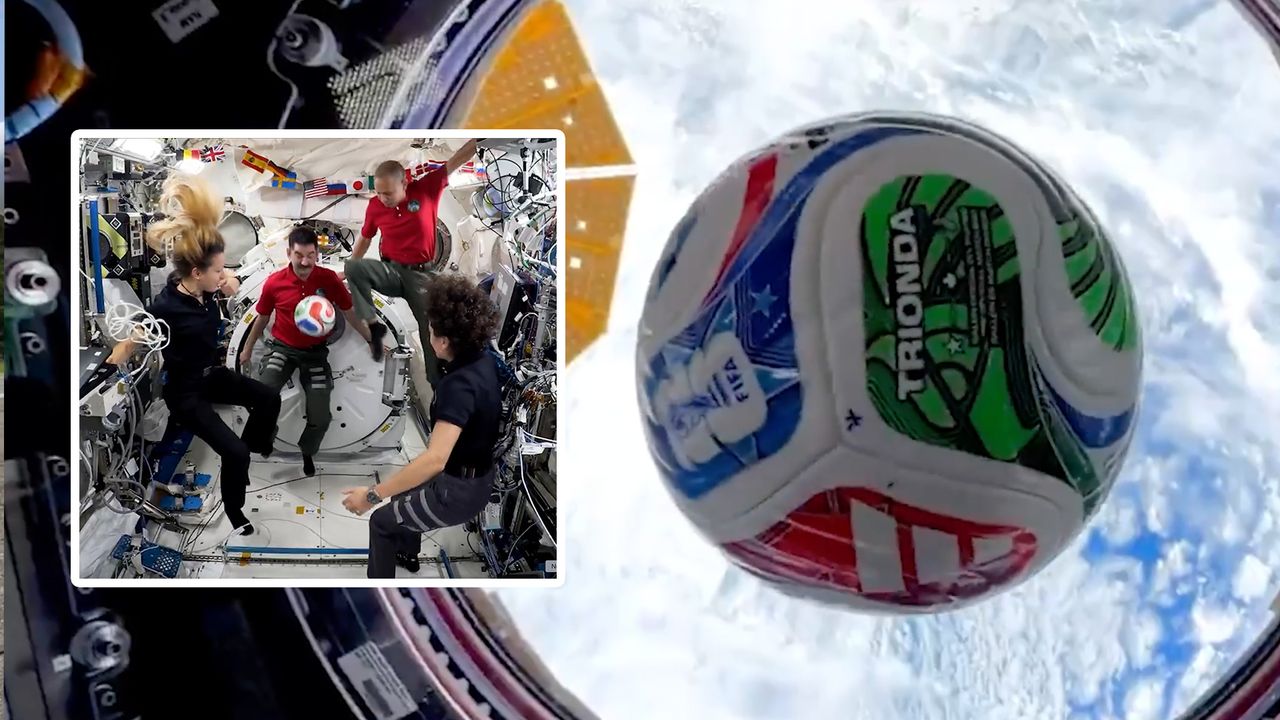
NASA sent a FIFA World Cup 2026 ball to the ISS so astronauts can test their footwork in zero gravity (video)
Key Points
NASA sent a FIFA World Cup 2026 ball to the ISS so astronauts can test their footwork in zero gravity (video) NASA's celebrations of the FIFA World Cup extended to the ground as well, with Artemis 2 astronauts appearing at a match in Houston. Astronauts on the ISS had an epic microgravity kickoff with a FIFA soccer ball, as the agency highlighted how soccer balls are influenced by space research. NASA and European Space Agency (ESA) astronauts got the official FIFA World Cup ball rolling,...
NASA sent a FIFA World Cup 2026 ball to the ISS so astronauts can test their footwork in zero gravity (video)
NASA's celebrations of the FIFA World Cup extended to the ground as well, with Artemis 2 astronauts appearing at a match in Houston.
Astronauts on the ISS had an epic microgravity kickoff with a FIFA soccer ball, as the agency highlighted how soccer balls are influenced by space research.
NASA and European Space Agency (ESA) astronauts got the official FIFA World Cup ball rolling, zero-G style, in the Kibo module of the International Space Station. The impromptu match, published on X June 20, formed part of NASA's push to explain how space relates to soccer.
As NASA explains, soccer has been studied scientifically on the ISS. The orbital laboratory has hosted "studies that improve understanding of the aerodynamics and physics involved in soccer ball flight," the agency stated in a June 8 release about soccer tech. An example study in 2019 examined how the mass of a soccer ball influences the rotation, stability and motion of the sphere. NASA did not name the study, but the date lines up with the Adidas OS SPIN experiment that ran between 2019 and 2021, as described in an agency database of ISS experiments.
Adidas has put electronics in official match balls since 2022, NASA noted, which allows broadcasters and officiators to monitor speed, position and contactor. "But those sensors also add mass in specific locations inside the ball, and uneven mass distribution can affect how a ball moves through the air," the agency pointed out.
Watching soccer ball movements in microgravity can therefore lead to better design to account for the sensors, the agency noted. "The findings have improved understanding of how embedded technologies, including match-ball sensors, can influence performance during play," NASA stated. "The research contributed to studies used in the development and evaluation of soccer balls for major international tournaments, including FIFA World Cup competition."
More recently, ISS astronaut Jessica Meir showed students how soccer ball mass and spin works in microgravity. "What you see here is a soccer ball that passes one of the most important tests in sports engineering: balanced mass distribution," the Expedition 74 NASA astronaut said, floating alongside a spinning ball, in a YouTube video posted last month.
The agency has also studied soccer balls on the ground. At NASA's Ames Research Center in California, researchers examined Adidas' Brazuca ball in a wind tunnel. They particularly examined a phenomenon known as "knuckling", which happens when the airflow on the seams makes the ball move unexpectedly in mid-air.
"NASA engineers measured the speeds and flow conditions where this effect was most pronounced," the agency stated of the Brazuca ball, which was used in the 2014 world cup. "Adjustments in panel shape, seam depth, and surface texture can influence flight consistency, helping determine whether a ball curves, dips, or holds its line during play."
NASA has showed up a lot at the celebrations already. On June 20, Artemis 2 moon astronauts Reid Wiseman and Victor Glover delivered the ball for a Netherlands-Sweden match in Houston (nearby NASA's Johnson Space Center for astronaut training).
This year's world cup is jointly hosted by the U.S., Mexico and Canada and will wrap up on July 19. On June 11, NASA held an exhibit at Fan Festival Houston about FIFA, pledging to open the event during every tournament match held in Houston's east downtown.
You must confirm your public display name before commenting
Please logout and then login again, you will then be prompted to enter your display name.
Elizabeth Howell (she/her), Ph.D., was a staff writer in the spaceflight channel between 2022 and 2024 specializing in Canadian space news. She was contributing writer for Space.com for 10 years from 2012 to 2024. Elizabeth's reporting includes multiple exclusives with the White House, leading world coverage about a lost-and-found space tomato on the International Space Station, witnessing five human spaceflight launches on two continents, flying parabolic, working inside a spacesuit, and participating in a simulated Mars mission. Her latest book, "Why Am I Taller?" (ECW Press, 2022) is co-written with astronaut Dave Williams.