
Politics
DJI Osmo Pocket 4P review: The best gimbal camera money can't buy
Key Points
DJI Osmo Pocket 4P review: The best gimbal camera money can't buy The OG goes "pro" with two lenses, class-leading dynamic range and optical zoom. To say it's been a long road to the Osmo Pocket 4P is an understatement. It first leaked in March, was officially teased in May, then fully launched in China in June while Europe and the US remained under embargo.
DJI Osmo Pocket 4P review: The best gimbal camera money can't buy
The OG goes "pro" with two lenses, class-leading dynamic range and optical zoom.
To say it's been a long road to the Osmo Pocket 4P is an understatement. It first leaked in March, was officially teased in May, then fully launched in China in June while Europe and the US remained under embargo. DJI offered a few more glimpses before going quiet again, but the official global launch is finally happening today.
There's just one catch. Thanks to government restrictions on DJI products, no retailer in the US can officially sell it. It's not impossible to get hold of one, if you really want it, but the question is: Do you? Let me help you with that.
Hardware
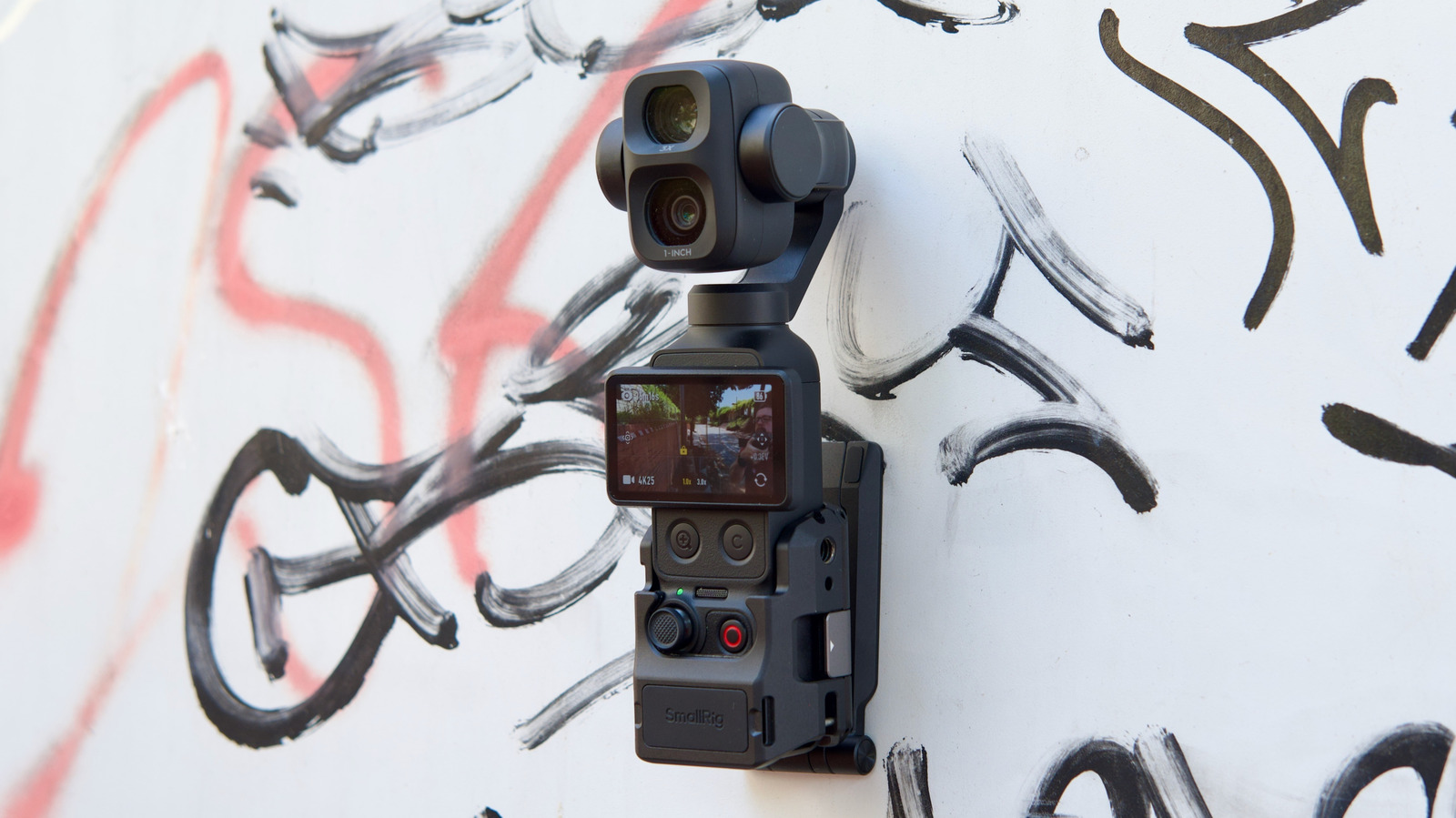
The headline feature of the Pocket 4P is its new dual-lens gimbal. The primary camera is a familiar 20mm-equivalent f/2.0 wide-angle with a 1-inch sensor, while the new addition is a 60mm-equivalent f/1.8 medium telephoto paired with a 1/1.28-inch sensor. Together they deliver true 3x optical zoom, up to 6x in-sensor zoom and a maximum 12x digital zoom.
Despite early rumours, the Pocket 4P doesn't record in 6K. Instead, it tops out at 4K video, with frame rates up to 240 fps for slow motion, alongside 37-megapixel stills.
One of the first features DJI highlighted during its unusually drawn-out launch was the claimed 17 stops of dynamic range. That's an eye-catching figure for a camera aimed at creators and vloggers — especially when Sony rates its $6,000 Alpha A1 at 15 stops. If those claims hold up, the Pocket 4P has the potential to offer class-leading performance in challenging lighting. There are caveats, though. The full 17 stops are only available from the primary camera, and only when shooting in the new 10-bit D-Log 2 color profile, which I'll come back to later.
Elsewhere, the body is unchanged from the standard Pocket 4. You get the same 2-inch OLED touchscreen, two physical buttons — one dedicated to zoom and another that can be customized — plus a clickable joystick for zoom and gimbal control. It also comes with 103GB of internal storage, a microSD card slot and the expansion port for accessories such as DJI's magnetic fill light. Because the camera's body is the same as the regular Pocket 4, it means it's also immediately compatible with a wide range of third-party accessories.
Optical zoom
The Pocket 4P's optical zoom deserves its own section because it's that good. DJI isn't the first to put a dual-lens system on a gimbal camera — Insta360 won that race — but it's a huge leap over the Pocket 4's 2x in-sensor zoom. The familiar 20mm wide-angle remains a capable all-rounder, while the new 60mm medium telephoto dramatically expands what the camera can do.
DJI is quick to point out that 60mm is the "sweet spot" for portraits, giving more natural face proportions, but it offers much more than that in practice. The smaller aperture also creates a shallower depth of field. This naturally puts more focus on your subject, be it a person, object or landmark. I particularly enjoyed the freedom to reframe shots in-camera without worrying about loss of quality. I shoot a lot of top-down product shots, and being able to reframe the subject before I press record is a huge time saver. Better still, ActiveTrack continues to work while zoomed in, making it far easier to keep yourself framed when filming solo.
True optical zoom tops-out at 3x, but the in-sensor zoom still preserves a high amount of quality. It was hard to find much noticeable degradation in quality or noise in anything I shot at 6x. Honestly, even at 12x, well into the realm of digital zoom, I was hugely impressed with the fidelity. At this extreme, you will notice a drop in quality, but it is less than I expected. When compared to 12x zooms from the Insta360 Luna Ultra, it's hard to pick a winner as both have their strengths.
The transition between the two lenses isn't completely seamless, however. DJI has already reduced the issue with a firmware update, but you'll still occasionally notice a slight shift in exposure, color or framing as the camera switches to the telephoto lens at exactly 3x. There's also a small perspective change caused by the physical distance between the lenses. The Luna Ultra behaves much the same way, and it's largely a limitation of the hardware rather than something software can eliminate entirely.
One area where Insta360 still has the edge is zoom control. On the Pocket 4P, you can zoom using either the joystick or the dedicated zoom button. The button works well: single presses jump between 1x and 3x, a double press goes to 6x, while a long press performs a smooth continuous zoom. The joystick is less convincing. It's easy to leave it assigned to pan mode, only to realise after recording has started that it isn't controlling zoom at all.
The Luna Ultra's thumb slider feels more intuitive than the one on the 4P. Short presses step through the zoom levels, while a long press delivers a smooth zoom, and those controls remain available regardless of screen orientation. On the Pocket 4P, the zoom button disappears from the interface when shooting in portrait mode, making it slightly less convenient for vertical video.
D-Log 2 and dynamic range
DJI's 10-bit Log modes have come a long way. The Pocket 3 was limited to D-Log M, a simplified version of the company's professional D-Log profile. The Pocket 4 introduced full D-Log, but the 4P goes a step further with D-Log 2 — the mode that enables the 17 stops of dynamic range.
There's a trade-off, though. Enable D-Log 2 and the camera becomes much more restrictive. Zoom is disabled, limiting you to the primary 20mm lens, and slow-motion recording is unavailable. ActiveTrack still works, however, so you're not giving up every advanced feature.
D-Log 2 also caps the ISO at 3,200, which can become a limitation in darker environments. On the plus side, its minimum ISO drops to 100, compared with ISO 400 on the original D-Log. That makes it much easier to shoot in bright conditions without relying as heavily on ND filters.
Image quality
In my review of the standard Pocket 4, I praised its image quality and excellent low-light performance. The same is true here. Colors are natural, exposure is reliably well judged and the Pocket 4P consistently delivers polished-looking footage with very little effort. Spend a little time dialling in the settings and it can produce genuinely cinematic results.
One long-standing criticism of the Pocket series is that it tends to oversharpen footage, and there are still hints of that here. Thankfully, it's easy to tone down in the image settings. Fine textures such as foliage retain plenty of detail without becoming noisy, even after dark. In fact, the Pocket 4P's low-light performance is one of its biggest strengths, producing footage that belies the camera's tiny size.
Creators who like to color grade have even more flexibility thanks to D-Log and D-Log 2, both of which capture a flatter image for post-production in applications such as Premiere Pro or DaVinci Resolve. Unlike the Luna Ultra, there's no Dolby Vision recording, but DJI instead offers a 10-bit HDR mode. If you'd rather avoid color grading altogether, a selection of built-in color profiles lets you quickly shift the look from vibrant and cinematic to something more subdued.
Battery life and data transfer
The Pocket 4P's 1,545mAh battery might not sound huge by cellphone standards, but out in the field it's generally good for about 200-220 minutes of real-world, varied use. That's pretty impressive, especially if you compare it to something like a GoPro — the Hero 13 offers about an hour less in like-for-like use. The better news is that the Pocket 4P charges incredibly fast. I was able to get from zero to 50 percent in about 10 minutes and a full charge in little over 30 (with a 100W charger).
DJI also keeps things speedy with data transfer. The onboard storage shuffles 4K video over to my hard drive at about twice the speed as the Luna Ultra. The claimed data rate is 800MB/s, which is impressive, especially for someone like me with years of moving files from SD cards at (a now wimpy-feeling) 150MB/s, give or take.
The competition
When I reviewed the Pocket 4 just a few months ago, I remarked on the surprising lack of competition in the gimbal camera market. That's no longer true. Insta360's Luna Ultra is already here, with the Luna Pro on the horizon, giving DJI its first serious challengers in years.
The biggest difference between the standard Pocket 4 and the 4P is, of course, the addition of the 60mm telephoto lens. In Europe, the two are priced at €399 and €499 respectively. For an extra €100, the creative flexibility the second lens brings makes the upgrade an easy one to recommend. The Luna Ultra, by comparison, commands a much steeper $770 (around €720 in Europe).
The picture changes in the US, however. Because the Pocket 4P still isn't officially on sale here, importing one pushes the effective price closer to $1,000. At that point, the Luna Ultra suddenly looks far more competitive.
Ultimately, both the Pocket 4P and Luna Ultra are excellent cameras with different strengths, and there's a reason YouTube creators and Reddit users remain split over which is best. If you're buying in Europe or another market where DJI sells the Pocket 4P at retail, it's the more compelling value.
Wrap-up
True complaints are hard to find, but DJI still has plenty of room to improve the Pocket 4P experience. Lens transitions are mostly seamless now, but the occasional minor shift in color temperature or framing are still an annoyance. D-Log 2 also has space to grow, especially when you consider the much-touted 17 stops of dynamic range comes with a few serious limitations. There are also a few nice-to-haves, like zebras and histograms that would make this feel even more "P for Pro."
Was the Pocket 4P worth the wait? The answer is yes. But to what degree depends on where you live. If you can deal with the inflated re-sell price, or can source one yourself at the MSRP, it's a solid evolution for DJI's Pocket series.