
Politics
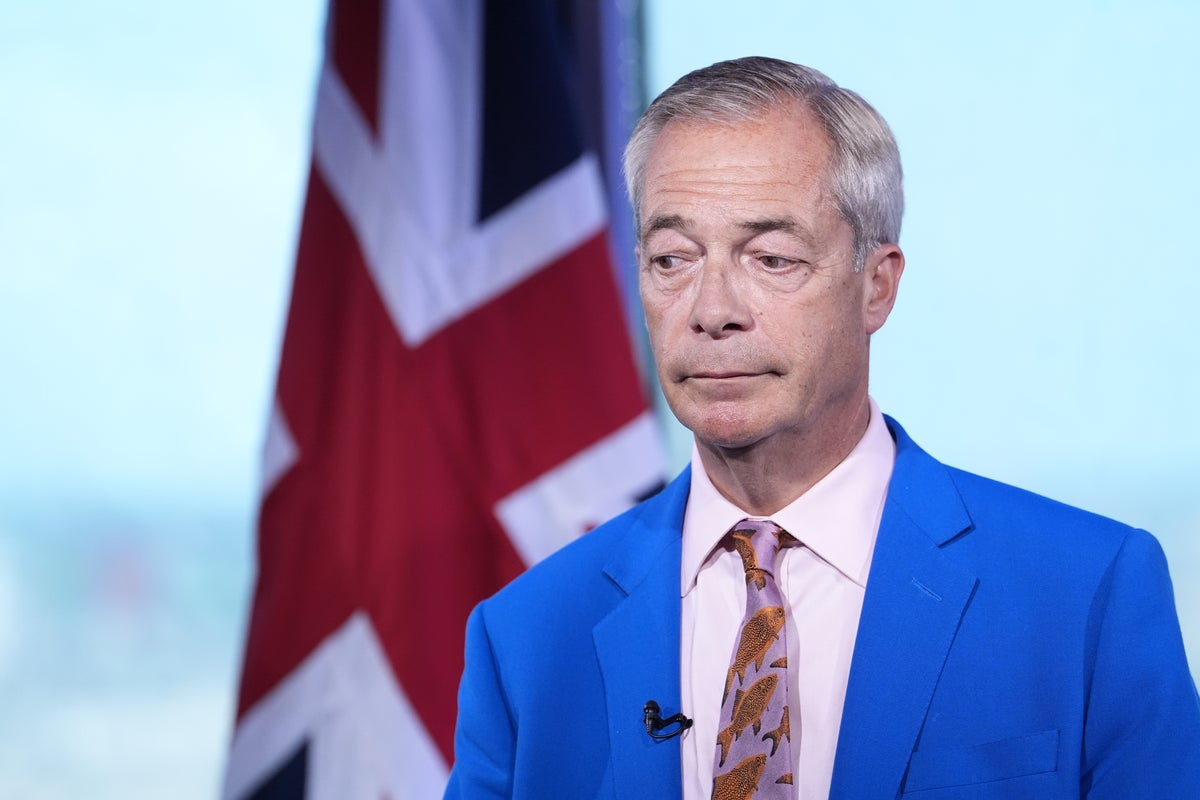
Collapse in Farage’s approval rating could spell the end for the Reform revolution
Key Points
Collapse in Farage’s approval rating could spell the end for the Reform revolution Nigel Farage has weathered various political storms, but political editor David Maddox explains why this crisis might be different - Bookmark - CommentsGo to comments The latest polling showing Nigel Farage’s plummeting approval ratings will no doubt make grim reading for the Reform UK leader, but the problems he and his party face go far deeper. His personal approval ratings have seen an almost vertical drop...
Collapse in Farage’s approval rating could spell the end for the Reform revolution
Nigel Farage has weathered various political storms, but political editor David Maddox explains why this crisis might be different
- Bookmark
- CommentsGo to comments
The latest polling showing Nigel Farage’s plummeting approval ratings will no doubt make grim reading for the Reform UK leader, but the problems he and his party face go far deeper.
His personal approval ratings have seen an almost vertical drop since the start of July, according to the latest research from More in Common, and for a party like Reform UK that is so dependent on the energy, charisma and ability of a single man, the -32 rating – down 10 points in just a fortnight – is potentially catastrophic.
Nevertheless, Mr Farage has come through various crises before and remains one of the few political mainstays of the last few decades in British politics, so some will quite reasonably ask why this time is any different.
Since he first was elected for Ukip as a member of the European Parliament 27 years ago, Mr Farage has left in his wake a trail of prematurely ended political careers of rivals and opponents, who either underestimated him or wrote him off.
He has survived a plane crash, leadership challenges, come out of retirement twice, created a new party, won a referendum and at 62 appeared to be on the cusp of overturning British politics in a way that had not happened since the Labour Party replaced the Liberals a century ago.
Ask David Cameron, George Osborne, Theresa May, Boris Johnson, Robert Kilroy Silk, Ben Habib, Rupert Lowe and many, many others how easy it is to beat Mr Farage and you will get the same glum answer that it is not.
But as Mr Farage goes into battle against a bin and 32 other fringe candidates in a by-election of his own making, there is a feeling that something is different this time.
Maybe it is because, for the first time in his long political career of almost three decades, Mr Farage was seeking to do something beyond being a single issue agitator. He was not fighting to leave the EU, the cause which defined most of his career, but to become prime minister and actually form a government with a start-up party.
To put it in context, the last time an insurgent party managed to have a prime minister elected was in 1924 with Ramsay MacDonald. It had taken Labour 24 years to get to that point.
Reform UK were hoping to have reached that point in less than a decade from when it first ran candidates in the last European Parliament election fought in the UK in 2019 as the Brexit Party. In reality it was looking at turning around a party, which has only been in its current form since 2024, and being ready to win by 2029.
Even in a social media age of enormous upheaval around the globe this was always a big ask.
But the problem is that Reform’s strategy of getting into Downing Street against all the odds has now been badly exposed.
The party had a 15-month grace period where it led in every single poll. This month that came to an end with Andy Burnham replacing the incredibly unpopular Sir Keir Starmer and taking Labour back into the lead.
Meanwhile, the Tories under Kemi Badenoch, with a much higher approval rating than Mr Farage, have begun to gain support.
Insiders now admit that the failure by Reform to sort out its candidate selection procedure and put together a proper policy platform “with a coherent narrative” has left them exposed.
One said: “I have never known Nigel to be so grumpy and tired. He is fed up.”
“They are far too reliant on him,” said another.
There is a view though in the party that a drop was inevitable and all is not lost.
“We knew that the establishment and their friends in the media would come after Nigel,” said one ally. “They were not going to let him walk into Downing Street without a fight. It was always going to be dirty.”
Another noted that once Starmer had gone, “Burnham was always going to have a bounce. We are relaxed about it. Let’s see where things are in December.”
They are reminding themselves that in the summer of 2024, Sir Keir’s party was riding high in the polls and Labour was confidently claiming “the grown ups are back in charge” with a huge poll lead.
But with questions now hanging over Farage about his integrity and the people in his inner circle, there is a sense that this could be terminal for Reform’s faint hopes.
The problem being, according to strategists and pollsters, that if Reform is no longer the centre-right party to beat Labour then people will start looking at the Tories again with Ms Badenoch enjoying a much better public rating. The party is also being outflanked on the right by Restore Britain, led by his former Reform ally-turned-rival Rupert Lowe.
Reform’s strategy was to use the polls to show that they were inevitable as the next government, now they are not even inevitable as the main party of the right.
Added to that their leader is tired, wounded, angry and losing the confidence of the public taking the party down with him.
But most people in Reform will admit that without Farage, Reform cannot win, so if he stops being a political asset then the challenge may be finished.
Join our commenting forum
Join thought-provoking conversations, follow other Independent readers and see their replies
Comments
Farage (ORG)
the Reform revolution Collapse (EVENT)
the Reform revolution (EVENT)
Nigel Farage (PERSON)
David Maddox (PERSON)
Nigel Farage’s (PERSON)
UK (LOCATION)
Common (PERSON)
-32 (ORG)
British (ORG)
Ukip (ORG)
the European Parliament (ORG)
the Labour Party (ORG)
David Cameron (PERSON)
George Osborne (PERSON)