
World News
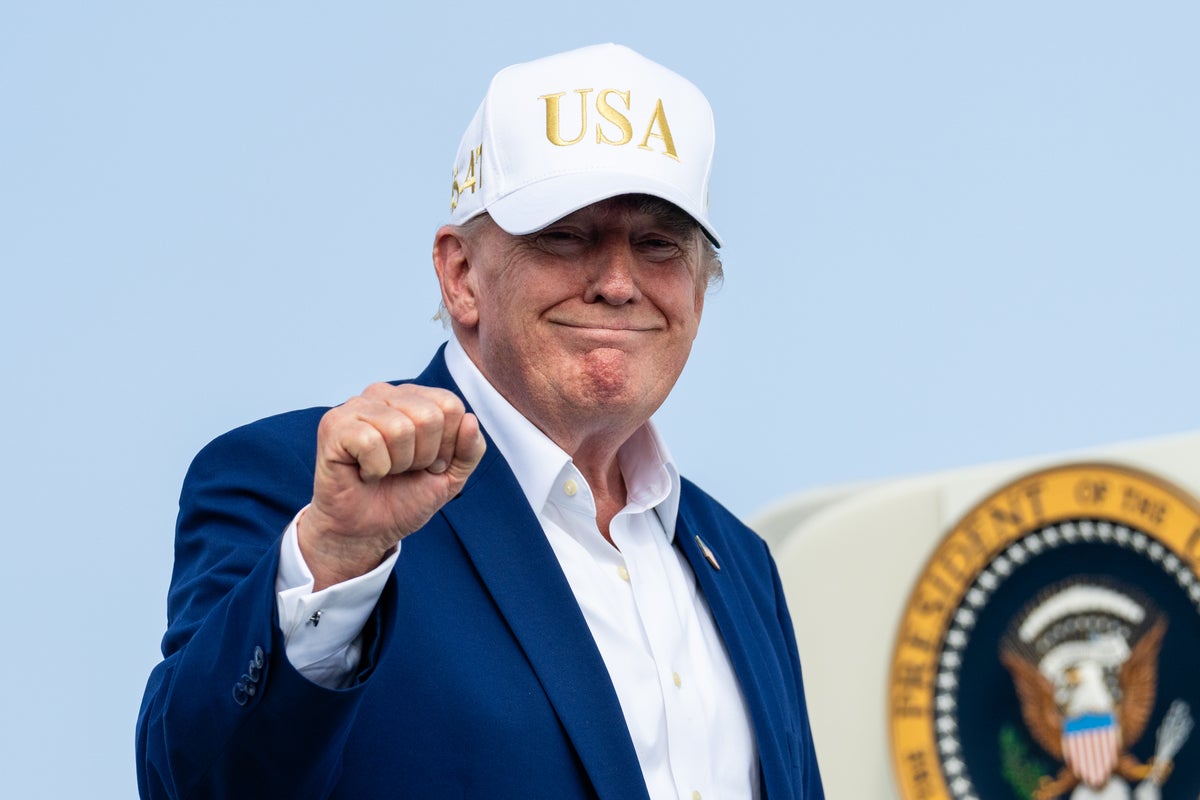
Iran-US war latest: Trump ‘low-keying it’ with Iran as Tehran demands compensation to reopen Strait of Hormuz
Key Points
Iran-US war latest: Trump ‘low-keying it’ with Iran as Tehran demands compensation to reopen Strait of Hormuz Iran has warned the Strait will remain shut until the US meet six crucial conditions - Bookmark - CommentsGo to comments US president Donald Trump has said the US is "low-keying it" with Iran as talks to end their war and reopen shipping through the Strait of Hormuz appeared to have stalled. "We are only semi-negotiating with them. We are just watching Iran with its huge inflation...
Iran-US war latest: Trump ‘low-keying it’ with Iran as Tehran demands compensation to reopen Strait of Hormuz
Iran has warned the Strait will remain shut until the US meet six crucial conditions
- Bookmark
- CommentsGo to comments
US president Donald Trump has said the US is "low-keying it" with Iran as talks to end their war and reopen shipping through the Strait of Hormuz appeared to have stalled.
"We are only semi-negotiating with them. We are just watching Iran with its huge inflation and the fact they have no money," he told Axios.Iran has set out a series of demands that it says the US must meet before it will sign off on a deal with Oman to partially open up the Strait, including the payment of compensation for war damages.
The head of Iran’s supreme national security council, Mohammad Bagher Zolghadr, said the Strait will remain shut until the US meet six conditions, including ending the war and aggression against Iran and its allies in Lebanon, Palestine, Yemen, and Iraq forever.
It comes as the US is pushing for defence companies to “dramatically” accelerate weapons production as the Iran war drains through their missile supplies.
Deputy defence secretary Steve Feinberg gave companies three weeks to lay out how they would “drive significantly faster, more aggressive delivery schedules and/or increased production for critical capabilities.”
“Years-long development cycles are not acceptable,” Mr Feinberg added in a memo obtained by The Washington Post.
“We must dramatically accelerate our program schedules and expand our production capacity now.”
Netanyahu says Trump's new Gaza plan is unacceptable
Israeli prime minister Benjamin Netanyahu restated his rejection of Donald Trump's latest Gaza plan in televised remarks to his right-wing government on Sunday, even as Israel's military has effectively halted attacks in the territory under pressure from the US president.
Netanyahu is struggling in the polls as he seeks re-election at a vote due on 27 October but is caught between far-right ministers angered by concessions in Gaza and his key military backer, Trump, who wants progress toward ending the conflict there with a new 15-point roadmap. Israel has scaled back attacks in Gaza since Monday, when Nikolay Mladenov, the Gaza envoy for Trump's Board of Peace that oversees the ceasefire, met with Netanyahu.
A source familiar with Israel's position said it had agreed that the military would only act against what it perceives as immediate threats in Gaza and no longer carry out targeted assassinations as it had been doing on a near-daily basis. Mladenov said on Sunday that discussions on the new roadmap were ongoing.
Houthis attack Saudi refinery
Iranian strikes on Strait of Hormuz shipping have been coupled with increased attacks by its Yemen-based allies, the Houthi rebels, who have targeted ships at another oil chokepoint on the other side of the Arabian Peninsula between the Red Sea and Gulf of Aden.
The Houthis also declared a naval blockade against Saudi Arabia in the Red Sea last month in response to what they said was a Saudi siege on them in Yemen, an allegation denied by Riyadh, which backs Yemen's internationally recognised government.
The Yemeni rebel group said they had attacked Saudi Aramco's Jazan refinery on Sunday, two days after the kingdom signed a defence pact with Sunni Muslim allies Turkey and Pakistan in response to growing regional instability from the US-Israeli war on Shi'ite Iran.
The Saudi energy ministry said a fire had broken out at the refinery but was later extinguished with no injuries and authorities were dealing with the incident, without giving a cause.
Turkish foreign minister Hakan Fidan said the new alliance was not directed against Iran or any other country, but rather served as a general pledge to support security.
US ‘low-keying’ talks with Iran
US president Donald Trump said in an interview with Axios that the US was "low-keying" it with Iran.
"We are only semi-negotiating with them. We are just watching Iran with its huge inflation and the fact they have no money."
Washington and Tehran agreed to a ceasefire in June, but the US reimposed a blockade on Iranian shipping in the Gulf in July, a move that Tehran said violated the truce, which by then had already broken down.
"Once the deal is announced to restore commercial shipping without impediments, the United States will lift the blockade of Iranian ports," a US official told Reuters on condition of anonymity.
Fallout from war in Iran is leaving millions vulnerable to hunger
As the US, Iran and Oman edge towards an interim agreement to reopen the Strait of Hormuz, months of insecurity and disruption are leaving millions more vulnerable to hunger in Yemen.
The economic fallout from the regional conflict has driven up food and fuel prices, while more than four months of conflict with Iran has driven renewed escalation in Yemen, compounding one of the world's worst humanitarian crises.
More than half the population were already facing hunger, but slow progress from world leaders to re-open the Strait has caused months of disruption to global food and energy supplies, disrupting humanitarian aid operations.
Fallout from war in Iran is leaving millions vulnerable to hunger
Iran says Oman deal on strait is near but sets US conditions
Iran said it was nearing a final pact with Oman defining new shipping lanes between them through the Strait of Hormuz but repeated that the US must meet other conditions, including compensation and an end to sanctions and military threats, before the strategic waterway is reopened.
A US official told Reuters on Friday that Iran and Oman were close to a deal that could pave the way for restoring safe passage through the strait, a major conduit for oil and gas shipping before Iran blocked Hormuz in response to US and Israeli attacks on Tehran that began in late February.
Iranian foreign minister Abbas Araqchi said on Sunday an agreement with Oman on the strait was in its "final stages" but reiterated comments made on Saturday that Tehran would not reopen the channel unless the US met certain demands made by Tehran.
Mr Araqchi said reopening the strait would depend in part on the US paying compensation for damage it caused in widespread attacks on Iran.
The secretary of Iran's top national security body, Mohammad Baqer Zolqadr, also listed ending further US threats against Iran; halting aggression toward Iran and its Lebanese, Palestinian, Yemeni and Iraqi allies; removing a US naval blockade in the Gulf; lifting sanctions on Iran; and releasing frozen Iranian assets.
'We're low-keying it on Iran', says Trump
Donald Trump told Axios on Sunday that he’s “low-keying it” on Iran with talks to end the war still on ice.
The US president signalled that he preferred to allow economic pressure on Iran to mount, as opposed to ordering a new military offensive, with both sides still held at an impasse.
Iran, aware of the impact of delaying the reopening of the Strait of Hormuz, has indicated it is also willing to maintain the status quo until the US concedes to its demands.
“We're only semi-negotiating with them. We're just watching Iran with its huge inflation & the fact they have no money,” Trump told Axios, adding: “It will work out. It always works out. It's like a chess game.”
Iranian foreign minister Abbas Araghchi earlier ruled out a resumption of negotiations with the US until Washington ends its violations of the so-called memorandum of understanding to end the war, according to Iranian media.
Trump foe vows he’s ‘prepared to support a bad deal’ to end war in Iran
Connecticut Sen. Chris Murphy tore into Donald Trump’s ongoing inability to reach an agreement to permanently end the war with Iran on Sunday and said that it was increasingly obvious that Trump would be forced to take a “bad” deal to extract the U.S. from the conflict.
But Murphy, speaking on NBC’s Meet the Press on Sunday, told host Kristen Welker that he’d support any effort to end the war at this point — even a “terrible-bad deal” — as traffic continues to be heavily restricted through the Strait of Hormuz and the U.S. has so far been unable to pressure Iran to accept any deal reopening the strait and addressing its nuclear program.
Read the full story:
Trump foe vows he’s ‘prepared to support a bad deal’ to end war in Iran
US military pushes companies to ‘dramatically accelerate’ weapons production as Iran war burns through supply, memo says
The US is pushing for defence companies to “dramatically” accelerate weapons production as the Iran war drains through their missile supplies, it is understood.
Deputy defence secretary Steve Feinberg gave companies three weeks to lay out how they would “drive significantly faster, more aggressive delivery schedules and/or increased production for critical capabilities.”
“Years-long development cycles are not acceptable,” Mr Feinberg added in the memo, which was obtained by The Washington Post.
Pentagon pushes to ‘dramatically’ speed production as Iran war burns through weapons
UAE oil tanker attacked by missile in Strait of Hormuz
The United Arab Emirates condemned an Iranian missile attack on its carrier as it passed through the Strait of Hormuz today, accusing Tehran of "acts of piracy".
State news agency WAM initially reported ADNOC as saying one of its vessels had been targeted by a missile early on Saturday and that the situation was under control.
The UAE Foreign Ministry later condemned what it called "the hostile Iranian attack" on an ADNOC vessel.
Neither statement gave details on the tanker, its cargo or possible damage. No injuries were reported.
The ministry said the attack violated a U.N. Security Council resolution on freedom of navigation and accused Iran's Revolutionary Guards of "acts of piracy" by targeting commercial shipping and using the waterway as a tool of economic pressure.
Netanyahu rejects Trump's Gaza peace plan
Benjamin Netanyahu has rejected Donald Trump's Gaza peace plan, insisting Israel will not withdraw until Hamas fully disarms.
The US president claimed last month that there had been a breakthrough in his plan to end the war, which both Israel and Hamas agreed to last year and which started with the ceasefire.
Israel has continued to carry out strikes on Gaza since agreeing to the ceasefire last October.
The peace deal put forward by the US last year would have seen Hamas relinquish its weapons, Israeli forces withdraw from Gaza as the disarmament progresses, and an international stabilisation force work with a new Palestinian police force until a new Palestinian government takes over in Gaza.
Join our commenting forum
Join thought-provoking conversations, follow other Independent readers and see their replies
Comments
Iran (LOCATION)
US (LOCATION)
Tehran (LOCATION)
Strait (LOCATION)
Donald Trump (PERSON)
the Strait of Hormuz (LOCATION)
Axios (PERSON)
Oman (LOCATION)
supreme national security council (ORG)
Mohammad Bagher Zolghadr (PERSON)
Lebanon (LOCATION)
Palestine (LOCATION)
Yemen (LOCATION)
Iraq (LOCATION)
the Iran war (EVENT)