
Science
NASA astronaut and 1st female French spacewalker remove failed ISS antenna but run out of time for replacement
Key Points
NASA astronaut and 1st female French spacewalker remove failed ISS antenna but run out of time for replacement Anil Menon and Sophie Adenot are back inside the International Space Station after a 6-hour, 23-minute spacewalk. Two astronauts — including the first French woman in history to perform a spacewalk — worked outside of the International Space Station (ISS) on Tuesday (Aug 18), becoming temporary TV repairpersons. Just like what frequently happens on Earth, the work required more time...
NASA astronaut and 1st female French spacewalker remove failed ISS antenna but run out of time for replacement
Anil Menon and Sophie Adenot are back inside the International Space Station after a 6-hour, 23-minute spacewalk.
Two astronauts — including the first French woman in history to perform a spacewalk — worked outside of the International Space Station (ISS) on Tuesday (Aug 18), becoming temporary TV repairpersons. Just like what frequently happens on Earth, the work required more time than the "appointment" allowed, requiring a second visit to be scheduled.
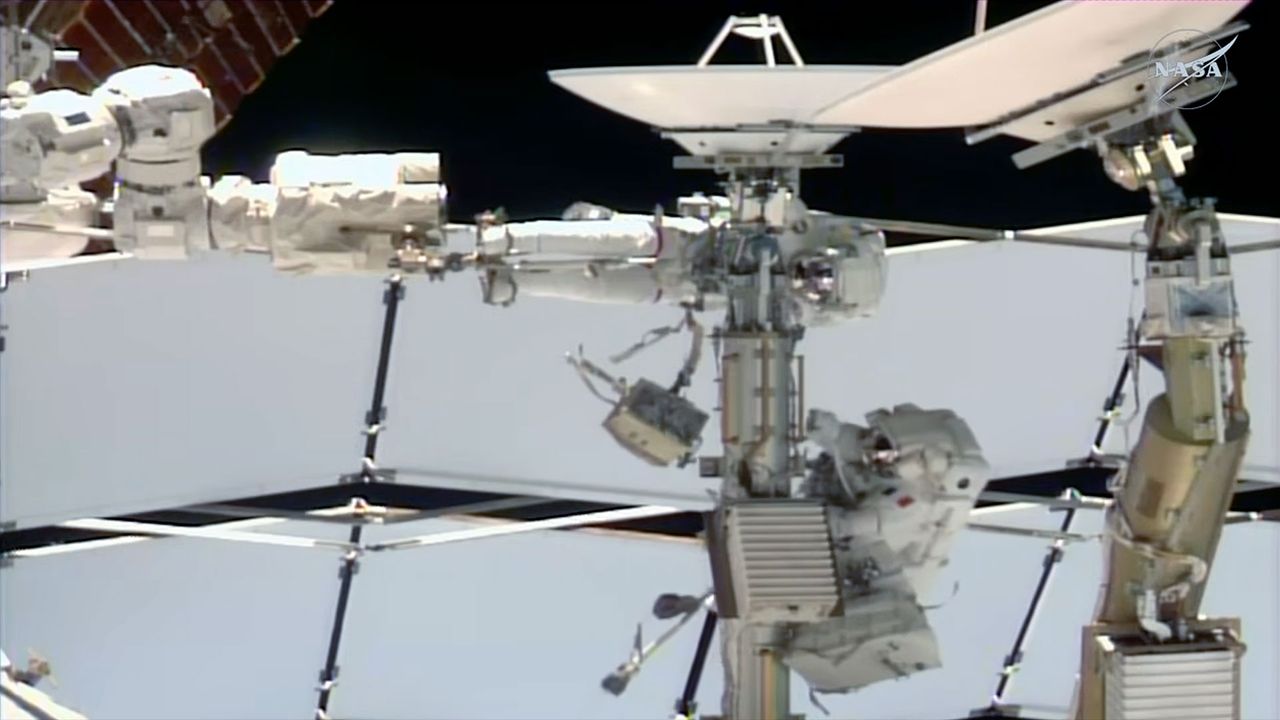
NASA astronaut Anil Menon and ESA (European Space Agency) astronaut Sophie Adenot were tasked with the removal and replacement of a Space-to-Ground antenna that since November had ceased being able to track NASA's data relay satellites, rendering it unusable. A second antenna has been in use since, continuing the transmission of critical data and enabling high-speed communications with Mission Control Houston.
Spacewalk planners had allocated about six and a half hours for the work to be completed. The two Expedition 75 crewmates were successful in removing the failed Space-to-Ground antenna from its mount on the station's truss but ran into delays disconnecting its electrical connections and and locking down gimbal bolts, or pins, to secure the large dish assembly during its transport to its temporary stowage location.
"We got into this with the mindset that we wanted everything to go perfectly," said Menon as the spacewalk came to an end. "Things were a lot different than expected, but what I would say that I am really impressed with is that all of those contingencies were well thought out."
As such, flight controllers had the astronauts tether the failed antenna to the truss and waived them off installing the replacement antenna, leaving it for a future extravehicular activity (EVA) still to be scheduled. Mission managers will decide whether to add that task to a spacewalk already planned for next Tuesday (Aug. 25) or to leave it for a later outing.
"We are looking at times," radioed Mission Control to the spacewalkers. "We are going to go directly to the long-duration tie-down of this SGANT on the Z-1 truss."
Menon and Adenot began the spacewalk at 8:29 a.m. EDT (1229 GMT) when they switched their spacesuits to battery power. Their EVA ended once they were back inside the U.S. Quest airlock and re-pressurization began at 2:52 p.m. EDT (1852 GMT).
Their total time logged on this spacewalk was 6 hours and 23 minutes.
Tuesday's spacewalk was the 282nd in support of ISS assembly, maintenance and upgrades. It was Menon's second EVA since making his first outing with fellow NASA astronaut Jessica Meir on Aug. 6, increasing his total spacewalking time to 12 hours and 50 minutes.
It was the first time that Sophie Adenot ventured into the vacuum of space, making her the first female and fifth citizen of France to perform a spacewalk after Jean-Loup Chrétien, Jean-Pierre Haigneré, Philippe Perrin, and Thomas Pesquet.
"What a day!" said Adenot. "My deepest gratitude to everyone who made this possible — the pioneers who came before us, but also the incredible teams working behind the scenes today."
This was the fifth spacewalk conducted out of the International Space Station this year, the second for Expedition 75 and the 97th using U.S. extravehicular mobility unit (EMU) spacesuits at the space station.
You must confirm your public display name before commenting
Please logout and then login again, you will then be prompted to enter your display name.
Robert Pearlman is a space historian, journalist and the founder and editor of collectSPACE.com, a daily news publication and community devoted to space history with a particular focus on how and where space exploration intersects with pop culture. Pearlman is also a contributing writer for Space.com and co-author of "Space Stations: The Art, Science, and Reality of Working in Space” published by Smithsonian Books in 2018.
In 2009, he was inducted into the U.S. Space Camp Hall of Fame in Huntsville, Alabama. In 2021, he was honored by the American Astronautical Society with the Ordway Award for Sustained Excellence in Spaceflight History. In 2023, the National Space Club Florida Committee recognized Pearlman with the Kolcum News and Communications Award for excellence in telling the space story along the Space Coast and throughout the world.