
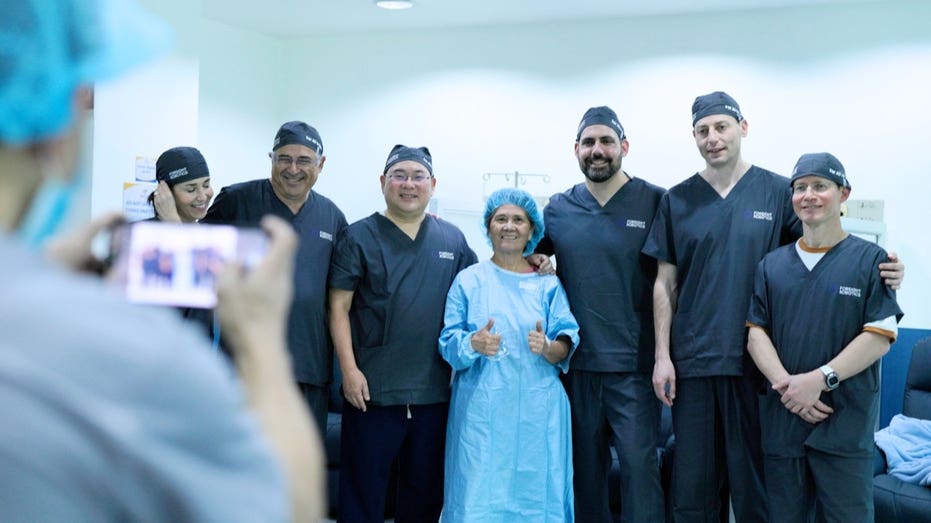
If you or someone you love has had cataract surgery, you know how routine the whole thing can feel. You arrive, the surgeon does the procedure, and you are usually back home the same day. Now a robot is entering that familiar routine.
ForSight Robotics says its JASPER Robotic Surgical Platform has now been used in 26 fully robotic-assisted cataract surgeries in human patients. According to the company, every procedure was completed robotically without the surgeon having to switch to a manual operation. That may sound like the robot took over the operating room. It did not.
New! Free live CyberGuy class: Protect Your Money From Today’s Biggest Threats
Join us Saturday, August 29, at 10 AM ET for a free CyberGuy LIVE class covering five simple steps to help defend yourself against AI scams, fraud, identity theft and financial hacks. Kurt "CyberGuy" Knutsson will explain how to set up bank alerts, strengthen your account logins, protect your phone number, freeze your credit and help secure your retirement savings against unauthorized transfers. No technical experience is needed. You’ll also receive our financial protection checklist, and every registrant will get a link to the class recording afterward.
Reserve your free spot today at CyberGuyLive.com.
ROBOT LEARNS TO DISMANTLE BROKEN MACHINES
JASPER works through surgeon-controlled telemanipulation. The doctor directs the procedure while the robotic system translates those commands into tiny movements inside the patient's eye. That matters because we're starting to see robots take on bigger roles in surgery. However, the details about who is actually in charge can get lost in the headline. Fully robotic-assisted cataract surgery reaches 26 patients
ForSight announced its first-in-human robotic cataract surgery earlier this year. The company has since completed another 14 procedures, bringing its total first-in-human clinical experience to 26 patients. ForSight says all 26 procedures were completed with JASPER without converting to conventional manual surgery. The patients also received the same types of anesthesia commonly used in cataract surgery. Doctors used either topical anesthesia or mild sedation depending on the patient. Everyone went home the same day. That may sound like a small detail next to the robot, but I think it is one of the more interesting parts of this story.
ForSight is trying to show that robotics can fit into the way cataract surgery already works. The goal is to add robotic technology without turning a familiar outpatient procedure into something completely different. So far, the company says JASPER has worked within that normal clinical routine. Still, 26 patients is a small group. This is early clinical experience, not proof that robotic cataract surgery is ready for widespread use.
The phrase "fully robotic-assisted" needs a little unpacking because it can easily sound like JASPER is making decisions on its own. It isn't. The surgeon controls the procedure through telemanipulation. JASPER then translates those commands into movements by the robotic instruments working inside the eye.
The system gives the surgeon high-definition 3D visualization. It can scale movements and filter out natural hand tremor. Real-time eye tracking helps JASPER respond as the eye moves during surgery. ForSight also uses computer vision to help support the surgeon during the procedure. The big difference here is that JASPER is designed to perform the complete cataract procedure, rather than stepping in for only one part of the operation. The doctor still decides what happens next and remains in control throughout.
We have seen other approaches to robotic surgery move in different directions. CyberGuy previously covered an AI-powered robot that independently completed a key phase of gallbladder surgery on a lifelike surgical model. JASPER takes a more hands-on approach from the surgeon's perspective. The robot handles the physical movements, but the doctor is still calling the shots.
COULD A PAINT-ON ELECTRONIC TATTOO SPOT HEART ATTACKS?
Cataract surgery is already one of the most common operations in the world. ForSight says more than 30 million procedures are performed each year globally. That gives this technology a very different kind of potential impact. We are not talking about a robot built for an extremely rare procedure. If systems like JASPER eventually prove safe and practical, they could enter a part of medicine that touches millions of people every year.
Robotic surgery is also beginning to stretch beyond the traditional operating room. In March, CyberGuy reported on a London surgeon who remotely guided a robot to remove a patient's prostate cancer from about 1,500 miles away. More recently, researchers tested humanoid robots during live gallbladder surgeries in a preclinical study. Human surgeons remotely controlled those robots too. JASPER brings that same idea of surgeon-controlled robotics to the eye, where tiny movements matter enormously. ForSight believes the technology could give surgeons greater precision and stability. The company also sees JASPER as a possible foundation for future AI-enabled surgical tools.
Before you start asking your eye doctor when the robot is arriving, there is an important reality check. JASPER is still under design and development and has not been approved for commercial use. ForSight is continuing clinical work as it moves toward additional studies and regulatory submissions. There is also one number in the announcement that deserves a closer look: 100%. ForSight says 100% of the 26 procedures were completed robotically without switching to manual surgery. That is impressive, but it is also very specific.
The figure does not mean JASPER has a 100% success rate. Nor does it prove the system is safer than conventional cataract surgery. We also do not yet know whether patients will have better long-term outcomes. Those questions need much more evidence. Whenever you see a big percentage attached to a new medical technology, look at exactly what the number measures. In this case, it measures robotic completion of the procedure.
If you need cataract surgery today, this does not change your treatment options. JASPER isn’t a commercial system that you can request from your eye doctor. What it does give us is a preview of how surgery could evolve. Instead of a surgeon physically manipulating every instrument by hand, the doctor could control a robotic system that translates those decisions into extremely precise movements. For eye surgery, that could be a big deal.
The technology may eventually help surgeons work with greater stability. It could also open the door to new ways of performing highly specialized procedures. But there is a difference between something working in 26 patients and something being ready for millions of people. Researchers still need larger studies. Regulators will have to examine the system closely. Doctors will also want to see how robotic cataract surgery compares with the procedures they already perform every day. For now, JASPER gives us an intriguing look at where eye surgery may be heading.
What grabs me about this story isn’t simply the fact that a robot was involved in eye surgery. We've been watching robots move deeper into medicine for years. What gets my attention is how normal ForSight says the experience remained for the patient. People received familiar anesthesia and went home the same day. Meanwhile, a surgeon controlled a robotic platform through the complete cataract procedure. That tells me the real test for medical robots may be whether they can fit into existing care without making everything more complicated. At the same time, 26 patients is still 26 patients. I want to see larger studies and a clearer picture of how patients do over time. Another big question is whether robotic surgery actually improves results or mainly gives surgeons a different way to perform the same procedure. Then there is the AI question. ForSight says JASPER could eventually support AI-enabled surgical capabilities. That could push this technology into a very different territory down the road. Right now, though, the surgeon is still firmly in charge.
If your eye doctor told you a robot would perform the physical movements during cataract surgery while the surgeon controlled every step, would you be comfortable with that or would you want the traditional approach? Let us know by writing to us at Cyberguy.com
Sign up for my FREE CyberGuy Report
Copyright 2026 CyberGuy.com. All rights reserved.