
Science
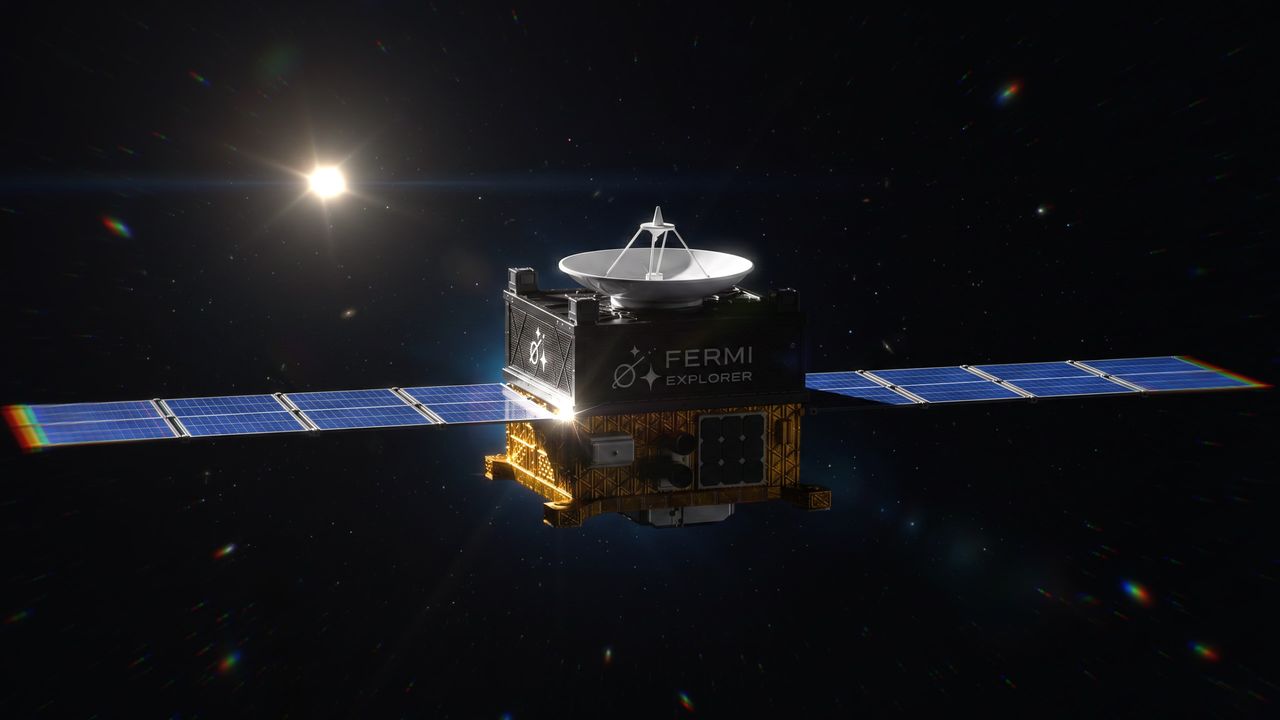
Nonprofit wants to launch 80,000-year mission to Alpha Centauri in 2029 (video)
Key Points
Nonprofit wants to launch 80,000-year mission to Alpha Centauri in 2029 (video) The first dedicated mission to another star will launch before the end of the decade, if all goes according to plan. A nonprofit called the Fermi Explorer Mission announced today (Sept. 1) that it plans to send a small probe toward Alpha Centauri by 2029.
Nonprofit wants to launch 80,000-year mission to Alpha Centauri in 2029 (video)
The first dedicated mission to another star will launch before the end of the decade, if all goes according to plan.
A nonprofit called the Fermi Explorer Mission announced today (Sept. 1) that it plans to send a small probe toward Alpha Centauri by 2029. But none of us will live to see the interstellar spacecraft's historic arrival; its journey is expected to take about 80,000 years.
"We hope to be both the first to leave and the last to arrive at Alpha Centauri," Philip Johnston, co-founder and president of the Fermi Explorer Mission, said in a statement today. "None of us will be here when this journey ends, and that is the point. It's about taking the first achievable step and inspiring future generations to keep pushing beyond the limits we inherited."
Johnston is also co-founder and CEO of Starcloud, a company that plans to operate data centers in space. He started the Fermi Explorer Mission with fellow Starcloud co-founders Ezra Feilden and Adi Oldean. Former U.S. Air Force officer Garrett Jamison leads day-to-day execution of the project. Some big names in the spaceflight world have signed on as advisors, including former Blue Origin president Rob Meyerson and Matt Gialich, co-founder and CEO of the asteroid-mining company AstroForge.
The Fermi Explorer project is ambitious but achievable, according to Johnston and his colleagues. They want to launch a spacecraft to the three-star Alpha Centauri system — the sun's nearest stellar neighbor, at about 4.4 light-years away — by 2029.
This directed trajectory will be a first. Though NASA's Voyager 1 and Voyager 2 spacecraft are in interstellar space, they're not headed toward any particular star; rather, they're journeying outward on the path they took to complete their "grand tour" of Jupiter, Saturn, Uranus and Neptune.
The Fermi Explorer spacecraft will carry at least 2.2 pounds (1 kilogram) of payload, and its entire mission will cost less than $15 million, according to the team. If all goes to plan, the returns on that investment will be considerable.
Breaking space news, the latest updates on rocket launches, skywatching events and more!
"The mission is intended to make the idea of interstellar travel real, and to encourage more people to confront one of humanity's biggest unanswered questions when we look beyond our planet: 'Where is everybody?' (the Fermi Paradox)," the Fermi Explorer team said via X today.
The Fermi Paradox takes its name from the famed physicist Enrico Fermi, who posited the "Where is everybody?" question in 1950. It has taken on greater significance in the past decade or so, as scientists have realized how common exoplanets — potential abodes for life — are throughout our Milky Way galaxy.
There are just three possible explanations for the paradox, according to the Fermi Explorer team:
- Human-like intelligence is rare throughout the universe
- It's not rare, but intelligent species don't survive for long
- It's common and long-lasting, but intelligent aliens generally don't make themselves known to their cosmic colleagues (either by choice or by circumstance)
Launching a directed interstellar mission won't solve the paradox, but it will give us some data that we didn't have before.
"After the Fermi Explorer Mission, we will have more confidence both that is possible for intelligent species to leave for their nearest star in a way that isn't resource prohibitive, and that there are least some species that try to do it (namely us!)," team members wrote in an FAQ about the mission. "This has the effect of throwing the Fermi Paradox into even greater focus."
The team says it envisions a small spacecraft, one that weighs just 220 to 440 pounds (100 to 200 kilograms) here on Earth. It will also likely employ electric propulsion, which is more efficient than traditional chemical thrusters.
Electric propulsion is also a proven system, meaning the Fermi Explorer team isn't relying on futuristic tech to travel to the stars. This has been a stumbling block for other interstellar projects, such as the apparently defunct Breakthrough Starshot, which wanted to blast tiny sailcraft to Proxima Centauri — part of the Alpha Centauri system — using powerful lasers. (That futuristic tech would be great if it worked, however; Breakthrough Starshot aimed to accelerate its nanoprobes to about 20% the speed of light, which equates to a roughly 20-year trip to Proxima Centauri.)
The details — who will build the spacecraft, for example, and what payloads it will carry — will be nailed down in the coming months. The project says it already has a proposal from one major satellite manufacturer that comes in under the $15 million cap.
And speaking of money: The Fermi Explorer team wants some financial help getting this mission off the ground. You can donate to the project, which is a 501(c)(3) nonprofit, here.
You must confirm your public display name before commenting
Please logout and then login again, you will then be prompted to enter your display name.
Michael Wall is the Spaceflight and Tech Editor for Space.com and joined the team in 2010. He primarily covers human and robotic spaceflight, military space, and exoplanets, but has been known to dabble in the space art beat. His book about the search for alien life, "Out There," was published on Nov. 13, 2018. Before becoming a science writer, Michael worked as a herpetologist and wildlife biologist. He has a Ph.D. in evolutionary biology from the University of Sydney, Australia, a bachelor's degree from the University of Arizona, and a graduate certificate in science writing from the University of California, Santa Cruz. To find out what his latest project is, you can follow Michael on Twitter.
the Fermi Explorer Mission (ORG)
Alpha Centauri (LOCATION)
Philip Johnston (PERSON)
Johnston (PERSON)
Starcloud (ORG)
Ezra Feilden (PERSON)
Adi Oldean (PERSON)
U.S. Air Force (ORG)
Garrett Jamison (PERSON)
Blue Origin (ORG)
Rob Meyerson (PERSON)
Matt Gialich (PERSON)
AstroForge (ORG)
NASA (ORG)
Jupiter (LOCATION)