
Technology
Excavation in Poland reveals Stone Age man buried with decapitated heads and a tooth necklace
Key Points
Excavation in Poland reveals Stone Age man buried with decapitated heads and a tooth necklace A Stone Age burial of a man with a toothy necklace and human skulls surprised archaeologists excavating in Poland. Archaeologists were excavating in a Roman-period cemetery in Poland when they came across something extremely unusual: the grave of a man who was buried with two decapitated human heads, a necklace made from 42 mammal teeth, and a battle ax. That ax provided an important clue: He was...
Excavation in Poland reveals Stone Age man buried with decapitated heads and a tooth necklace
A Stone Age burial of a man with a toothy necklace and human skulls surprised archaeologists excavating in Poland.
Archaeologists were excavating in a Roman-period cemetery in Poland when they came across something extremely unusual: the grave of a man who was buried with two decapitated human heads, a necklace made from 42 mammal teeth, and a battle ax. That ax provided an important clue: He was actually from the Stone Age, three millennia older than the Roman cemetery.
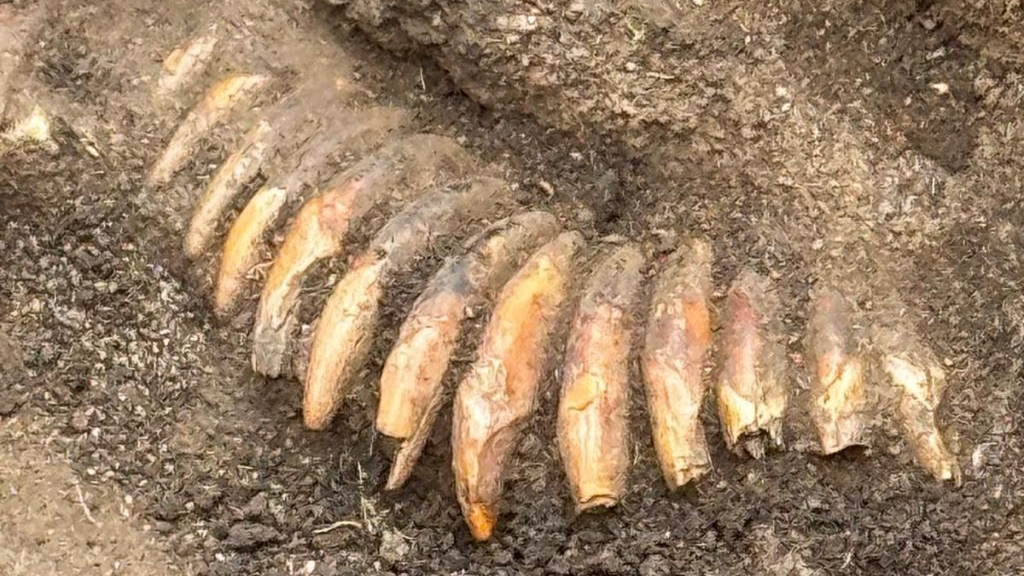
"We were practically packing up, and then we discovered a circular shape in the ground and began digging," Paweł Dąbrowski, a biological anthropologist at Wrocław Medical University, said in a Sept. 2 translated statement. "We found fairly well-preserved animal teeth arranged in a necklace."
The grave, which was found near Wrocław in southwest Poland, included the nearly complete skeleton of an adult male who was buried with amber beads, a flint blade and a battle ax made of serpentinite, a greenish metamorphic rock. The style of the stone ax suggests the burial was made around 2900 B.C., during the Middle Neolithic period (New Stone Age), according to the statement.
But a handful of teeth and bones that were also deposited in the grave as funeral offerings made the burial stand out as particularly unusual.
"The arrangement of the 42 teeth was precise," Dąbrowski said, "and upon further inspection, it turned out that all of them had holes drilled through their roots. They must have formed a kind of necklace."
The teeth that made up the necklace were incisors and canines that belonged to large mammals, such as wolves, deer, bears and potentially humans, Dąbrowski said in a Sept. 4 translated statement.
"It's possible we've discovered the grave of a warrior or hunter, but because of this necklace, we can assume it was someone important, for example, the leader of a family clan," Dąbrowski said.
Get the world’s most fascinating discoveries delivered straight to your inbox.
The burial also contained the remains of two human skulls, which the archaeologists think may be from decapitated heads that were buried with the man as gifts or funeral offerings. However, further analysis of the skulls is needed to confirm or rule out decapitation, according to the first statement.
RELATED STORIES
- Man rummaging in a Polish junkyard finds a 1,800-year-old shield holding the cremated remains of a Vandal warrior
- 800-year-old 'hugging skeletons' are genetically confirmed as Poland's only medieval same-sex double burial
- Medieval knight 'Lancelot' and his stunning stone tomb found under ice cream shop in Poland
A similar elite person's burial filled with axes, flint tools and amber beads was previously discovered nearby, the researchers noted in the statements. In that case, the bones of a calf suggested that the animal had been sacrificed at the grave. But to date, these are the only two burials of their kind in the area. According to the statements, they might be from members of the Corded Ware culture, which likely spread Indo-European languages around Europe and Asia.
According to Dąbrowski, the next step is to analyze the remains from both Stone Age burials to figure out if the people were related and what their lives were like nearly 5,000 years ago. He expects the first results of the analyses to be available later this year.
What do you know about the Paleolithic, Mesolithic and Neolithic eras? Find out with our Stone Age quiz.
Kristina Killgrove is a staff writer at Live Science with a focus on archaeology and paleoanthropology news. Her articles have also appeared in venues such as Forbes, Smithsonian, and Mental Floss. Kristina holds a Ph.D. in biological anthropology and an M.A. in classical archaeology from the University of North Carolina, as well as a B.A. in Latin from the University of Virginia, and she was formerly a university professor and researcher. She has received awards from the Society for American Archaeology and the American Anthropological Association for her science writing.
You must confirm your public display name before commenting
Please logout and then login again, you will then be prompted to enter your display name.