
Science
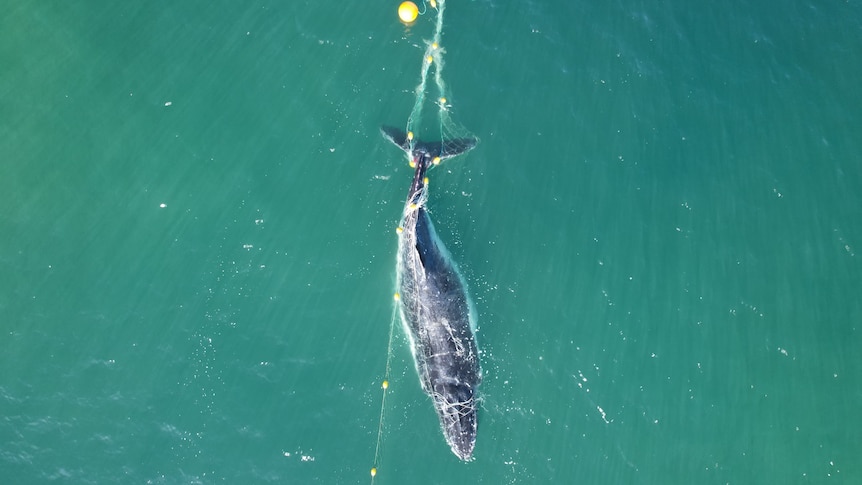
High-frequency 'pingers' trial to keep whales out of shark nets
Key Points
Queensland tests acoustic alarms to ward off whales from shark nets In short: A trial has begun of high-frequency acoustic alarms attached to shark nets off Noosa. The nets will be monitored to gauge the effect on migratory whales. It is hoped the technology will result in a reduction in the number of whales becoming entangled each year.
Queensland tests acoustic alarms to ward off whales from shark nets
In short:
A trial has begun of high-frequency acoustic alarms attached to shark nets off Noosa.
The nets will be monitored to gauge the effect on migratory whales.
What's next?
It is hoped the technology will result in a reduction in the number of whales becoming entangled each year.
For the first time in 15 years, acoustic alarms attached to shark nets off Queensland's coastline are changing pitch.
Authorities hope the new, high-frequency 'pingers' will more effectively prevent whales from becoming trapped in nets.
About 50,000 humpbacks pass by Australia's east coast each year, with the southern migration currently in full swing.
Shark control program operations coordinator Sam Fary said about "0.02 per cent" of the whales would interact with the nets — but there was always room for improvement.
"This is a higher frequency, something that we haven't used before … this is world-leading research in this space," Mr Fary said.
The five-week trial is being conducted in waters off Noosa Heads, as part of a collaboration between the University of Queensland, the state government and the alarm supplier, Future Oceans.
How does it work?
James Turner from Future Oceans said the pingers sent a sound into the water that is understood to be heard by whales and dolphins.
"They acoustically illuminate things like fishing nets and drum lines … whales are actually moving away from whatever the gear the pingers are attached to," Mr Turner said.
"The University of Queensland did some trials and decided that one of the frequencies was going to be even better than the frequency that the government's been using for the past 15 years in the pingers."
Mr Turner said the technology was constantly evolving, and they hoped to soon be able to understand the sounds the whales made.
"Researchers think that they can start to break down the sequences and the signals whales are using," he said.
"And if we learn what are deterrent signals or an alert signal to them, then we can replicate those."
Keeping watch
Researchers from the University of Queensland will be at Noosa Heads for the trial.
Riona McNamara said they would be set up for 10 hours each day.
"We're watching the shark nets and observing any whales that track close to them," she said.
"People are really inquisitive about what we're doing and yeah, perfect position to watch the nets and the whales migrating through."
Humpbacks and High-rises chief executive Olaf Meynecke, whose conservation organisation monitors whale movements, said previous studies had not demonstrated similar pingers to be a sufficient deterrent.
"These shark nets have clearly proven to be lethal for a lot of non-target species, and their effectiveness [in deterring sharks] is questionable," Dr Meynecke said.
He said there were approximately 60 entanglements along the east coast each year, but the number could be higher due to inaccurate reporting.
"If we take out the shark nets during the whale season, we won't have any entanglements of whales. It's simple as that,"he said.
Primary Industries Minister Tony Perrett said the trial reflected the state government's commitment to swimmer safety.
"Queensland's shark control program plays an important role in protecting beachgoers, and we are always looking at ways we can improve the program with contemporary technology and science," Mr Perrett said.