
Science
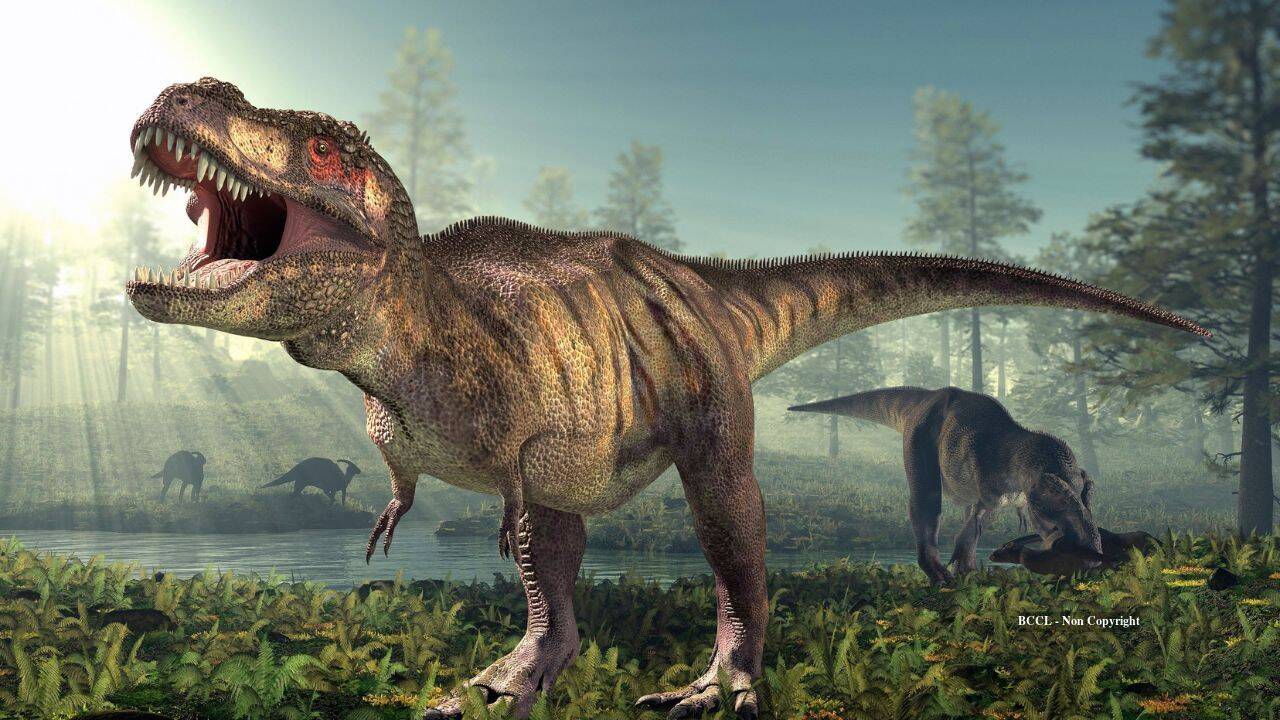
T rex footprints reveal the giant dinosaur walked, not ran
Key Points
For decades, paleontologists have studied Tyrannosaurus rex (T. rex) through bones, teeth and isolated footprints. Those fossils reveal what the animal looked like, how large it was and what it may have eaten, but they rarely show the creature in motion. That changed with the discovery of a short trail in southwestern North Dakota.
For decades, paleontologists have studied Tyrannosaurus rex (T. rex) through bones, teeth and isolated footprints. Those fossils reveal what the animal looked like, how large it was and what it may have eaten, but they rarely show the creature in motion. That changed with the discovery of a short trail in southwestern North Dakota. Four enormous three-toed footprints, pressed into mud about 66.5 million years ago, form the first known trackway attributed to an adult T. rex. The spacing between the prints suggests that the animal was moving at roughly 3.5 to 4.5 miles per hour, a pace comparable to a brisk human walk. As reported by The Guardian and Good Good News Network, the find offers an unusually direct glimpse of a giant predator simply walking across the ancient landscape.
A trail preserved in ancient mudThe trackway was found in the Hell Creek Formation, a fossil rich region that stretches across parts of North Dakota, South Dakota, Montana and Wyoming. During the late Cretaceous Period, this landscape looked very different from the modern badlands. Rivers crossed broad floodplains, forests grew along their banks and dinosaurs moved through a warm environment near the Western Interior Seaway.
The footprints formed when a large dinosaur stepped across wet sediment. If the impressions dried before being buried by additional layers of mud or sand, they could survive as natural records of movement. Over geological time, the sediment hardened into rock, preserving the shape and position of each step.
The newly described trackway is about 23 feet long and contains four footprints, arranged as two left and two right steps. Each print is roughly three feet long. That alternating sequence is what makes the discovery so valuable. A single footprint can show size and anatomy, but several footprints can reveal stride, direction and speed.
Why the trackmaker was likely T. rexScientists cannot observe the original dinosaur, so identifying a trackmaker requires comparing the footprints with known anatomy and other evidence. The North Dakota prints are large, three-toed, fossil-rich, and shaped like the feet of a tyrannosaur. Their size indicates that the animal was an adult rather than a juvenile.
The surrounding Hell Creek Formation contains abundant T. rex bones, making the species the most likely source of the footprints. Researchers also examined the narrow angle between the toes and the overall form of the impressions. No other known animal in the formation fits the combination of size, shape, geological age and location as well.
Paleontologists are careful with such conclusions because tracks are not always easy to assign to a particular species. Several large predatory dinosaurs had three toes, and footprints can be distorted by mud, erosion or later geological pressure. In this case, however, the evidence strongly supports an adult Tyrannosaurus rex as the trackmaker.
A walking dinosaur, not a sprinting oneThe distance between successive footprints, known as the stride, measures approximately 13 feet. By combining stride length with estimates of hip height and body proportions, scientists calculated a speed of about 3.5 to 4.5 miles per hour.
That is not a running pace. It is closer to the speed of a person taking a brisk walk. The finding does not mean T. rex was incapable of running. It shows that this individual was walking when it left the trackway, perhaps while moving between feeding areas, following a riverbank or simply travelling across the floodplain.
The distinction matters because speed is closely tied to biomechanics. A walking animal keeps at least one foot on the ground during part of each stride, creating a different pattern from a running animal. The spacing and arrangement of the footprints preserve evidence of that gait.
For a dinosaur that may have weighed several tons, the result is striking. The predator was not necessarily charging or chasing prey. It was moving in a relatively relaxed way, leaving behind a sequence of steps that remained hidden in stone until modern scientists recognised them.
What tracks reveal that bones cannotBones provide detailed information about anatomy, but footprints preserve behaviour. They can show whether an animal was walking, running, standing, turning or travelling with others. They may also reveal how the foot was placed and how the body shifted from one step to the next.
A trackway can therefore complement skeletal evidence. Scientists can compare the size of the footprints with the proportions of known T. rex skeletons, then use stride and gait to refine estimates of movement. The result is a more complete picture of the animal as a living creature rather than a reconstructed skeleton.
The North Dakota trackway is especially important because isolated adult T. rex footprints had been reported before, but a connected sequence had not been confidently described. Without several prints in a row, calculating speed and interpreting movement is far more difficult.
In that sense, the discovery is not just another T. rex fossil. It is a behavioural fossil, a record of something the animal was doing.
A discovery made by a careful observerThe trackway was first identified in 2025 by Kent Hups, a volunteer associated with the Denver Museum of Nature and Science. The find was made on federal land administered by the US Forest Service near Marmarth in southwestern North Dakota.
Discoveries like this often depend on trained attention rather than dramatic excavation. A researcher or volunteer may notice an unusual shape in a rock surface, a pattern that does not match ordinary erosion or a partial footprint exposed by weathering. Once recognised, the feature can be documented, photographed and studied in detail.
Scientists from the Denver Museum of Nature and Science and Liverpool John Moores University examined the trackway using conventional measurements and digital methods. Three of the footprints are expected to be transferred to the museum, where they can be preserved, displayed and made available for further research.
The story also highlights the importance of protecting fossil sites. Public lands can contain evidence that changes scientific understanding, but exposed fossils are vulnerable to erosion, illegal collecting and damage from weather or development.
The final chapter of the dinosaursThe footprints date to roughly 66.5 million years ago, near the end of the Cretaceous Period. That places them close to the mass extinction that eliminated all non-avian dinosaurs.
The trackway does not reveal whether the T. rex survived until the asteroid impact that ended the Cretaceous. It simply records one individual moving through its environment during the final part of the species’ existence. Yet the timing gives the discovery an emotional dimension. These may be among the last traces left by a full-grown T. rex before the world changed forever.
At the time, T. rex was one of North America’s dominant predators. It occupied ecosystems filled with horned dinosaurs, duck billed dinosaurs, armoured species, turtles, crocodilians and early mammals. The four footprints capture a tiny moment in that much larger world.
The animal may have been searching for food, travelling toward water or following another dinosaur. Its purpose is unknowable, but the motion is preserved with unusual clarity.
Rethinking the image of T. rexPopular culture often presents Tyrannosaurus rex as a roaring, sprinting hunter. That image is based partly on its anatomy and partly on the drama of films and museum displays. The trackway adds a quieter perspective.
The dinosaur was capable of being powerful without constantly moving at maximum speed. Like modern predators, it probably spent much of its time walking, resting and conserving energy. A relaxed walking gait may have been far more common than a high speed chase.
This does not make the animal less impressive. A seven ton predator moving at human walking speed would still have been an overwhelming presence. Its stride covered about 13 feet, and each foot pressed a three foot impression into the ground. Even at a walk, its scale would have been difficult for any smaller animal to ignore.
The trackway allows scientists and the public to imagine T. rex as an animal with a daily routine, not merely as a symbol of prehistoric violence.
A new window into dinosaur movementThe discovery may also help researchers compare T. rex with other large theropods. By studying stride lengths, foot placement and gait, scientists can test biomechanical models developed from skeletons and computer simulations.
If the observed walking speed matches predictions based on anatomy, it strengthens confidence in those models. If it differs, researchers may need to reconsider assumptions about leg posture, muscle strength or body balance.
Digital scans can preserve the footprints in three dimensions, allowing scientists to examine details that might be missed through surface observation. Researchers can study the depth of each print, the angle of the toes and how sediment flowed around the foot. These details may reveal whether the ground was soft, firm, wet or uneven.
The site can also be compared with other trackways from the Hell Creek Formation. Together, these records may show how dinosaurs moved across different parts of the landscape and whether individuals travelled alone or in groups.
Why one short trail mattersOnly four footprints were needed to change what scientists know about adult T. rex behaviour. The trail is short, but the information it contains is unusually rich. It establishes that an adult animal walked across the landscape, provides a reasonable speed estimate and confirms that direct evidence of movement can survive even when no skeleton is present nearby.
The discovery also illustrates how incomplete the fossil record remains. Paleontologists have found many T. rex bones, including partial and nearly complete skeletons, but a living animal leaves more than bones behind. Tracks, bite marks, nests and coprolites all add evidence about behaviour.
Every new trace can challenge assumptions. A dinosaur imagined as a fast runner may be found walking. A species assumed to travel alone may leave tracks alongside others. The fossil record becomes more informative when researchers look for actions as well as anatomy.
The North Dakota trackway gives T. rex something it had been missing: a documented walk. More than 66 million years later, the mud still holds the evidence.
[Image text:] BCCL-Non Copyright