
Science
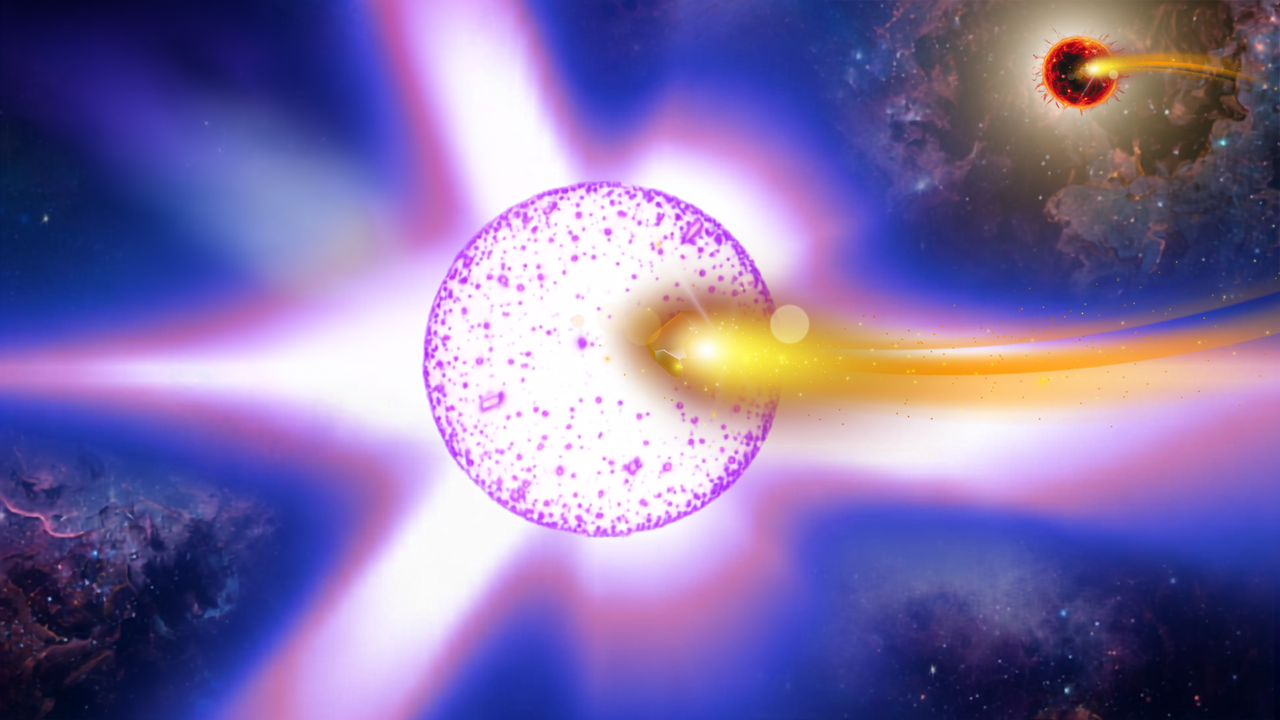
The universe's most extreme dead stars can form from vampire white dwarfs — and scientists finally know how
Key Points
The universe's most extreme dead stars can form from vampire white dwarfs — and scientists finally know how Like a cosmic Goldilocks, white dwarfs have to experience conditions that are "just right" to transform into neutron stars. When stars the size of our sun die, they leave behind powerful stellar remnants called white dwarfs — and these white dwarfs can transform into even more extreme objects called neutron stars, composed of the densest material in the universe. However, scientists...
The universe's most extreme dead stars can form from vampire white dwarfs — and scientists finally know how
Like a cosmic Goldilocks, white dwarfs have to experience conditions that are "just right" to transform into neutron stars.
When stars the size of our sun die, they leave behind powerful stellar remnants called white dwarfs — and these white dwarfs can transform into even more extreme objects called neutron stars, composed of the densest material in the universe. However, scientists have found that conditions must be "just right" for the major makeover to occur. You can think of it like a cosmic "Goldilocks" situation.
As it turns out, the white dwarf has to be feeding on a companion star like some kind of cosmic vampire.
Neutron stars and white dwarfs are both born when stars run out of the fuel supplies needed for nuclear fusion happening in their cores, but the difference between the two lies with their masses.
Stars with masses similar to that of the sun end their lives when they run out of hydrogen in their cores. This halts the nuclear fusion process — which involves converting that hydrogen to helium — leading to the stars collapsing and shedding their outer layers to become a white dwarf with around the mass of the sun crammed into the width of Earth.
When stars with masses around eight times that of the sun collapse after running out of hydrogen in their cores, they generate enough pressure and heat in these cores to fuse the produced helium into even heavier elements. This process only ends when the star attains a core of iron. The final collapse results in a supernova explosion and creates a neutron star with a mass between one and two times that of the sun. That's the usual way neutron stars form.
However, what if there's a bridge between the white dwarf scenario and neutron star scenario? Scientists have long suspected there is indeed a pathway for a white dwarf to become a neutron star. This new work maps out that pathway, calling it accretion-induced collapse (AIC).
"In AIC, the progenitor is already a stellar remnant, and the trigger is not its own evolution but material handed to it by a companion," team leader Laurenz Thümmler of ETH Zurich told Space.com.
The researcher added that an AIC begins with a stellar remnant in the form of a white dwarf, while the traditional route to birthing a neutron star begins with a massive "living" star. Yet, in the AIC, the collapse of an overfeeding white dwarf continues in a broadly similar way to the collapse of a massive star that creates a neutron star.
As Thümmler explains, in both cases, the neutron star creation process involves the massive star's core imploding and zippy particles called "neutrinos" carrying away energy from the event. However, an important difference is in the "standard" massive star collapse scenario, the subsequent core-collapse supernova and neutron star birth happens inside a thick envelope of material that has been ejected during the massive star's death throes. In AICs, however, this thick envelope of matter is absent.
"AIC is expected to be faint and fast, and why so little matter is ejected compared with an ordinary supernova. Not all white dwarfs could undergo an AIC, and that is the essential point."
Though AICs have been theorized about for years, Thümmler and team wanted to know what characteristics a white dwarf would need in order to undergo this transformation. They set about investigating this using 3-dimesional simulations.
It's what is inside that counts
Most white dwarfs consist of carbon and oxygen. However, some stars collapse to form a white dwarf composed of oxygen, neon and magnesium. That only happens for a narrow range of stellar masses, meaning this composition represents a minority population of white dwarfs.
When carbon and oxygen white dwarfs overfeed on stellar material from a companion or donor star, they eventually reach the so-called Chandrasekhar limit, usually around 1.4 stellar masses. Above this limit, they can go supernova. They don't become neutron stars as a result of these "Type 1a" supernovas, however, but are rather completely destroyed. Oxygen, neon and magnesium white dwarfs can avoid that destruction thanks to their high densities.
"They are typically born more massive and denser than carbon-oxygen white dwarfs and therefore require less additional mass to approach the Chandrasekhar limit," Thümmler said.
However, Thümmler and colleagues discovered this isn't the only condition needed to provoke an AIC. The white dwarf can't be too greedy either.
The team found that the accretion rate, or rate at which material from the donor star falls onto the white dwarf, has to fall within a fairly narrow window to allow an AIC to occur.
"If it is too low, nova eruptions can expel much of the accumulated material again; if it is too high, winds, envelope expansion, or binary interaction can prevent the white dwarf from reaching the conditions required for collapse," Thümmler said. "The accretion has to be fast enough, and steady enough, to get it there without triggering explosive burning along the way.
"When those conditions hold, electrons are captured onto neon and magnesium nuclei. This removes the pressure supporting the star, and the collapse follows."
All this means that AICs are expected to be rare events, although the rate at which they occur remains highly uncertain.
The team also found the environment around AICs is somewhat surprising.
"We expected the most neutron-rich material, which produces the heaviest elements, to emerge along the rotation axis, since that is where the magnetically driven outflow is strongest," Thümmler said. "It does not."
Instead, the team's models revealed neutron-rich material emerging at the mid-latitudes of white dwarfs as they transform into neutron stars. This is region where the outflows of matter driven by intense magnetic fields collide with winds heated by energy-carrying neutrinos.
Thümmler explained that this is significant because it means that these events would appear different based upon the angle at which they are observed.
How to spot white dwarf transformations
Laurenz said these AICs could be identified by Vera C. Rubin Observatory and other telescopes as a bright ultraviolet and optical event lasting two to three days, potentially accompanied by X-ray emissions and longer-lasting radio emissions.
However, the neutron stars created by such events may be difficult to distinguish from stellar remnants birthed in the traditional way.
"They are expected to populate the lower end of the neutron-star mass distribution because the collapsing white dwarf has a mass close to the Chandrasekhar limit and ejects relatively little material," Thümmler said. "However, ordinary stellar-collapse channels, particularly those involving low-mass progenitors, can also produce neutron stars with masses of approximately 1.1 to 1.4 solar masses, so a low mass alone would not uniquely indicate an AIC origin."
The team isn't done investigating AICs, with Thümmler explaining there are two main approaches to take next.
"The first is to make the predicted light curves more reliable by following both the radioactive heating and energy injection in substantially greater detail," Thümmler said. "This requires distinguishing energy carried by gamma rays, which can escape relatively early from the low-mass ejecta, from that deposited more efficiently by charged particles, while also modelling how the neutron star wind heats and accelerates the heavy-element-rich material."
The team's simulations can then be used to follow the expansion of the ejecta from the AIC and calculate how the observed light curve and spectra depend on viewing angle.
"This work is currently underway," Thümmler said. "The second direction is to test the robustness of the explosion geometry, since our present models begin with a relatively simple magnetic-field configuration and more complex or tilted fields may produce different angular ejecta patterns."
The team's research is available to view as a pre-print on the paper repository site arXiv.
You must confirm your public display name before commenting
Please logout and then login again, you will then be prompted to enter your display name.
Robert Lea is a science journalist in the U.K. whose articles have been published in Physics World, New Scientist, Astronomy Magazine, All About Space, Newsweek and ZME Science. He also writes about science communication for Elsevier and the European Journal of Physics. Rob holds a bachelor of science degree in physics and astronomy from the U.K.’s Open University. Follow him on Twitter @sciencef1rst.