
Technology
‘We don’t have to repeat the 30 years’: India taps Asia’s chip hubs to fast-track semiconductor ambitions
Key Points
‘We don’t have to repeat the 30 years’: India taps Asia’s chip hubs to fast-track semiconductor ambitions In the first of a series on India’s chipmaking ambitions, CNA speaks to industry players about what India can learn from Asia’s established chip hubs - and where it can carve out a role of its own. When Nanie Torres moved from the Philippines to Sanand in India’s western state of Gujarat nearly two years ago, he brought with him more than three decades of semiconductor manufacturing...
‘We don’t have to repeat the 30 years’: India taps Asia’s chip hubs to fast-track semiconductor ambitions
In the first of a series on India’s chipmaking ambitions, CNA speaks to industry players about what India can learn from Asia’s established chip hubs - and where it can carve out a role of its own.
NEW DELHI: When Nanie Torres moved from the Philippines to Sanand in India’s western state of Gujarat nearly two years ago, he brought with him more than three decades of semiconductor manufacturing experience.
Now general manager of operations at Kaynes Semiconductor, he is helping run one of India’s first commercial chip-packaging plants, where chips are assembled, tested and prepared for use in electronic devices. The plant began production in March.
Kaynes is part of a wave of semiconductor projects coming online as India seeks to build a domestic chip manufacturing industry and expand its role in the global semiconductor supply chain.
Since launching its semiconductor push in 2021, the government has approved 12 manufacturing projects involving more than 1.64 trillion rupees (US$17 billion) in planned investment. Five have entered commercial production, while the remaining seven are still being built or ramped up.
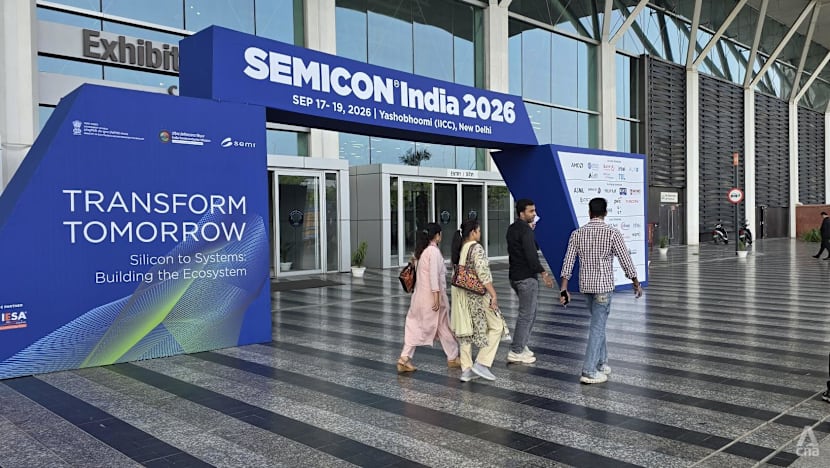
At Semicon India 2026 in New Delhi this month, industry experts told CNA that India has built a deep pool of chip designers over decades, but has far less experience manufacturing and packaging semiconductors at scale.
To bridge that gap, Kaynes Semiconductor CEO Raghu Panicker said the company recruited industry veterans from the Philippines and Malaysia who had “done it before”, while building an Indian team around them.
He believes that India’s late start need not mean decades of catching up. “We don't have to repeat the 30 years it took others to get here. We can bring in people who have done it before, learn from the existing ecosystem and jump ahead,” he told CNA.
BUILDING THE CHIP SUPPLY CHAIN
India’s semiconductor plants in commercial production so far are largely focused on the back-end stages of chipmaking - assembly, testing and packaging.
Micron, Kaynes Semiconductor and CG Semi operate such facilities in Sanand, while Suchi Semicon packages chips in Surat, Gujarat. CDIL Semiconductor also produces semiconductor devices in Mohali, Punjab.
India’s first wafer fabrication plant is now expected to begin commercial operations in mid-2028, later than its initial end-2026 target.
A wafer is a thin slice of semiconductor material, such as crystalline silicon, on which circuits are built - the essential foundation of a chip.
The next challenge is building the supply chain around fabrication plants, experts said.
“Our worry is how we grow the local ecosystem,” Panicker said.
“How do we manufacture more of the materials, components and equipment we need here in India?”
Semicon 2.0 - a 1.27-trillion-rupee programme approved by the Indian government in July - reflects that shift.
“The objective … is not limited to establishing individual semiconductor manufacturing facilities, but to build a complete ecosystem around them,” Electronics and IT Minister Ashwini Vaishnaw said this month.
But building that ecosystem does not necessarily mean localising every part of the semiconductor supply chain, industry experts said.
For instance, a single fab can require about 50 different gases to turn silicon wafers into chips, according to Diganta Sarma, head of strategy and business development of Indian industrial gas supplier Inox Air Products.
Inox currently produces about a dozen gases used in semiconductor manufacturing in India and is looking to add roughly 10 more.
“Many of the rest would still need to come from established producers overseas,” Sarma said, adding that producing these gases requires specialised technology and expertise.
Some specialised capabilities are beginning to move into India as demand grows.
US chip toolmaker Lam Research announced plans to invest more than 100 billion rupees in its first Indian plant making specialised silicon parts used in semiconductor manufacturing equipment.
Peter Holland, vice president of global supply chain at Lam Research, told CNA that those components are currently sourced from several locations, including the United States, South Korea, China and Malaysia.
DIVERSIFYING, NOT DECOUPLING
Semiconductors power everything from smartphones and cars to telecom networks and defence equipment, making resilient supply chains increasingly important, said experts.
Speaking at Semicon India 2026, Prime Minister Narendra Modi said new and reliable manufacturing hubs such as India were increasingly important “at a time when supply chains are being weaponised”.
Recent disruptions have highlighted those vulnerabilities, from a July earthquake that halted chip production in Japan to Chinese export controls on critical semiconductor materials in 2023 and 2024.
But resilience does not mean severing ties with established semiconductor economies, industry experts said.
Japan, for instance, has lost ground to countries such as South Korea in some chips, but remains a key supplier of specialised equipment and materials, Invest India CEO and former Intel India head Nivruti Rai told CNA.
“They retained the choke points,” Rai said, adding that even global semiconductor giants such as South Korea's SK Hynix and Taiwan's TSMC depend on Japanese suppliers.
India is seeking to tap that expertise while building more capacity at home.
For instance, Tata Electronics signed agreements at the Semicon India conference with Japanese suppliers including Fujifilm and Sumitomo Chemical to supply critical semiconductor materials and explore producing more of them in India.
Singapore-based semiconductor equipment maker ASMPT, meanwhile, has a sales and service operation in India, while its manufacturing remains in established hubs including Singapore and Malaysia.
Its marketing director Kenneth Koh said India needs to attract suppliers across raw materials, components and advanced manufacturing as the industry expands.
“Without the ecosystem, everything else will have to be imported,” he said, adding that this would increase manufacturing time and costs.
Geopolitical tensions are also creating another source of supply-chain uncertainty.
Indian chip designer Axiro Semiconductor, for instance, avoids Chinese foundries and packaging facilities for some customers concerned about geopolitical exposure.
But that does not necessarily remove China from its supply chain, said CEO Naveen Yanduru.
“Our supply chain is outside of China, but the raw materials that our suppliers depend upon are coming from China,” he said.
The goal is not to eliminate any overseas supplier, but to avoid concentrating critical inputs in any single geography, said Ajit Manocha, president and CEO of SEMI, a global semiconductor industry association.
“To me, de-risking only means creating redundancy in the system,” Manocha said, explaining that alternative suppliers and manufacturing locations can prevent a disruption in one country from halting production in another.
CAN INDIA MOVE FROM BUYER TO GLOBAL SUPPLIER?
Building a resilient semiconductor industry will require India to also become a supplier to the global chip industry, said industry executives.
Ashok Chandak, president of the India Electronics and Semiconductor Association, said the country should look beyond the “China Plus One” strategy, under which companies diversify production outside China to reduce geopolitical and supply-chain risks.
“China Plus One is an old phrase,” Chandak said. Instead, he advocates an “India Plus Many” approach - designing and manufacturing more semiconductors in India, while supplying customers across multiple countries.
Kaynes is already discussing with overseas equipment makers for ways to become part of their global supply chains.
“We can start by manufacturing spare parts in India and supplying them overseas,” Panicker said.
“Then we can move from making the spares to assembling the equipment, and eventually manufacturing the complete equipment here.”
There are early signs that overseas suppliers are interested in using India in that way.
ASETS makes etching machines, which it currently assembles in Singapore. The firm’s business development director Ramasamy Chockalingam told CNA he is looking for Indian companies to supply parts for its equipment.
Etching machines remove microscopic layers of material from wafers to create the structures that form a chip’s circuits.
“I'm trying to get the fundamental parts made in India,” Chockalingam said.
He identified aluminium machine bodies and relatively simple electronic assemblies as areas that Indian suppliers could potentially handle.
But more specialised work, including the precision finishing needed for equipment used in semiconductor clean rooms, is not yet readily available, he said.
India imported about 2.3 trillion rupees worth of chips in 2024, according to data from government think tank NITI Aayog.
Industry executives said India does not need to produce every part of a semiconductor.
The country could focus on areas with lower barriers to entry than building large wafer fabs, such as advanced packaging and semiconductor materials, said Manocha of SEMI.
The key, he said, was to identify a few areas of the semiconductor ecosystem where India can build enough capability to become difficult to replace.
“There you become indispensable, and that creates leverage for you.”
[Image text:] Exhibit
SEMICON'India2026
SEP17-192026|Yashobhoomi CCND
Ssomi
TRANSFORM
TOMORROW
Silicon to Systems
Building the Ecosystem